Consent Managers Under the DPDP Act: Registration Opens
The registration framework for Consent Managers under the Digital Personal Data Protection (DPDP)
DDecode Civils
· 4 min read
Consent Managers Under the DPDP Act: Registration Opens
Why in News
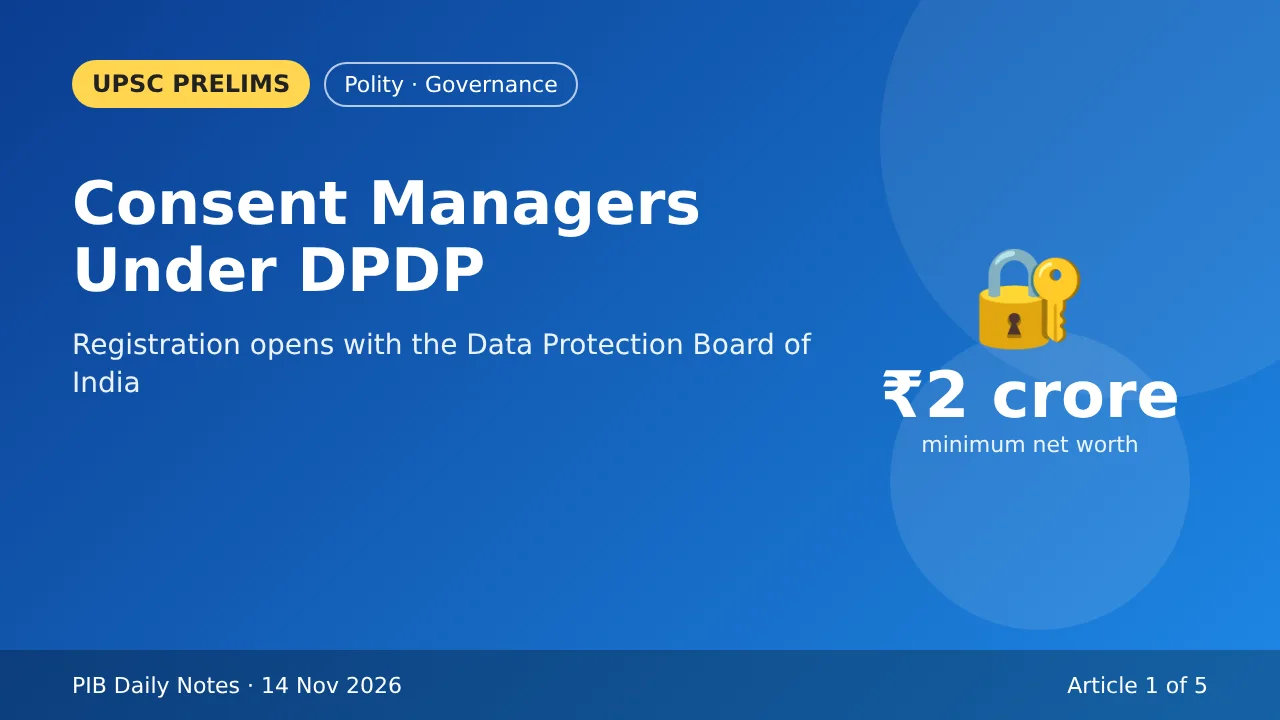
The registration framework for Consent Managers under the Digital Personal Data Protection (DPDP) Act, 2023 came into effect on 13 November 2026. The Ministry of Electronics and IT (MeitY) launched the portal dpbi.gov.in, where eligible Indian companies can now apply to the Data Protection Board of India for registration.
News Summary
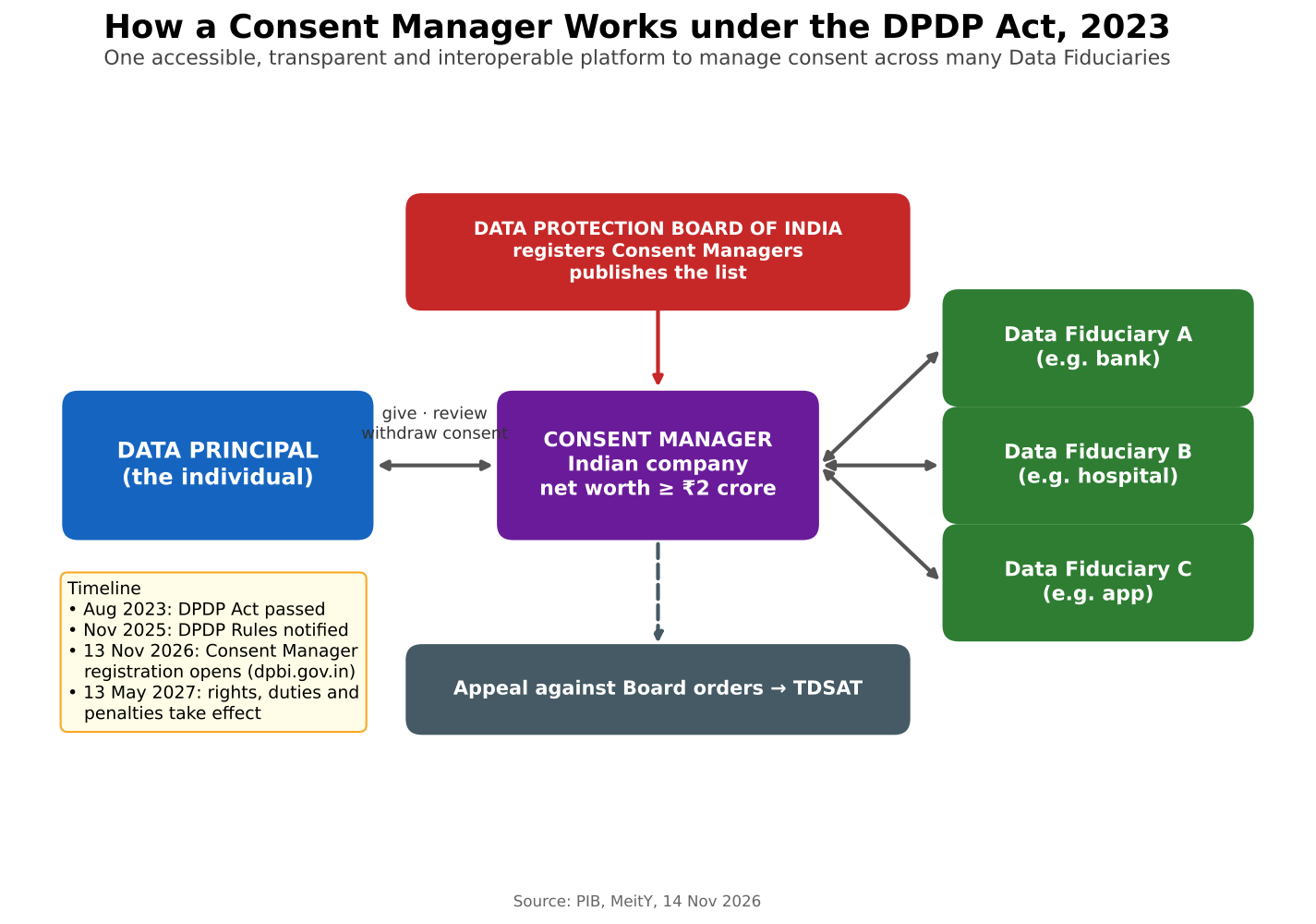
A Consent Manager is an entity registered with the Data Protection Board that lets a person give, manage, review and withdraw consent through an accessible, transparent and interoperable platform.
Consent Managers are accountable to the Data Principal.
Only companies incorporated in India with adequate technical, operational and financial capacity can apply. The minimum net worth is ₹2 crore.
The Board will check applications and publish the list of registered Consent Managers on its website.
The other key provisions (rights of Data Principals, duties of Data Fiduciaries, the Board's inquiry and penalty process) start on 13 May 2027.
This is part of the phased roll-out under the DPDP Rules, 2025.
Prelims Facts & Static Linkages
Key terms in the DPDP Act
Data Principal: the individual to whom personal data relates. For a child, this includes the parent or lawful guardian.
Data Fiduciary: the entity that decides the purpose and means of processing personal data.
Significant Data Fiduciary: a fiduciary notified by the Centre because of the volume or sensitivity of data it handles. It has extra duties such as a Data Protection Officer and audits.
Data Processor: processes data on behalf of a fiduciary.
Consent Manager: a single point of contact through which the Data Principal manages consent across fiduciaries.
The DPDP Act at a glance
Feature
Provision
Passed
August 2023
Covers
Digital personal data, and offline data later digitised
Basis of processing
Consent, or certain "legitimate uses"
Children
Verifiable consent of a parent for anyone under 18
Regulator
Data Protection Board of India (set up by the Centre)
Appeals
Telecom Disputes Settlement and Appellate Tribunal (TDSAT)
Maximum penalty
Up to ₹250 crore per instance
Rights and duties
Rights of the Data Principal: access to information, correction and erasure, grievance redressal, and the right to nominate another person in case of death or incapacity.
Duties of the Data Fiduciary: give clear notice, keep data accurate, use reasonable security safeguards, report breaches to the Board and erase data once its purpose ends.
Constitutional and policy roots
K.S. Puttaswamy vs Union of India (2017): a nine-judge bench held that the right to privacy is a fundamental right under Article 21, as part of life and personal liberty.
Justice B.N. Srikrishna Committee (2018) drafted the first data protection bill.
The consent-manager idea draws on India's Data Empowerment and Protection Architecture (DEPA) and the RBI's Account Aggregator framework, in which licensed NBFCs move financial data only with the user's consent.
Likely Prelims angles
Who registers Consent Managers (the Data Protection Board, not MeitY).
The Article under which privacy is protected (Article 21).
Quick Revision
Consent Manager registration under the DPDP Act began on 13 November 2026.
Portal: dpbi.gov.in. Minimum net worth: ₹2 crore. Only Indian companies are eligible.
Consent Managers are accountable to the Data Principal.
The remaining core provisions take effect on 13 May 2027.
Privacy is a fundamental right under Article 21 (Puttaswamy, 2017).
Practice MCQ
Q. With reference to the Digital Personal Data Protection Act, 2023, consider the following statements:
1. Consent Managers are registered with the Data Protection Board of India.
2. Appeals against orders of the Data Protection Board lie with the National Company Law Appellate Tribunal.
3. Processing a child's personal data requires the verifiable consent of a parent or lawful guardian.
Which of the statements given above is/are correct?
(a) 1 only
(b) 1 and 3 only
(c) 2 and 3 only
(d) 1, 2 and 3
Answer: (b). Appeals lie with the Telecom Disputes Settlement and Appellate Tribunal (TDSAT).
Related PYQs
PYQ 1 (UPSC CSE Prelims 2024)
Under which of the following Articles of the Constitution of India, has the Supreme Court of India placed the Right to Privacy?
(a) Article 15
(b) Article 16
(c) Article 19
(d) Article 21
Answer: (d).
PYQ 2 (UPSC CSE Prelims 2026)
Which one of the following best describes the key objective of India's 'Open Network for Digital Commerce' (ONDC) initiative?
(a) To allow government control over all digital commerce transactions
(b) To replace private e-commerce players
(c) To break the dominance of large e-commerce platforms by enabling interoperability across networks
(d) To mandate UPI-based payments for all online transactions



 28
Nov 2026
 28
Nov 2026
 28
Nov 2026














0 comments
Discussion
No comments yet. Be the first.