Elettra 2.0: India Co-Partners in an Italian Synchrotron
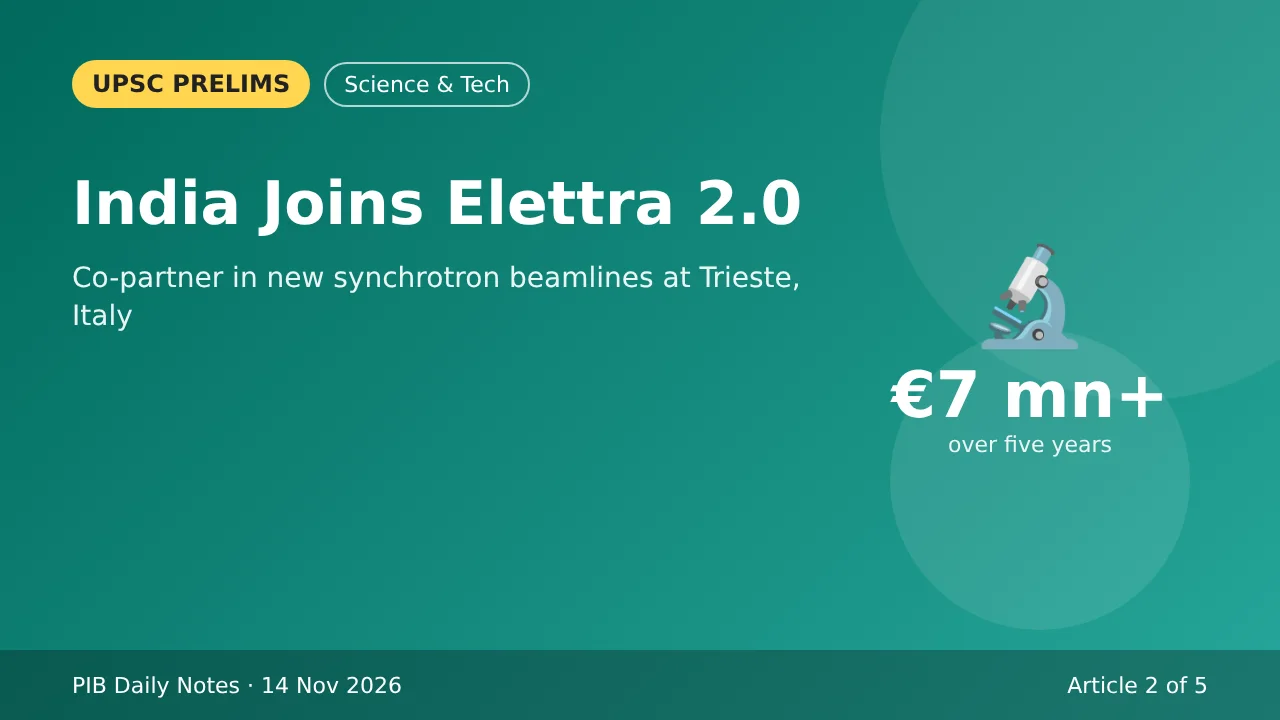
India has joined the Elettra 2.0 programme at Elettra Sincrotrone Trieste, Italy
DDecode Civils
· 4 min read
Elettra 2.0: India Co-Partners in an Italian Synchrotron
Why in News
India has joined the Elettra 2.0 programme at Elettra Sincrotrone Trieste, Italy, as a co-partner, with a commitment of more than 7 million euros over five years from 2026-27. Union Minister Dr. Jitendra Singh announced it during his visit to the facility on 13 November 2026.
News Summary
The money will build new research beamlines and train Indian scientists.
The two existing India-centric beamlines, XRD2 and Xpress, will be retired and replaced by two new ones:
micro-XRD (μXRD): a microfocus beamline for macromolecular crystallography, used to find the 3-D structure of proteins.
Xpress Superbend (Xpress-SB): a beamline for high-pressure diffraction, used to study materials under extreme pressure.
The Department of Science and Technology (DST) had paid about ₹22 crore for the old beamlines, which were inaugurated on 20 October 2016.
Indian scientists have worked at Elettra since 1998. India is its second-largest user after Italy, with over 1,100 proposals, ahead of France.
About 50–60 Indian scientists visit Trieste every year. Visits are funded under the Indo-Italian Executive Programme of Cooperation (EPOC).
Prelims Facts & Static Linkages
What is a synchrotron?
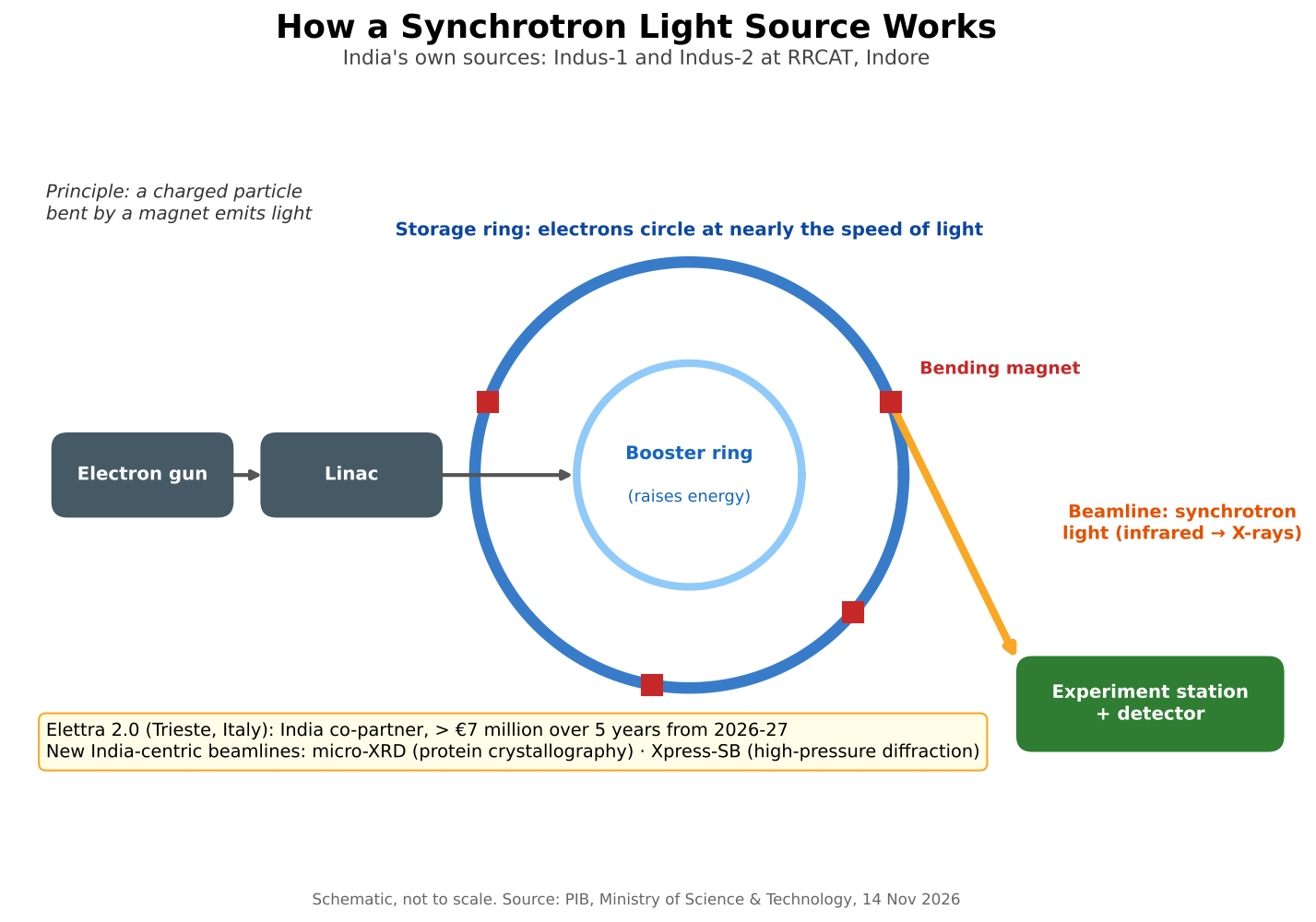
A synchrotron is a circular particle accelerator. Electrons are pushed to nearly the speed of light.
When magnets bend the path of these fast electrons, they give off very bright light called synchrotron radiation.
This light covers a wide band, from infrared and ultraviolet to X-rays. It is millions of times brighter than a hospital X-ray tube.
Each beamline takes this light to an experiment station, where it is shone on a sample.
Steps: electron gun, then linear accelerator (linac), then booster ring, then storage ring with bending magnets, then beamline and detector.
Uses of synchrotron light
Field
Use
Structural biology
Protein and virus structures for drug design
Materials science
Batteries, semiconductors, catalysts
High-pressure physics
Behaviour of matter as in the Earth's core
Heritage
Non-destructive study of paintings and fossils
Environment
Tracking pollutants in soil and water
Synchrotrons and big-science links of India
Indus-1 and Indus-2: India's own synchrotron sources at the Raja Ramanna Centre for Advanced Technology (RRCAT), Indore, under the Department of Atomic Energy.
CERN, Geneva: India became an associate member in 2017.
ITER, France: India is one of seven members of this fusion energy project.
FAIR, Germany: India is a founding partner of this antiproton and ion research facility.
LIGO-India: a gravitational-wave observatory planned at Hingoli, Maharashtra.
Key terms
X-ray diffraction (XRD): X-rays scatter off the regular rows of atoms in a crystal. The pattern reveals how the atoms are arranged.
Macromolecule: a very large molecule such as a protein or DNA.
Electromagnetic spectrum: radio waves, microwaves, infrared, visible light, ultraviolet, X-rays and gamma rays, in order of falling wavelength.
Likely Prelims angles
How synchrotron radiation is produced (charged particles bent by magnets).



 28
Nov 2026
 28
Nov 2026
 28
Nov 2026














0 comments
Discussion
No comments yet. Be the first.