India and the International Big Cat Alliance (IBCA) held a high-level side event titled "BIG CATS: Drivers of Climate Change Mitigation"
DDecode Civils
· 3 min read
Big Cat Conservation as Climate Action
Why in News
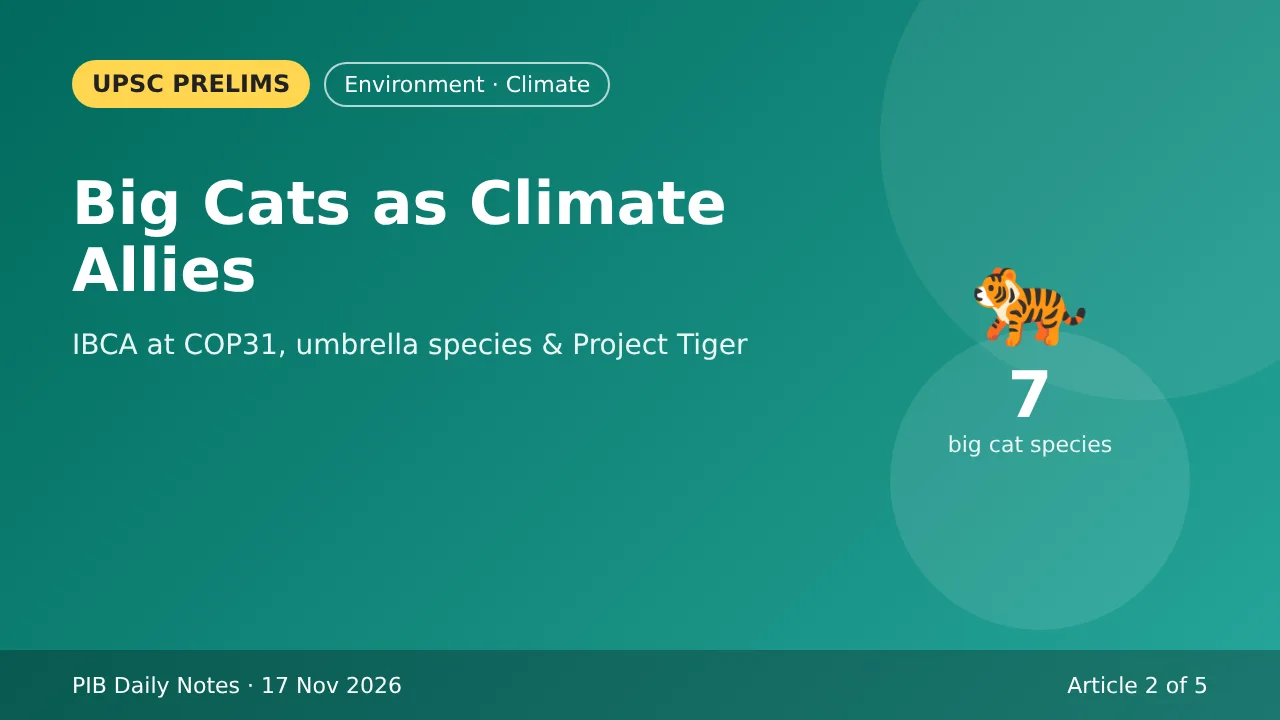
At UNFCCC COP31 in Antalya, Türkiye, India and the International Big Cat Alliance (IBCA) held a high-level side event titled "BIG CATS: Drivers of Climate Change Mitigation" on 16 November 2026. Union Environment Minister Bhupender Yadav said big cat conservation is a powerful pathway for climate mitigation.
News Summary
Ministers and representatives from big cat range countries attended, including Nepal, Venezuela, Cambodia and Sri Lanka.
Representatives of the Ramsar Convention and UNCCD also took part.
The Director General of IBCA presented the status of big cats in range countries. Participants praised India's cheetah reintroduction.
India's argument:
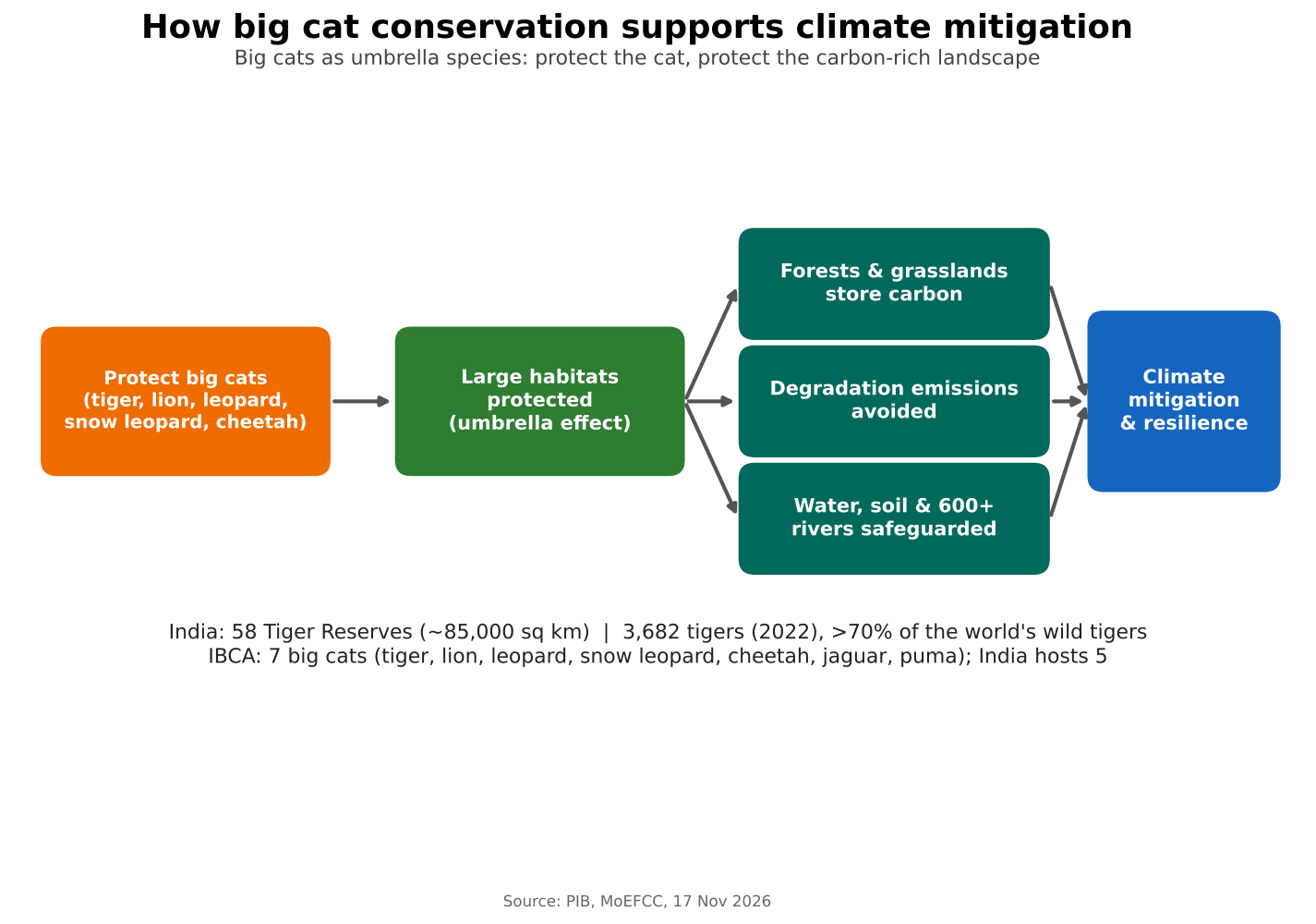
Big cats do not sequester carbon themselves.
Protecting them protects the forests, grasslands, wetlands and mountains that store carbon.
Protected habitats avoid emissions from habitat degradation.
As umbrella species, big cats help protect whole ecosystems and the communities that depend on them.
Wildlife conservation should be part of nature-based climate action.
India's tiger figures:
58 Tiger Reserves, covering about 85,000 sq km
More than 600 rivers rise in or flow through tiger landscapes
3,682 tigers (2022), more than 70% of the world's wild tigers
About 60 lakh (6 million) person-days of work each year from Project Tiger
Prelims Facts & Static Linkages
International Big Cat Alliance (IBCA)
Announced by the Prime Minister on 9 April 2023 at Mysuru, at the event marking 50 years of Project Tiger.
Covers the seven big cats:
Tiger
Lion
Leopard
Snow leopard
Cheetah
Jaguar
Puma
India is home to five of the seven. The jaguar and puma live only in the Americas.
IBCA became a treaty-based intergovernmental organisation in 2025, with its headquarters in India.
Membership is open to range countries and to non-range countries interested in big cat conservation.
Tiger conservation framework
Element
Fact
Project Tiger
Launched in 1973, with 9 reserves
NTCA
Statutory body under the Wildlife (Protection) Act, 1972, created by the 2006 amendment
Tiger census
All India Tiger Estimation, every four years
Largest tiger reserve
Nagarjunsagar–Srisailam (Andhra Pradesh and Telangana)
IUCN status of tiger
Endangered
Key terms
Umbrella species: a species whose protection automatically protects many others in the same habitat. Tigers need large ranges, so protecting them protects big landscapes.
Nature-based solutions: actions that protect, manage or restore ecosystems to tackle problems such as climate change.
Ramsar Convention (1971): protects wetlands of international importance.
UNCCD (1994): the UN Convention to Combat Desertification.
Big cats in India
Big cat
Fact
Asiatic lion
Found in the wild only in Gir, Gujarat; IUCN status Endangered
Snow leopard
Lives in the high Himalaya; IUCN status Vulnerable
Cheetah
Declared extinct in India in 1952; reintroduced at Kuno National Park in 2022
Leopard
Most widespread big cat in India
Recent tiger reserves
Madhav Tiger Reserve (Madhya Pradesh) was declared in 2025.
It includes the Sakhya Sagar Ramsar site.
It lies in Shivpuri district and became India's 58th tiger reserve.
Quick Revision
IBCA was announced at Mysuru on 9 April 2023.
It covers seven big cats, five of which are found in India.
Project Tiger began in 1973.
India had 3,682 tigers in 2022.
India has 58 tiger reserves.
NTCA is a statutory body under the Wildlife (Protection) Act.
Practice MCQ
Q. Which of the following big cats are found in the wild in India?
1. Snow leopard
2. Jaguar
3. Cheetah
4. Puma
Select the correct answer using the code given below:
(a) 1 and 2 only
(b) 1 and 3 only
(c) 2, 3 and 4 only
(d) 1, 2, 3 and 4
Answer: (b). Jaguars and pumas live only in the Americas. Cheetahs have been reintroduced at Kuno.
Related PYQs
PYQ 1 (UPSC CSE Prelims 2026)
With reference to Madhav National Park, which of the following statements is/are correct?
1. It was declared a Tiger Reserve in India in 2025.
2. Sakhya Sagar, which is designated as a Ramsar Site, is situated within this National Park.
3. Its area is shared between Madhya Pradesh and Rajasthan.
Select the answer using the code given below:
(a) 1 only
(b) 1 and 2
(c) 2 and 3
(d) 3 only
Answer: (b). The park lies wholly in Shivpuri district, Madhya Pradesh.



 24
Nov 2026
 24
Nov 2026
 24
Nov 2026














0 comments
Discussion
No comments yet. Be the first.