President Droupadi Murmu inaugurated the Golden Jubilee celebrations of the ICMR–National Institute of Malaria Research
DDecode Civils
· 3 min read
ICMR–NIMR Turns 50: India's Fight Against Malaria
Why in News
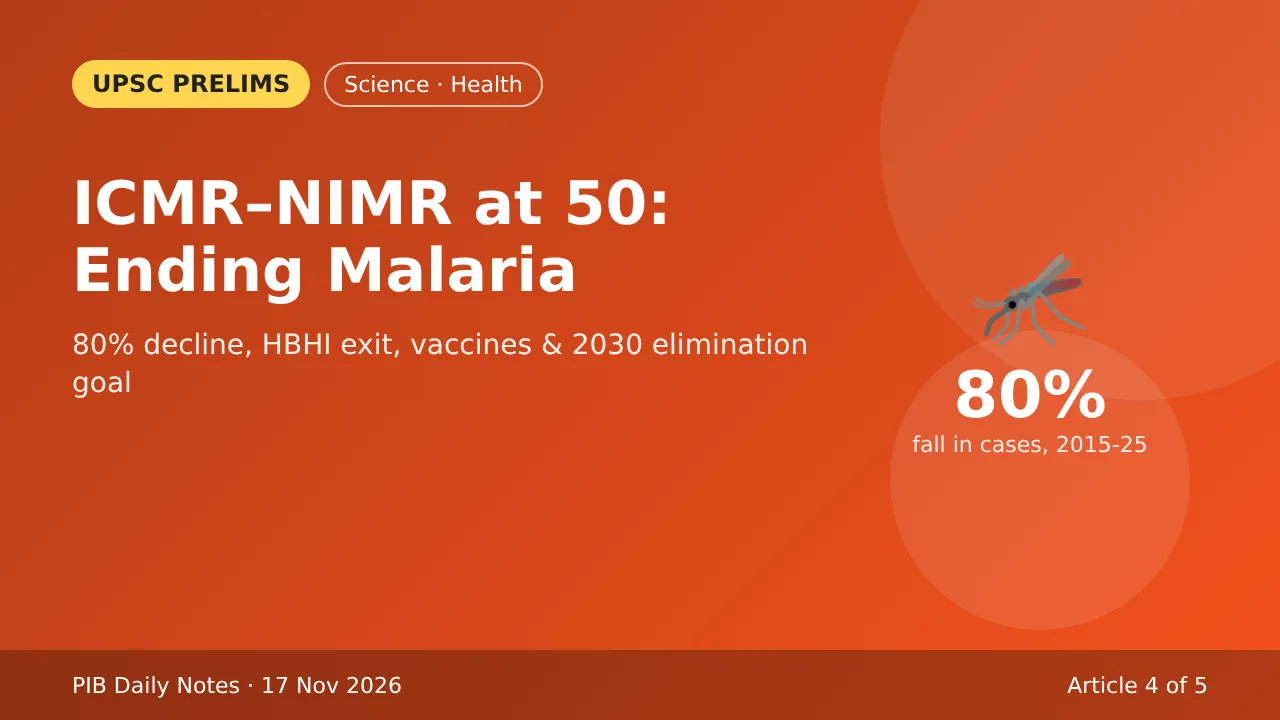
President Droupadi Murmu inaugurated the Golden Jubilee celebrations of the ICMR–National Institute of Malaria Research (NIMR) on 17 November 2026. She noted that India's malaria cases and deaths fell by nearly 80% between 2015 and 2025.
News Summary
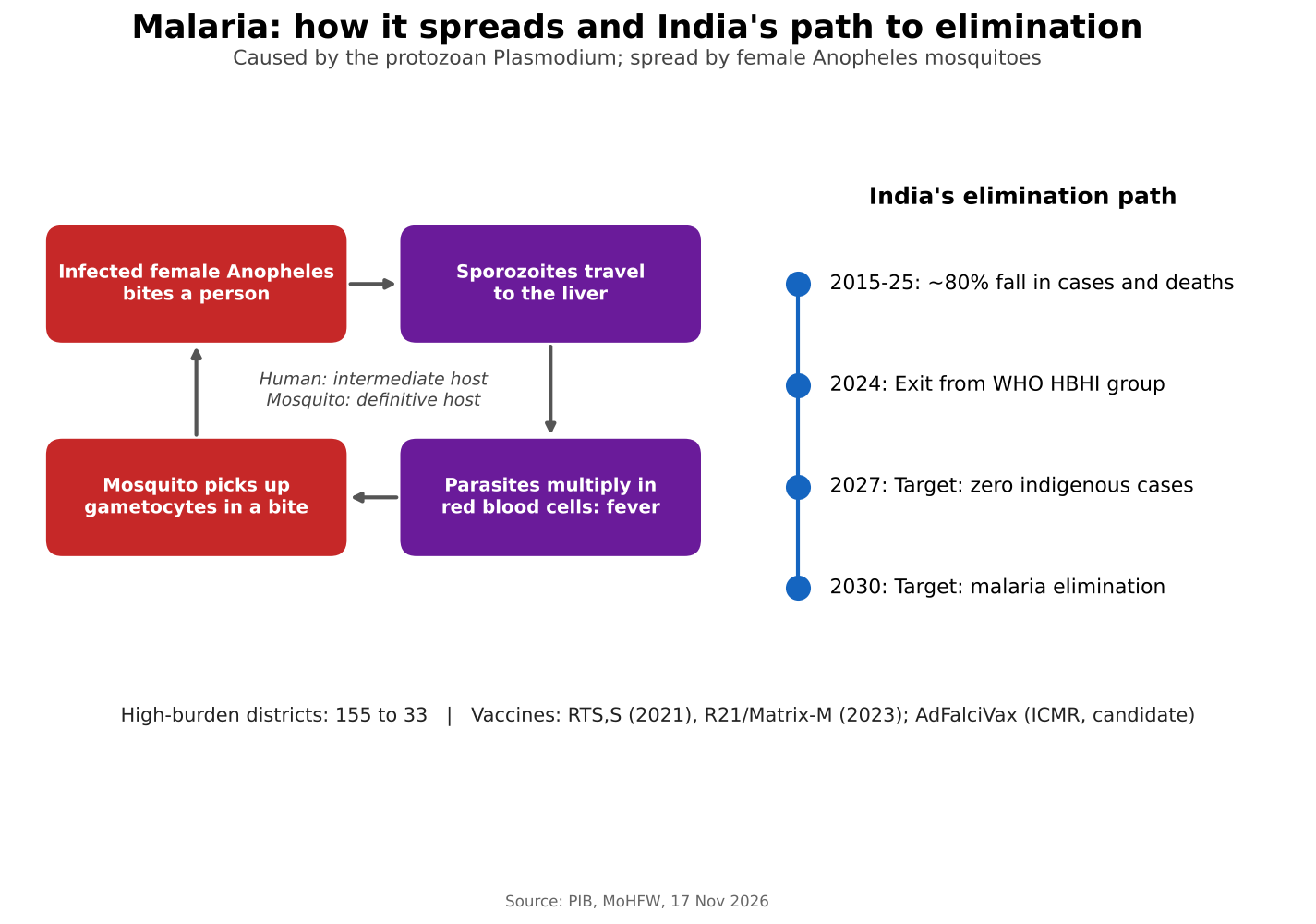
The number of high-burden districts fell from 155 to 33.
160 districts reported zero indigenous malaria cases during 2022–2025.
India exited the WHO's High Burden to High Impact (HBHI) group in 2024.
India has about 16% of the world's population but only about 0.7% of global malaria cases and 0.6% of malaria deaths.
Goals:
Zero indigenous cases by 2027
Malaria elimination by 2030
The President noted NIMR's role in the indigenous malaria vaccine being developed at Bhubaneswar.
Emerging challenges:
Climate change
Unplanned urbanisation
Insecticide resistance in mosquitoes
Drug resistance
ICMR's Comprehensive Case Management Project in Odisha showed that universal testing, complete treatment and strong surveillance cut transmission.
A commemorative postage stamp sheet was released.
The Health Minister said out-of-pocket health spending fell from 63% to 42%.
Prelims Facts & Static Linkages
Malaria basics
Caused by the protozoan parasite Plasmodium, not a bacterium or virus.
Spread by the bite of an infected female Anopheles mosquito.
Humans are the intermediate host and the mosquito is the definitive host, because the parasite's sexual stage happens in the mosquito.
In India, P. falciparum (the most deadly) and P. vivax cause most cases.
P. vivax can stay dormant in the liver and cause relapses. This is why completing the full course of medicine matters.
Vaccines
Vaccine
Fact
RTS,S/AS01 (Mosquirix)
First malaria vaccine recommended by WHO, in 2021
R21/Matrix-M
Second WHO-recommended vaccine (2023), developed by Oxford University and made by the Serum Institute of India
AdFalciVax
ICMR's indigenous candidate against P. falciparum, developed at ICMR-RMRC Bhubaneswar
India's framework
National Framework for Malaria Elimination (2016–2030)
National Strategic Plan for Malaria Elimination (2023–2027)
The programme runs under the National Center for Vector Borne Diseases Control (NCVBDC).
ICMR–NIMR (New Delhi) was founded in 1977 as the Malaria Research Centre.
World Malaria Day is on 25 April.
Prevention and control tools
Long-lasting insecticidal nets (LLINs) and indoor residual spraying.
Rapid diagnostic tests (RDTs) for early diagnosis.
Artemisinin-based Combination Therapy (ACT) for P. falciparum; chloroquine and primaquine for P. vivax.
Gambusia and guppy fish, which eat mosquito larvae, for biological control.
Removing stagnant water where mosquitoes breed.
WHO certifies a country as malaria-free after three consecutive years with no indigenous cases.
Other vector-borne diseases
Dengue, chikungunya and Zika: spread by Aedes mosquitoes, which breed in clean stored water.
Japanese encephalitis: spread by Culex mosquitoes.
Kala-azar: spread by sandflies.
Lymphatic filariasis: spread by Culex mosquitoes; India targets its elimination.
Who is most at risk
Malaria hits forested, tribal and hilly areas hardest, especially in Odisha, Chhattisgarh, Jharkhand and the North-East.
Pregnant women and young children face the highest risk of severe disease.
Quick Revision
ICMR–NIMR was founded in 1977.
Malaria cases and deaths fell about 80% between 2015 and 2025.
India left the WHO HBHI group in 2024.
The goal is malaria elimination by 2030.
Malaria is caused by Plasmodium and spread by female Anopheles mosquitoes.
R21/Matrix-M is made in India.
Practice MCQ
Q. With reference to malaria, consider the following statements:
1. It is caused by a protozoan parasite.
2. It is transmitted by the bite of the male Aedes mosquito.
3. India exited the WHO's High Burden to High Impact group in 2024.
Which of the statements given above are correct?
(a) 1 and 2 only
(b) 1 and 3 only
(c) 2 and 3 only
(d) 1, 2 and 3
Answer: (b). The vector is the female Anopheles.
Related PYQs
PYQ 1 (UPSC CSE Prelims 2010)
Widespread resistance of malarial parasite to drugs like chloroquine has prompted attempts to develop a malarial vaccine to combat malaria. Why is it difficult to develop an effective malaria vaccine?
(a) Malaria is caused by several species of Plasmodium
(b) Man does not develop immunity to malaria during natural infection
(c) Vaccines can be developed only against bacteria
(d) Man is only an intermediate host and not the definitive host



 24
Nov 2026
 24
Nov 2026
 24
Nov 2026














0 comments
Discussion
No comments yet. Be the first.