DGFT Bans Export of Lithium-Ion Battery Black Mass
DGFT has moved lithium-ion battery black mass (ITC(HS) code 85491400) from "Free" to "Prohibited"
DDecode Civils
· 3 min read
DGFT Bans Export of Lithium-Ion Battery Black Mass
Why in News
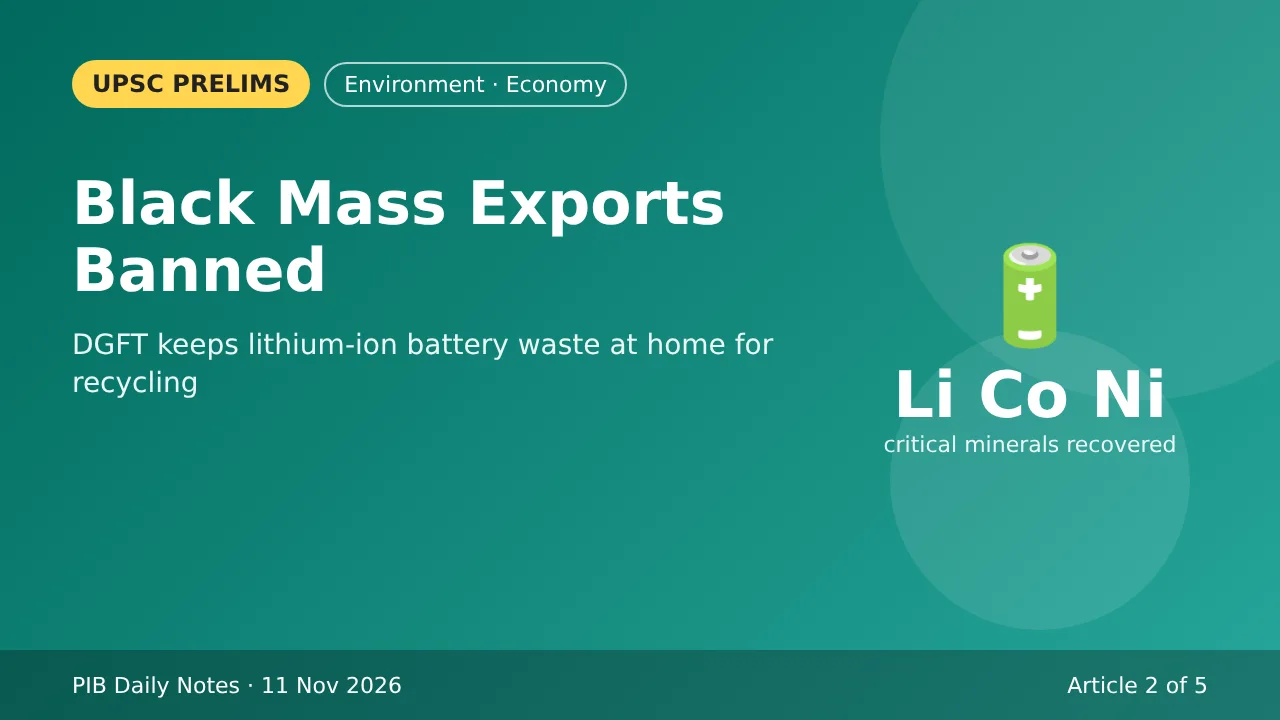
The Directorate General of Foreign Trade (DGFT) has moved lithium-ion battery black mass (ITC(HS) code 85491400) from "Free" to "Prohibited" for export, through Notification No. 49/2026-27 dated 10 November 2026. The aim is to keep critical minerals in battery waste for recycling within India.
News Summary
Black mass is the dark powder left after shredding end-of-life lithium-ion batteries and battery manufacturing scrap.
It holds recoverable lithium, cobalt, nickel and manganese, all critical minerals.
India's recycling and refining capacity has grown but is underused because of too little feedstock. Black mass was being exported while some recyclers imported it.
The ban is meant to give domestic recyclers assured feedstock, raise their capacity use and attract investment and jobs.
It is expected to reduce import dependence and foreign exchange outgo, and strengthen supply chains for EVs, energy storage and clean energy.
It complements the ₹1,500 crore Incentive Scheme for critical mineral recycling (approved September 2025) under the National Critical Mineral Mission (NCMM).
Transitional arrangements under Para 1.05 of the Foreign Trade Policy (FTP), 2023 apply. Several major economies already keep black mass for domestic processing.
Prelims Facts & Static Linkages
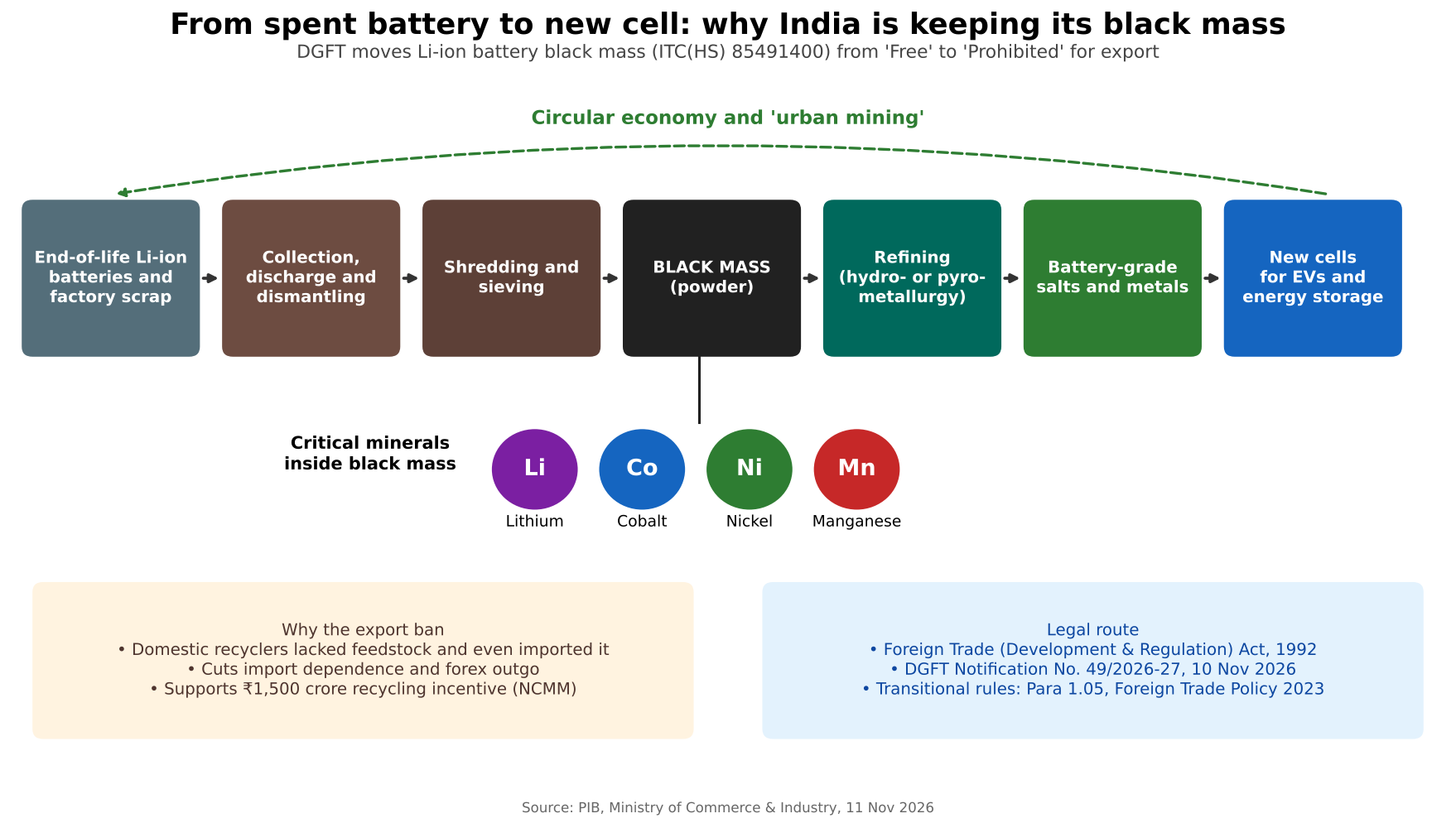
From battery to black mass to new cell
Spent batteries and factory scrap are collected, discharged and dismantled.
Cells are shredded and sieved; the metal casing and plastics are separated, leaving black mass.
Black mass is refined by hydrometallurgy (leaching with acids) or pyrometallurgy (smelting).
The output is battery-grade salts such as lithium carbonate and nickel sulphate.
These go back into cathodes for new cells, closing the loop of "urban mining".
Inside a lithium-ion cell
Part
Common materials
Cathode
Lithium with nickel, manganese, cobalt (NMC), or lithium iron phosphate (LFP)
Anode
Graphite
Electrolyte
Lithium salt in an organic solvent
Separator
Porous polymer film
How India controls exports
The Foreign Trade (Development and Regulation) Act, 1992 lets the Centre prohibit or restrict imports and exports.
DGFT, under the Department of Commerce, notifies the policy.
Items are listed under ITC(HS), India's trade classification built on the Harmonized System of the World Customs Organization.
Export policy for an item can be Free, Restricted, Prohibited or STE (only through a State Trading Enterprise).
Related policies
Battery Waste Management Rules, 2022 (Ministry of Environment): Extended Producer Responsibility (EPR) for collection and recycling targets.
E-Waste (Management) Rules, 2022: EPR for electronic waste.
NCMM (2025): exploration, overseas assets, processing and recycling of critical minerals.
KABIL: a joint venture of three PSUs that acquires critical mineral assets abroad.
Critical minerals list (2023): 30 minerals named by the Ministry of Mines.
Likely Prelims angles
What black mass is and which metals it contains.
Cathode versus anode materials.
The law and body that control exports.
Quick Revision
DGFT made black mass exports "Prohibited" on 10 November 2026.
Black mass is shredded battery powder with lithium, cobalt, nickel and manganese.
The ban gives domestic recyclers feedstock and cuts imports.
It supports the ₹1,500 crore recycling scheme under NCMM.
Export controls flow from the FT(D&R) Act, 1992.
Graphite is the usual anode; nickel, cobalt, manganese and lithium sit in cathodes.
Practice MCQ
Q. With reference to lithium-ion battery "black mass", consider the following statements:
1. It is obtained by shredding end-of-life lithium-ion batteries.
2. It contains recoverable cobalt and nickel.
3. Its export from India is now permitted only through a State Trading Enterprise.
Which of the statements given above is/are correct?
(a) 1 only
(b) 1 and 2 only
(c) 2 and 3 only
(d) 1, 2 and 3
Answer: (b). Its export is now "Prohibited", not channelled through a State Trading Enterprise.
Related PYQs
PYQ 1 (UPSC CSE Prelims 2025)
In the context of electric vehicle batteries, consider the following elements:
I. Cobalt
II. Graphite
III. Lithium
IV. Nickel
How many of the above usually make up battery cathodes?



 28
Nov 2026
 28
Nov 2026
 28
Nov 2026














0 comments
Discussion
No comments yet. Be the first.