A PIB Backgrounder released on 11 November 2026 reviewed six years of the Nasha Mukt Bharat Abhiyaan
DDecode Civils
· 4 min read
Nasha Mukt Bharat Abhiyaan at Six
Why in News
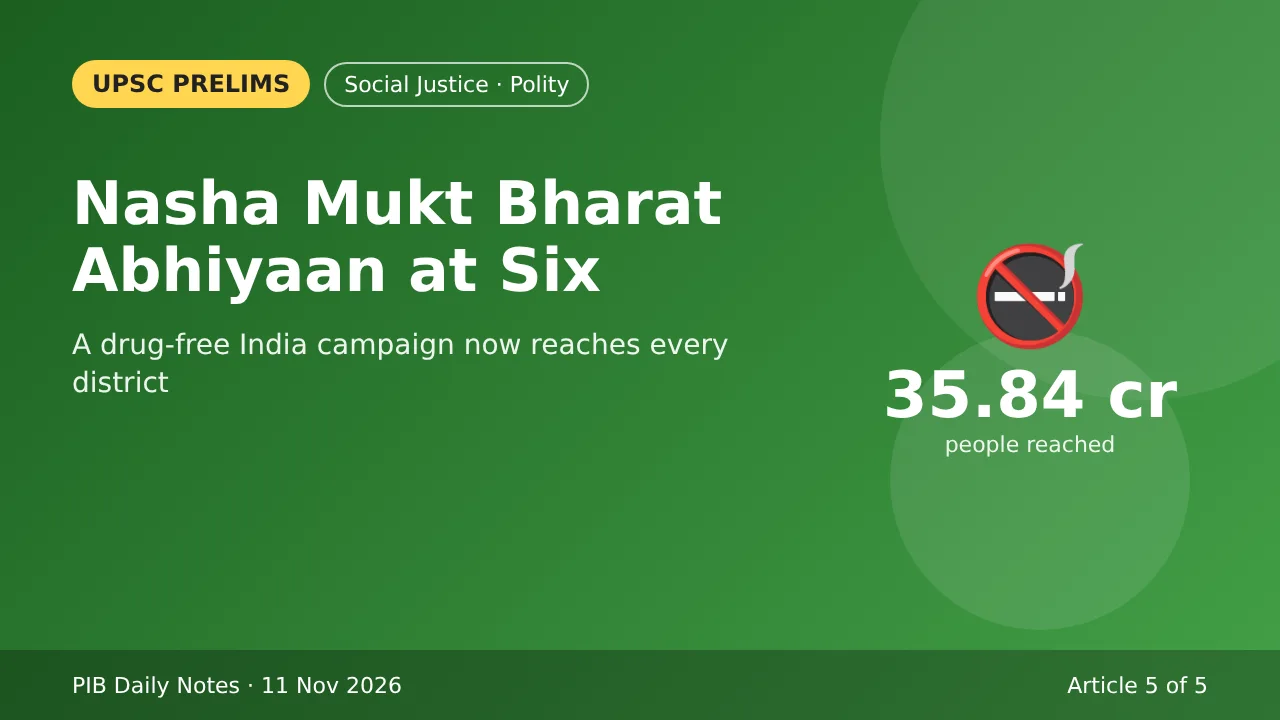
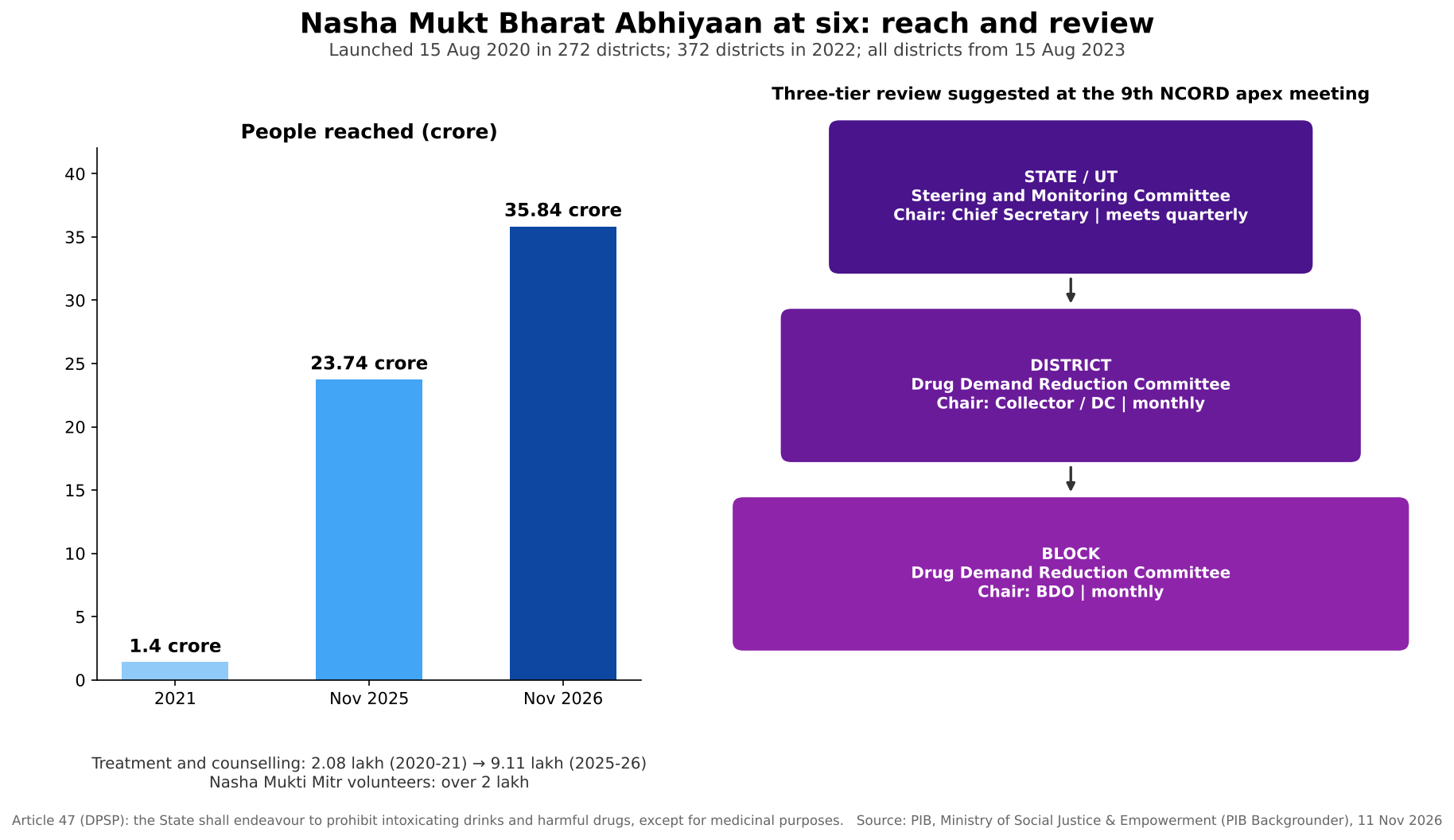
A PIB Backgrounder released on 11 November 2026 reviewed six years of the Nasha Mukt Bharat Abhiyaan (NMBA). The campaign has reached over 35.84 crore people, including 14.33 crore youth and 11.32 crore women, and now covers every district.
News Summary
NMBA was launched by the Ministry of Social Justice and Empowerment on 15 August 2020 in 272 vulnerable districts. It grew to 372 districts in August 2022 and to all districts from 15 August 2023.
The districts were chosen using inputs from the Narcotics Control Bureau and the first national survey on substance use.
It is the flagship awareness arm of the National Action Plan for Drug Demand Reduction (NAPDDR).
People seeking treatment and counselling rose from 2.08 lakh (2020-21) to 9.11 lakh (2025-26). Over 2 lakh citizens have enrolled as Nasha Mukti Mitr volunteers.
Over 33.57 lakh awareness activities have been held in educational institutions.
The 9th apex meeting of NCORD, chaired by the Home Minister, asked for a three-year action plan and suggested a three-tier review:
State/UT Steering and Monitoring Committee under the Chief Secretary, meeting quarterly
District Drug Demand Reduction Committee under the Collector, meeting monthly
Block committee under the Block Development Officer, meeting monthly
Each district gets ₹10 lakh a year as grant-in-aid for campaign activities.
Prelims Facts & Static Linkages
The scale of the problem (AIIMS–NDDTC survey, 2018, released 2019)
About 16 crore people used alcohol; over 5.7 crore needed help.
About 3.1 crore used cannabis and 2.26 crore used opioids.
Over 7 crore people had substance use disorders, including about 1.2 crore children and 58 lakh women.
Constitutional and legal framework
Provision or law
What it does
Article 47 (DPSP)
State shall endeavour to prohibit intoxicating drinks and harmful drugs, except for medicinal purposes
NDPS Act, 1985
Controls narcotic drugs and psychotropic substances
PIT-NDPS Act, 1988
Preventive detention of traffickers
Narcotics Control Bureau (1986)
Central enforcement and coordination agency, under the Ministry of Home Affairs
Supply side and demand side
Supply reduction: the Ministry of Home Affairs, NCB and the NCORD mechanism, which coordinates the Centre and States.
Demand reduction: the Ministry of Social Justice and Empowerment, through NAPDDR.
Treatment network:Integrated Rehabilitation Centres for Addicts (IRCAs), District De-addiction Centres (DDACs) and Addiction Treatment Facilities (ATFs) in government hospitals.
MANAS is the national anti-narcotics helpline, 1933.
Health and police are State List subjects, so the campaign depends on State, district and panchayat ownership.
Volunteers such as MY Bharat members, ASHA and Anganwadi workers carry the message to villages and wards.
Global links
UN conventions: Single Convention on Narcotic Drugs (1961), Convention on Psychotropic Substances (1971) and the 1988 Convention against Illicit Traffic.
26 June is the International Day against Drug Abuse and Illicit Trafficking.
India lies between the Golden Crescent (Afghanistan, Iran, Pakistan) and the Golden Triangle (Myanmar, Laos, Thailand).
Quick Revision
NMBA was launched on 15 August 2020 in 272 districts and now covers all districts.
It has reached 35.84 crore people.
Treatment seekers rose from 2.08 lakh to 9.11 lakh.
Article 47 is the constitutional basis for prohibition.
NAPDDR handles demand reduction; NCB and NCORD handle supply reduction.
Practice MCQ
Q. With reference to the Nasha Mukt Bharat Abhiyaan, consider the following statements:
1. It is implemented by the Ministry of Home Affairs.
2. It began in 2020 in districts identified as most vulnerable to substance use.
3. It is the awareness component of the National Action Plan for Drug Demand Reduction.
Which of the statements given above is/are correct?
(a) 1 and 2 only
(b) 2 and 3 only
(c) 3 only
(d) 1, 2 and 3
Answer: (b). The Ministry of Social Justice and Empowerment runs the campaign.
Related PYQs
PYQ 1 (UPSC CSE Prelims 2025)
Consider the following pairs:
Provision in the Constitution of India
Stated under
I. Separation of Judiciary from the Executive in the public services of the State
The Directive Principles of the State Policy
II. Valuing and preserving the rich heritage of our composite culture
The Fundamental Duties
III. Prohibition of employment of children below the age of 14 years in factories
The Fundamental Rights
How many of the above pairs are correctly matched?
(a) Only one
(b) Only two
(c) All the three
(d) None
Answer: (c).
PYQ 2 (UPSC CSE Prelims 2021)
Under the Indian Constitution, concentration of wealth violates



 28
Nov 2026
 28
Nov 2026
 28
Nov 2026














0 comments
Discussion
No comments yet. Be the first.