SAMPADA 2023–25, the Survey for Assessment of Markers of Population Health, Activity, Diet and Anthropometry
DDecode Civils
· 3 min read
ICMR's SAMPADA Survey Shows Lower Anaemia
Why in News
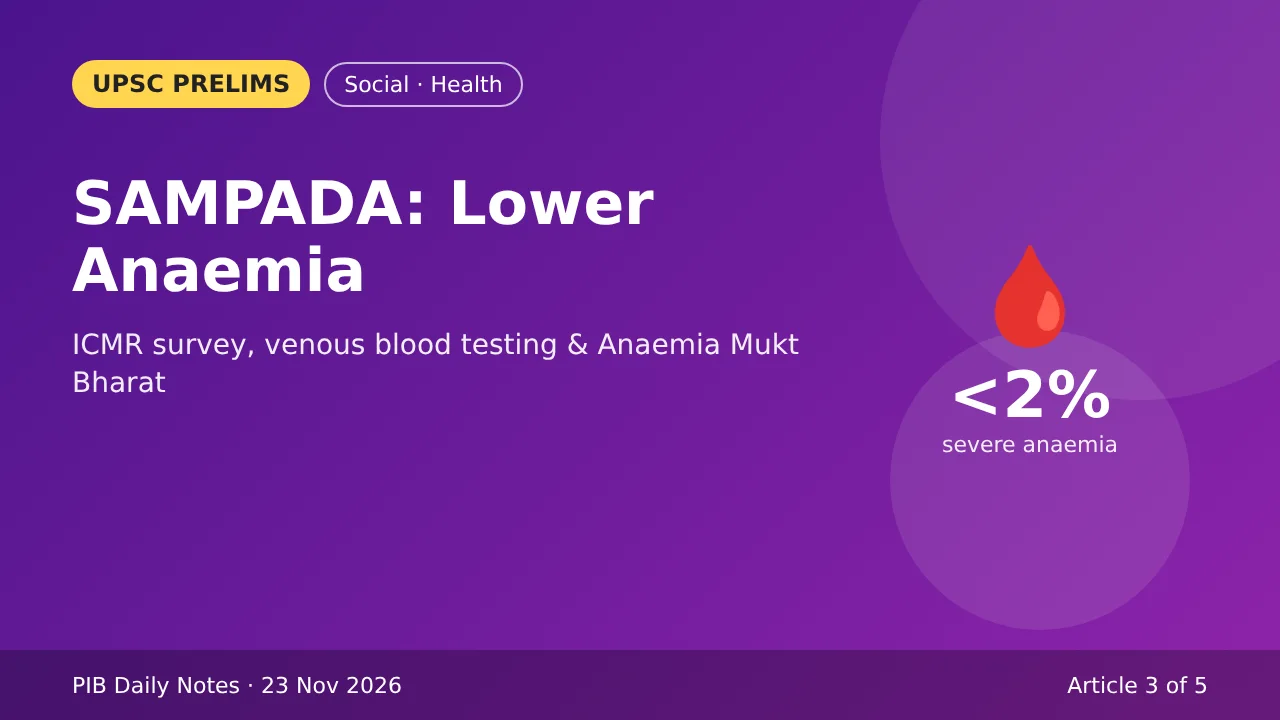
The Indian Council of Medical Research (ICMR) released findings of SAMPADA 2023–25, the Survey for Assessment of Markers of Population Health, Activity, Diet and Anthropometry. It shows lower anaemia prevalence than earlier national surveys.
News Summary
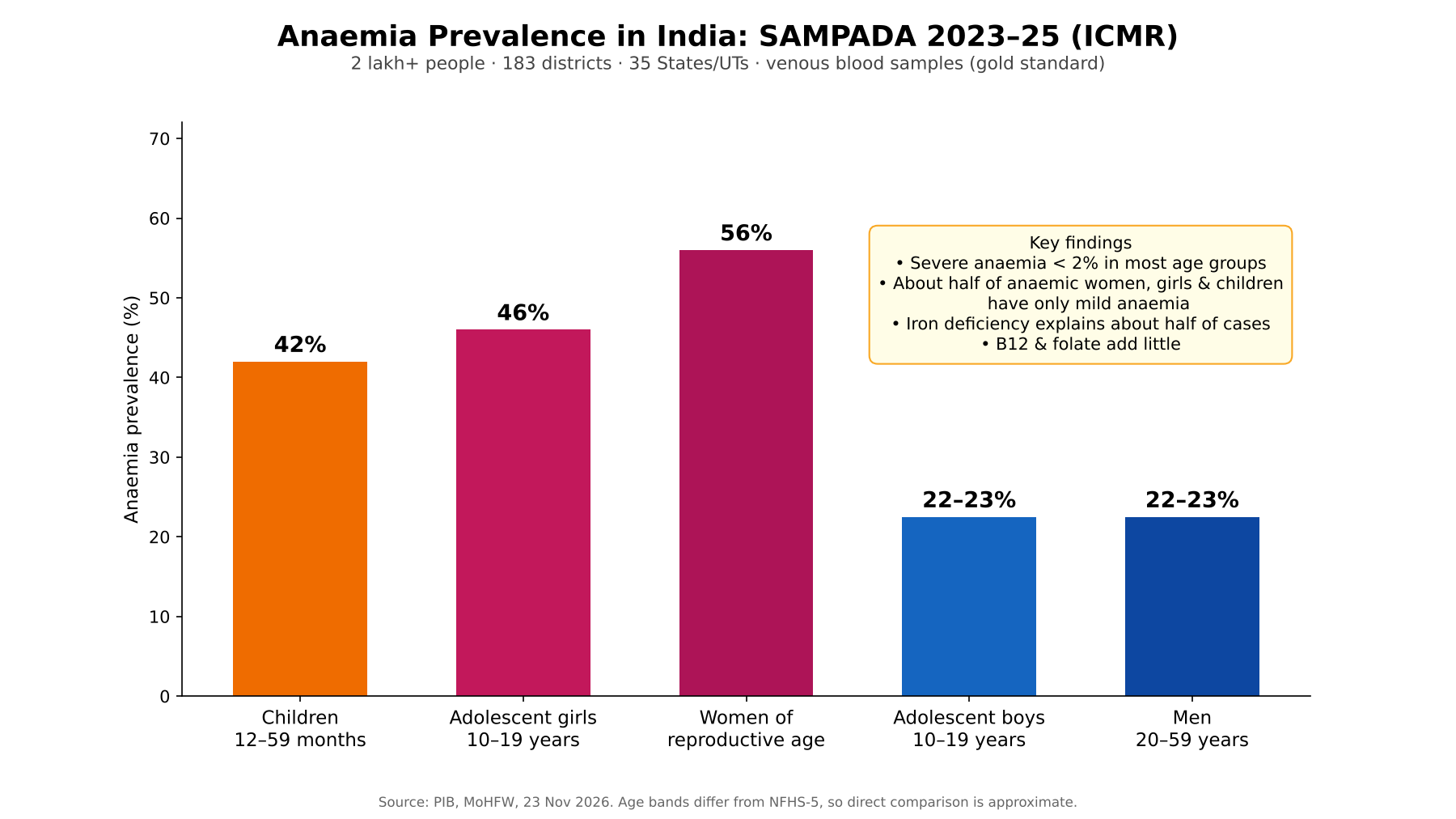
SAMPADA covered over 2 lakh people in 81,000+ households across 183 districts in 35 States and UTs.
More than 1.7 lakh blood samples were tested using the gold-standard venous blood method and automated analysers.
Prevalence by group:
Children aged 12–59 months: 42%
Adolescent girls (10–19 years): 46%
Women of reproductive age: 56%
Adolescent boys and men (20–59 years): 22–23%
Most anaemia is mild.Severe anaemia was below 2% in most age groups.
Iron deficiency explains about half of anaemia among women, adolescent girls and children.
Vitamin B12 and folate deficiency were equally common in anaemic and non-anaemic people, so they contribute little to anaemia.
It is among the first surveys to give national estimates for older adults.
Prelims Facts & Static Linkages
Why the numbers differ from NFHS-5
Blood sample: SAMPADA used venous blood, while NFHS used capillary (finger-prick) blood, which can overstate anaemia.
Analyser: automated lab analysers give more reproducible results than portable devices.
Age groups: SAMPADA's age bands differ from NFHS-5, so comparisons are approximate.
Older adults: SAMPADA adds national estimates for older adults, a group for which national data were limited.
Causes: anaemia also comes from infections, inflammation and haemoglobinopathies (such as thalassaemia and sickle cell disease), not just poor diet.
Anaemia basics
Item
Fact
What it is
Low haemoglobin, the iron-rich protein in red blood cells that carries oxygen
WHO cut-offs (Hb, g/dL)
Men below 13; non-pregnant women below 12; pregnant women and children aged 6–59 months below 11
Follows a 6×6×6 strategy: six target groups, six interventions and six institutional mechanisms.
Interventions include prophylactic Iron and Folic Acid supplements, deworming, a "Test, Treat and Talk" campaign, food fortification, and addressing non-nutritional causes.
AMB 2.0 aims to test, treat and track moderate and severe cases until they recover.
Related programmes
National Deworming Day is held on 10 February and 10 August for children and adolescents aged 1–19.
Fortified rice, with added iron, folic acid and vitamin B12, is supplied through the PDS and PM POSHAN.
The National Sickle Cell Anaemia Elimination Mission (2023) aims to eliminate sickle cell disease as a public health problem by 2047.
Likely Prelims angles
Interventions under Anaemia Mukt Bharat
What haemoglobin does and where iron is stored
Venous versus capillary sampling
Non-nutritional causes of anaemia
Quick Revision
SAMPADA was conducted by ICMR (through ICMR-NIN) over 2023–25.
It covered over 2 lakh people in 183 districts.
Prevalence was 42% in children aged 12–59 months, 46% in adolescent girls and 56% in women of reproductive age.
Severe anaemia is below 2% in most age groups.
Iron deficiency explains about half of the anaemia in vulnerable groups.
Anaemia Mukt Bharat was launched in 2018.
SAMPADA used venous blood, while NFHS used capillary blood.
Practice MCQ
Q. With reference to the SAMPADA survey, consider the following statements:
1. It was conducted by the Indian Council of Medical Research.
2. It used capillary blood samples to estimate haemoglobin.
3. It found vitamin B12 deficiency to be the main cause of anaemia in India.
Which of the statements given above is/are correct?
(a) 1 only
(b) 1 and 2 only
(c) 2 and 3 only
(d) 1, 2 and 3
Answer: (a). It used venous blood, and iron deficiency was the main contributor.
Related PYQs
PYQ 1 (UPSC CSE Prelims 2023)
Consider the following statements in the context of interventions being undertaken under Anaemia Mukt Bharat Strategy:
1. It provides prophylactic calcium supplementation for pre-school children, adolescents and pregnant women.
2. It runs a campaign for delayed cord clamping at the time of child-birth.
3. It provides for periodic deworming to children and adolescents.
4. It addresses non-nutritional causes of anaemia in endemic pockets with special focus on malaria, hemoglobinopathies and fluorosis.
How many of the statements given above are correct?
(a) Only one
(b) Only two
(c) Only three
(d) All four
Answer: (c). AMB provides Iron and Folic Acid, not calcium.



 24
Nov 2026
 24
Nov 2026
 24
Nov 2026














0 comments
Discussion
No comments yet. Be the first.