92nd meeting of the Standing Committee of the National Board for Wildlife (SC-NBWL)...
DDecode Civils
· 3 min read
Marine Conservation Takes Centre Stage at NBWL
Why in News
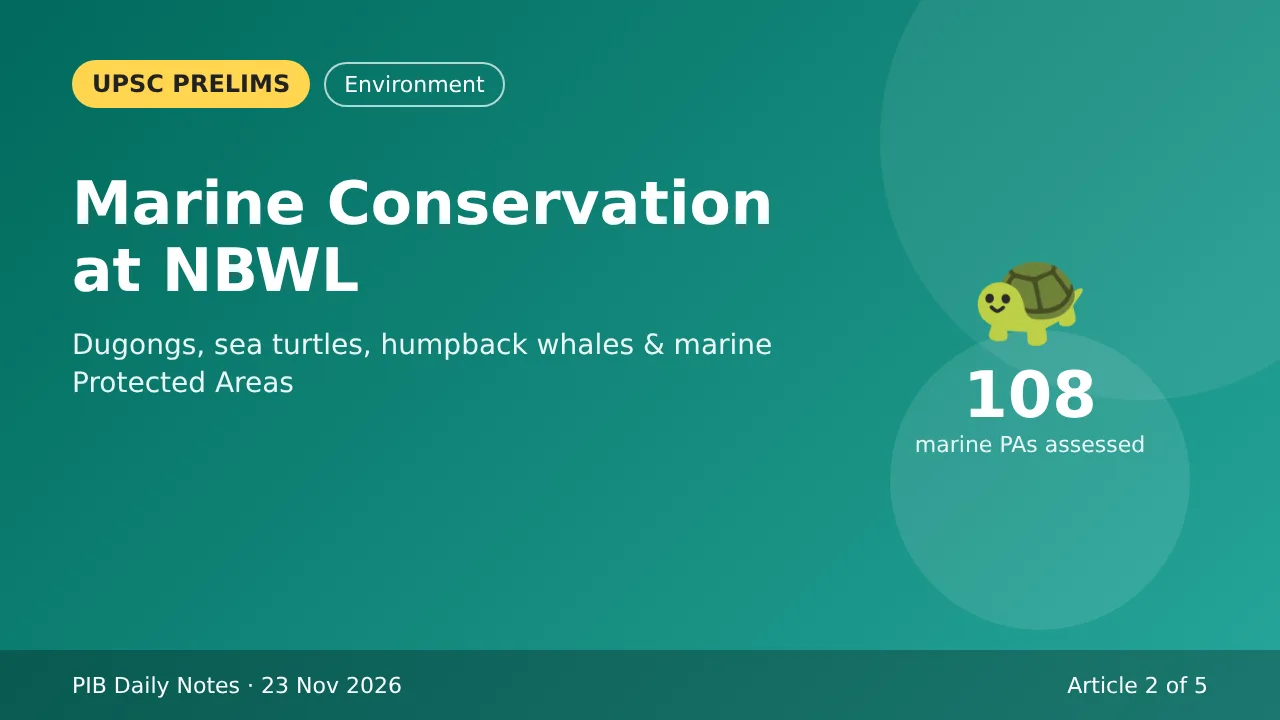
The 92nd meeting of the Standing Committee of the National Board for Wildlife (SC-NBWL), chaired by the Union Environment Minister, was themed on marine conservation. Reports on dugongs, marine turtles, the Arabian Sea humpback whale and marine protected areas were released.
News Summary
A Management Effectiveness Evaluation (MEE) for 2024–26 covered 108 coastal and marine Protected Areas.
A pan-India marine turtle assessment by the Wildlife Institute of India (WII) covered three nesting seasons (2022–25), about 1,300 km of coastline and 360 beach stretches, and four nesting species.
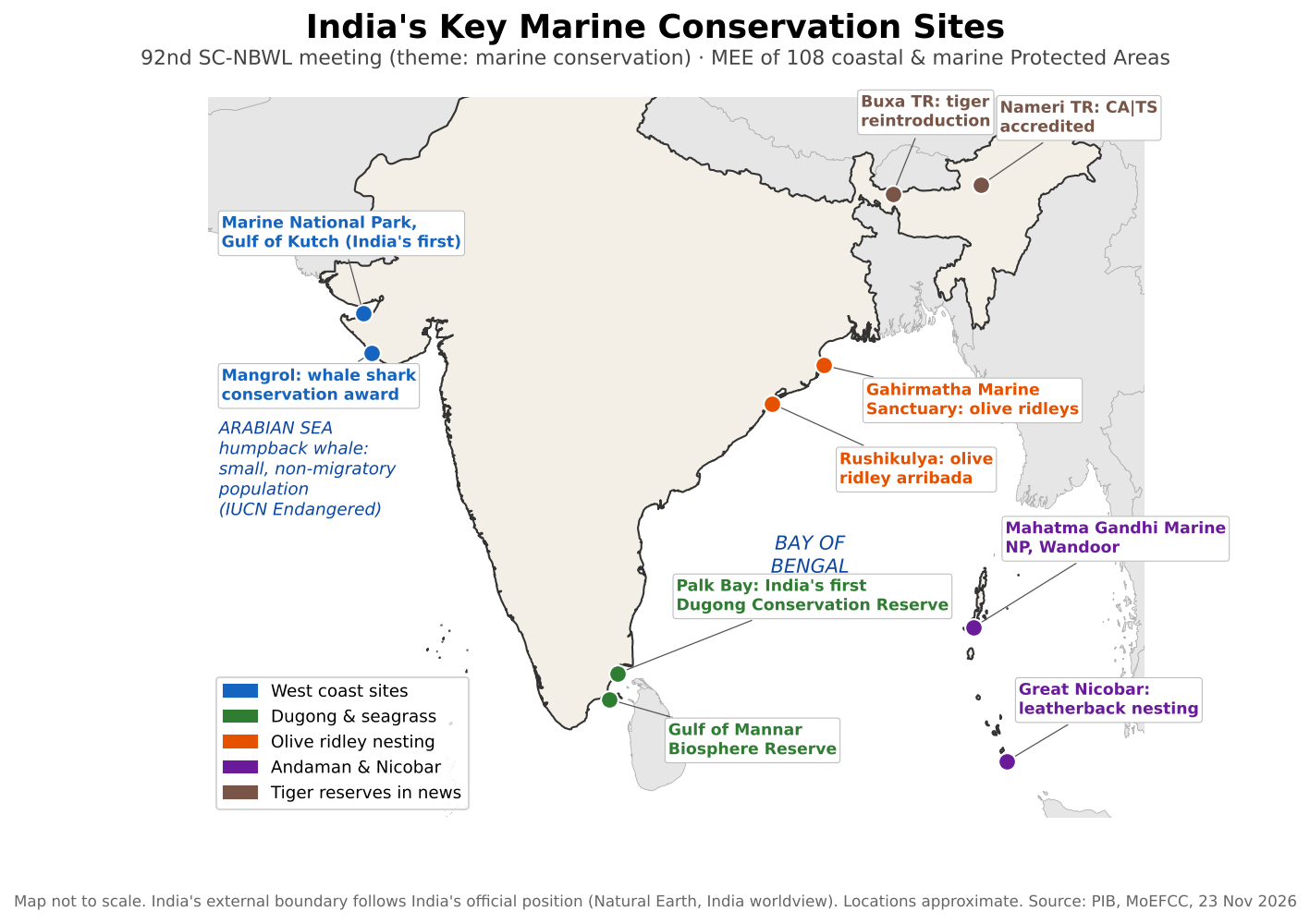
The first drone-based dugong count in Tamil Nadu estimated 270 ± 16 animals. India's first Dugong Conservation Reserve is in Palk Bay.
WII identified seven potential sighting hotspots for the Arabian Sea humpback whale, with entanglement in fishing gear as the main threat.
Nameri Tiger Reserve (Assam) received CA|TS accreditation.
A Field Manual on Small Cats, covering nine species, was released.
The committee considered 133 proposals needing wildlife clearance under the Wild Life (Protection) Act, 1972.
Wildlife Week 2026 highlights included tiger reintroduction in Buxa, the release of Great Indian Bustards in Rajasthan and a third Project Cheetah site.
Prelims Facts & Static Linkages
Key marine species in the news
Species
Key facts
Dugong (sea cow)
India's only herbivorous marine mammal; feeds on seagrass; IUCN Vulnerable; Schedule I
Olive ridley turtle
Mass nesting (arribada) at Gahirmatha and Rushikulya, Odisha; IUCN Vulnerable
Leatherback turtle
The largest sea turtle; nests in the Andaman and Nicobar Islands
Arabian Sea humpback whale
A small, non-migratory, isolated population; IUCN Endangered
Whale shark
The largest fish; the first fish listed in Schedule I (2001); Gujarat's Saurashtra coast is a key site
Why marine conservation matters
Seagrass meadows feed dugongs and turtles, and store carbon ("blue carbon").
Fishing gear entangles and drowns turtles, whales and dugongs, so turtle excluder devices and gear changes help.
Coastal development destroys nesting beaches and seagrass beds.
Community action works: the Mangrol fishers' cooperative won an award for whale shark conservation.
Marine protected areas to know
Marine National Park, Gulf of Kutch (Gujarat): India's first marine national park.
Gulf of Mannar Biosphere Reserve (Tamil Nadu): the first marine biosphere reserve in South and South-East Asia, and a dugong habitat.
Mahatma Gandhi Marine National Park, Wandoor (Andaman): coral reefs and turtles.
NBWL at a glance
Constituted under the Wild Life (Protection) Act, 1972, after the 2002 amendment.
The full Board is chaired by the Prime Minister.
The Standing Committee is chaired by the Environment Minister and appraises projects in and around Protected Areas.
CA|TS (Conservation Assured | Tiger Standards) is a global accreditation of tiger site management.
Likely Prelims angles
Which marine mammal is herbivorous
Mass nesting sites of olive ridleys
Who chairs the NBWL and its Standing Committee
Location of the Dugong Conservation Reserve
Quick Revision
The 92nd SC-NBWL meeting was themed on marine conservation.
The MEE covered 108 coastal and marine Protected Areas.
India's first Dugong Conservation Reserve is in Palk Bay, Tamil Nadu.
The Tamil Nadu dugong estimate is 270 ± 16.
Nameri Tiger Reserve in Assam received CA|TS accreditation.
The NBWL is chaired by the Prime Minister.
Practice MCQ
Q. Consider the following statements:
1. The dugong is a herbivorous marine mammal that feeds on seagrass.
2. Gahirmatha in Odisha is a mass nesting site of olive ridley turtles.
3. The Standing Committee of the National Board for Wildlife is chaired by the Prime Minister.
Which of the statements given above are correct?
(a) 1 and 2 only
(b) 2 and 3 only
(c) 1 and 3 only
(d) 1, 2 and 3
Answer: (a). The Environment Minister chairs the Standing Committee.
Related PYQs
PYQ 1 (UPSC CSE Prelims 2026)
Which of the following best explain(s) the rationale for protecting mangrove ecosystems in the context of climate resilience?
1. Mangroves reduce tidal energy and store freshwater, making them ideal sites for paddy cultivation in saline estuarine belts.
2. Their salt-sensitive roots filter seawater, making mangroves key to converting coastal land into freshwater aquaculture zones.
3. By withstanding tidal surges and offering biomass resources, mangroves function both as natural bio-shields and livelihood bases for rural communities.



 24
Nov 2026
 24
Nov 2026
 24
Nov 2026














0 comments
Discussion
No comments yet. Be the first.