Lakhpati Didi: 3.76 Crore Rural Women Cross ₹1 Lakh Income
A PIB backgrounder released on 15 November 2026 reviewed the Lakhpati Didi Initiative
DDecode Civils
· 3 min read
Lakhpati Didi: 3.76 Crore Rural Women Cross ₹1 Lakh Income
Why in News
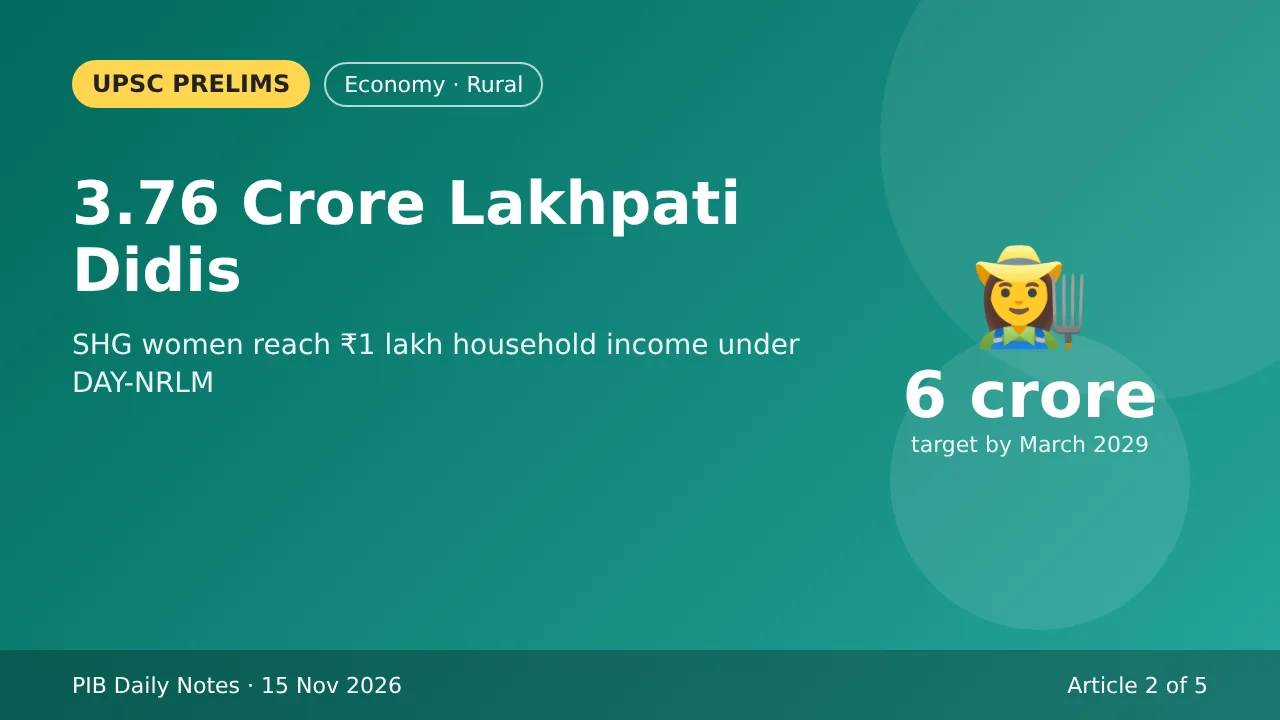
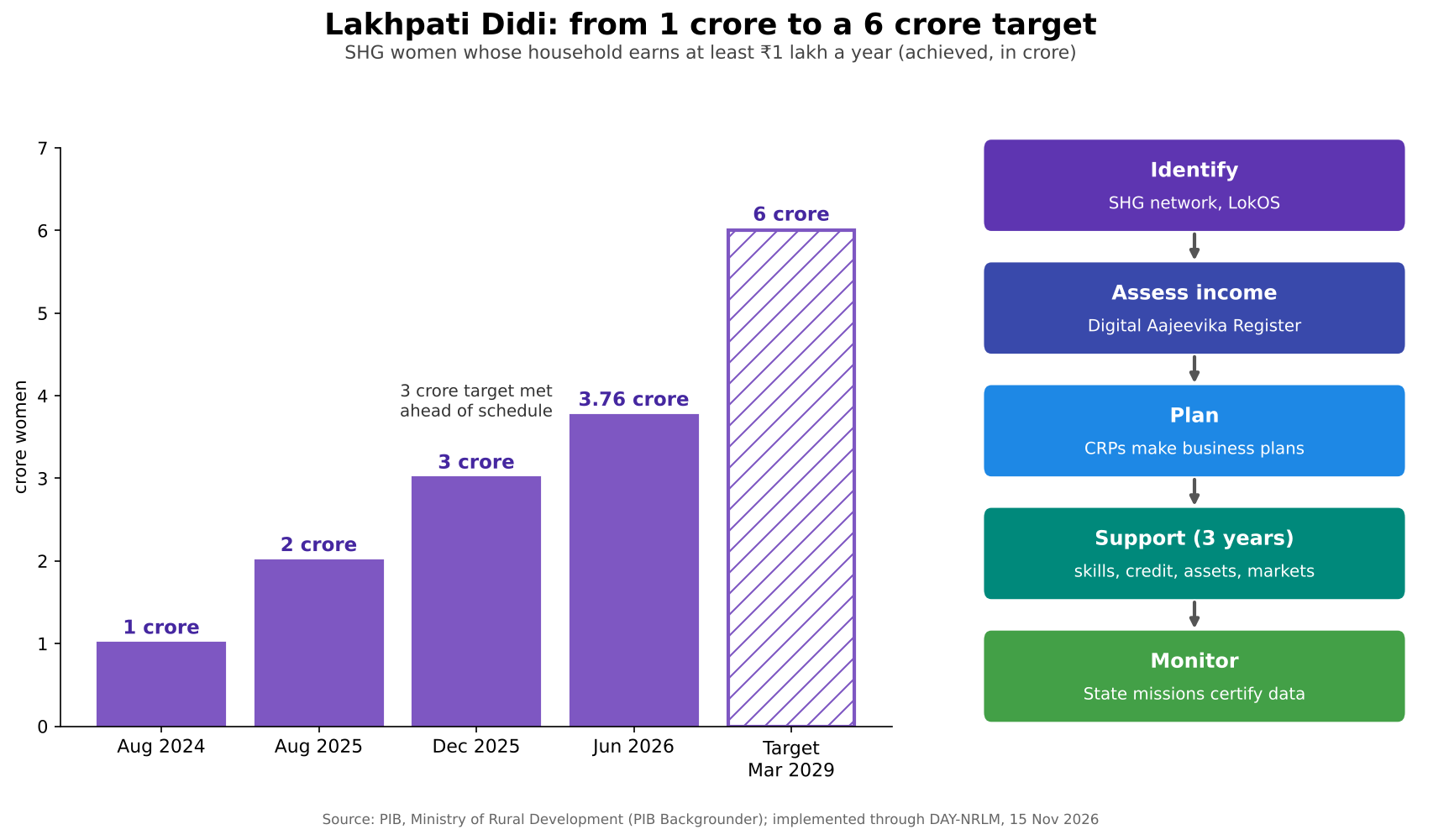
A PIB backgrounder released on 15 November 2026 reviewed the Lakhpati Didi Initiative. By June 2026, 3.76 crore rural Self-Help Group (SHG) women had become Lakhpati Didis, against a revised target of 6 crore by March 2029.
News Summary
A Lakhpati Didi is an SHG member whose household earns at least ₹1 lakh a year, sustained across seasons or business cycles.
The initiative was announced on 15 August 2023 with a target of 2 crore. The Interim Budget (February 2024) raised it to 3 crore, and February 2026 raised it to 6 crore.
The 3-crore target was met ahead of schedule in December 2025. Another 5.70 crore women are identified as "Potential Lakhpati Didis".
An IIM Ahmedabad study of 6,531 respondents in 17 States and UTs found a 61% rise in average monthly household income and a 61.7% rise in savings.
It runs through DAY-NRLM, which has about 10.13 crore members in 94.40 lakh SHGs.
States identified 12 priority livelihood sub-sectors, such as bamboo, honey, goat rearing, poultry and tasar silk.
Prelims Facts & Static Linkages
How the initiative works
Identification: potential beneficiaries are found through the SHG network and the LokOS platform.
Income assessment: the Digital Aajeevika Register (from May 2024) records each household's livelihoods and income.
Enterprise planning: trained Community Resource Persons (CRPs) prepare a business plan for each household, using the Didi Business Plan tool.
Support: women get skills, credit, assets and market links over three years.
Monitoring: national and State missions track progress, and States certify reported figures.
About DAY-NRLM
Feature
Detail
Launched
June 2011 as Aajeevika, later renamed DAY-NRLM
Ministry
Rural Development
Approach
One woman from each poor rural household joins an SHG
Structure
SHG, then Village Organisation, then Cluster Level Federation
Urban counterpart
DAY-NULM, under the Ministry of Housing and Urban Affairs
SHG basics
An SHG is a group of usually 10 to 20 members who save regularly and lend to each other.
Members share responsibility for loans, so peer pressure replaces collateral.
NABARD launched the SHG–Bank Linkage Programme in 1992.
Regional Rural Banks, cooperative banks and scheduled commercial banks lend to SHGs.
Why it matters
Women's income: it moves rural women from subsistence work to enterprise.
Financial inclusion: savings and credit through formal banks.
Convergence: links with agriculture, animal husbandry and MSME schemes.
Related schemes to link
Namo Drone Didi: drones for women SHGs to offer agri-services such as spraying fertiliser.
PM Vishwakarma and PMEGP: credit and skilling for artisans and micro-enterprises.
Van Dhan Vikas Kendras: value addition to minor forest produce by tribal SHGs.
ONDC and GeM: digital marketplaces that help SHG products reach buyers.
Likely Prelims angles
The ₹1 lakh household (not individual) income benchmark.
DAY-NRLM's ministry and three-tier structure.
The role of NABARD in SHG–bank linkage.
Quick Revision
Lakhpati Didi was announced on 15 August 2023.
The benchmark is ₹1 lakh annual household income.
Targets rose from 2 crore to 3 crore and then 6 crore by March 2029.
3.76 crore women had become Lakhpati Didis by June 2026.
It runs through DAY-NRLM under the Ministry of Rural Development.
An IIM Ahmedabad study found a 61% rise in household income.
Practice MCQ
Q. With reference to the Lakhpati Didi Initiative, consider the following statements:
1. It counts only the woman's individual income towards the ₹1 lakh benchmark.
2. It is implemented through the Deendayal Antyodaya Yojana–National Rural Livelihoods Mission.
3. The Digital Aajeevika Register records the livelihoods and income of each household.
How many of the above statements are correct?
(a) Only one
(b) Only two
(c) All three
(d) None
Answer: (b). The benchmark is total household income, not individual income.
Related PYQs
PYQ 1 (UPSC CSE Prelims 2023)
Consider the following statements:
1. The Self-Help Group (SHG) programme was originally initiated by the State Bank of India by providing microcredit to the financially deprived.
2. In an SHG, all members of a group take responsibility for a loan that an individual member takes.
3. The Regional Rural Banks and Scheduled Commercial Banks support SHGs.



 28
Nov 2026
 28
Nov 2026
 28
Nov 2026














0 comments
Discussion
No comments yet. Be the first.