A PIB backgrounder on 15 November 2026 described the Yuge Yugeen Bharat Museum
DDecode Civils
· 3 min read
Yuge Yugeen Bharat: North and South Blocks Become a National Museum
Why in News
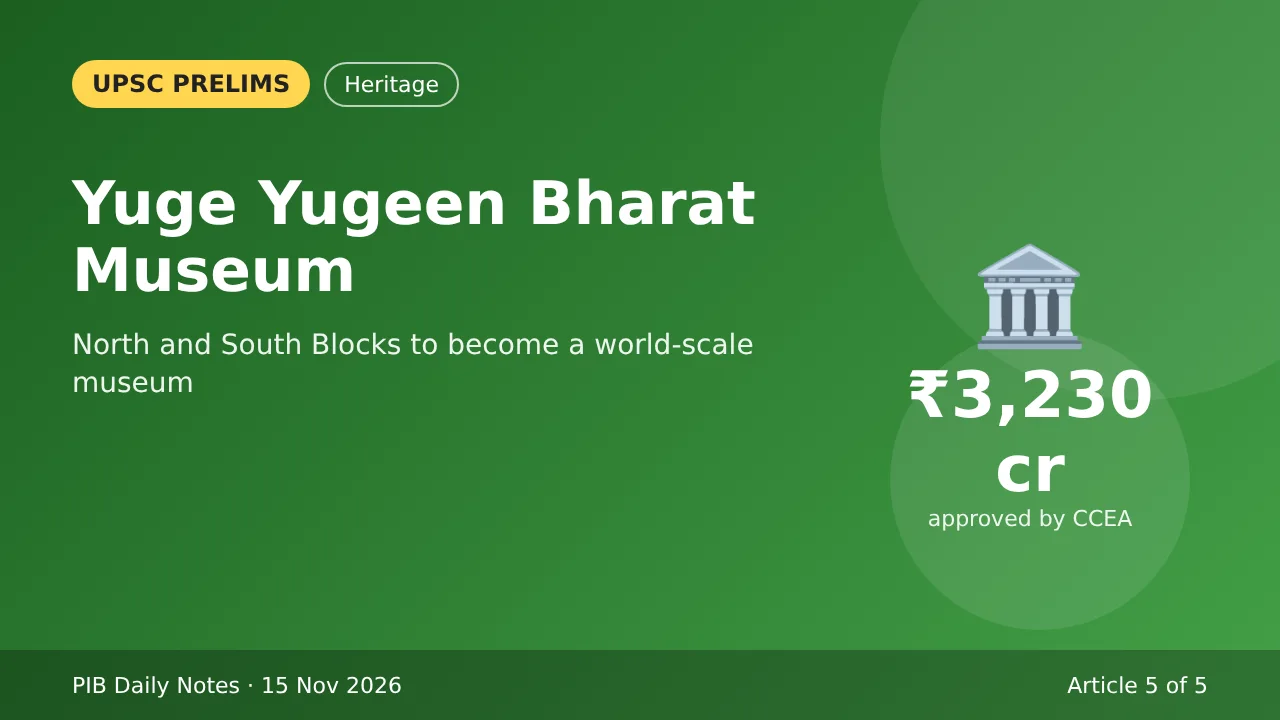
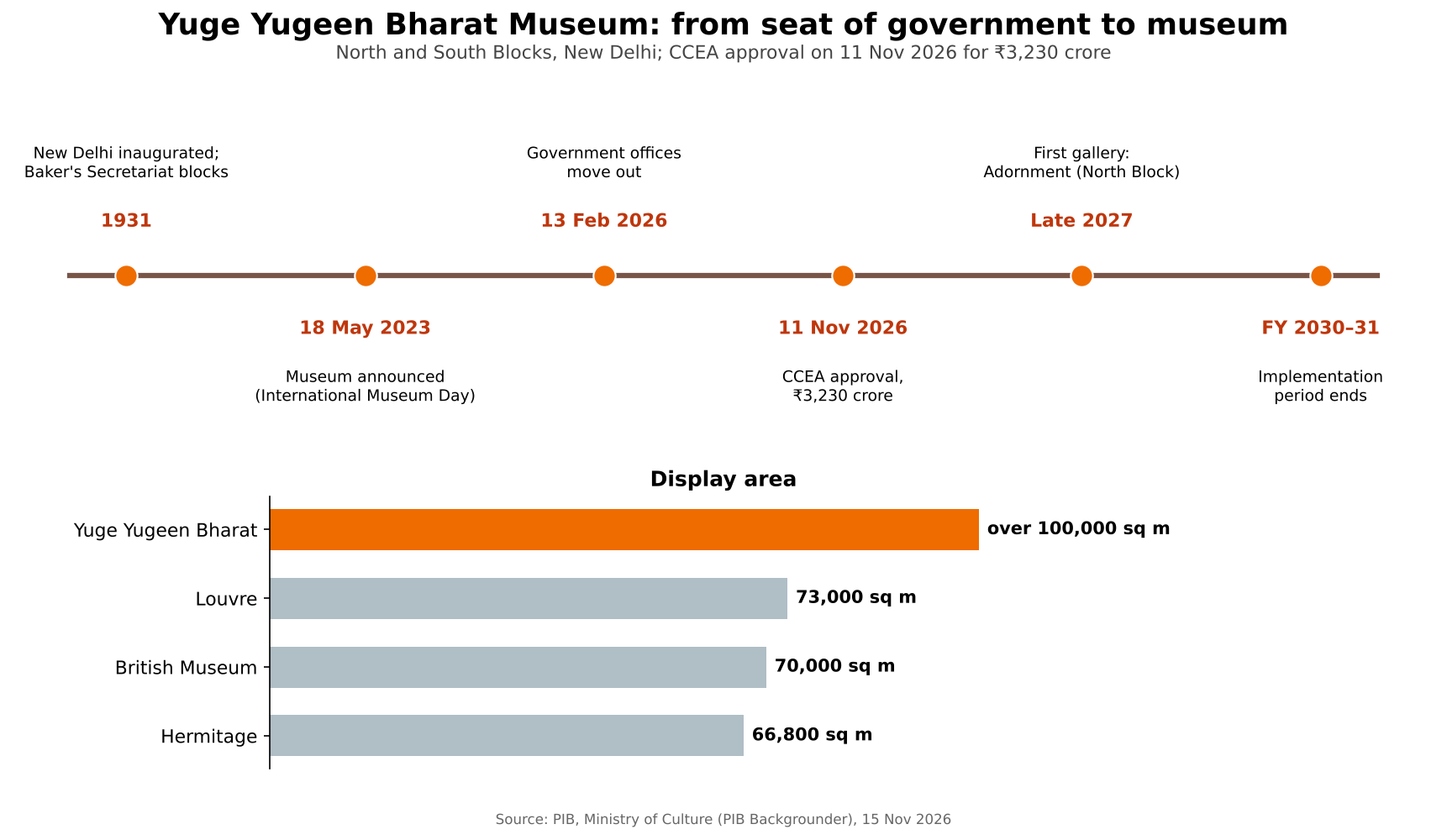
A PIB backgrounder on 15 November 2026 described the Yuge Yugeen Bharat Museum, to be built in the historic North and South Blocks, New Delhi. The Cabinet Committee on Economic Affairs (CCEA) approved it on 11 November 2026 at a cost of ₹3,230 crore.
News Summary
The project was first announced by the Prime Minister on 18 May 2023 (International Museum Day).
The two blocks housed government offices until 13 February 2026, nearly 95 years after South Block was inaugurated. Offices moved to Seva Teerth (the new PMO) and the Kartavya Bhavans.
Built-up area: about 1,78,509 sq m.
Display area: over 1 lakh sq m, larger than the Louvre (73,000), British Museum (70,000) and Hermitage (66,800).
Capacity:30,000 visitors a day and 1 crore a year.
About 18 lakh objects have been identified, from the National Museum, 52 ASI site museums, State museums and private collections.
Timeline: FY 2026–27 to FY 2030–31. The first gallery, Adornment, opens in North Block in late 2027.
Prelims Facts & Static Linkages
Key features
Adaptive reuse: old buildings get a new public use, with minimal changes to façades and character.
Thematic galleries: Architecture and Cityscapes, Mathematics and Astronomy, Languages and Scripts, Faith and Spirituality, and Bharat Connects (Trade and Ideas).
Technology: AR, VR and AI for storytelling. Digitisation with Google Arts & Culture (announced 5 November 2026).
Make in India: domestic vendors for museum materials.
The North and South Blocks
Designed by Herbert Baker. Edwin Lutyens designed Rashtrapati Bhavan and planned New Delhi.
Built in cream and red Dholpur sandstone, mixing classical design with Indian elements such as chhatris and jalis.
New Delhi was inaugurated in 1931, after the capital moved from Calcutta (announced at the Delhi Durbar, 1911).
They sit on the Central Vista, beside Kartavya Path (renamed from Rajpath in 2022).
Major museums and bodies
Institution
Fact
Indian Museum, Kolkata
Oldest museum in India (1814), set up by the Asiatic Society
National Museum, New Delhi
Opened in 1949, under the Ministry of Culture
Archaeological Survey of India
Founded in 1861, with Alexander Cunningham as first Director-General
CCEA
Cabinet committee chaired by the Prime Minister
Why adaptive reuse matters
It keeps historic buildings alive with a new public purpose, instead of leaving them empty or demolishing them.
It saves the embodied energy and materials of existing structures, so it is greener than new construction.
It opens former seats of power to citizens and tourists, as the Louvre (once a royal palace) shows.
It supports cultural tourism, research and jobs for artisans, conservators and museum professionals.
Likely Prelims angles
The architects of New Delhi's buildings.
Adaptive reuse as a heritage conservation idea.
Matching museums and heritage bodies with their founding facts.
Quick Revision
The museum will occupy North and South Blocks, New Delhi.
The CCEA approved it on 11 November 2026 for ₹3,230 crore.
Its display area of over 1 lakh sq m will exceed the Louvre's.
About 18 lakh objects have been identified.
The first gallery, Adornment, opens in late 2027.
Herbert Baker designed the two blocks.
Practice MCQ
Q. With reference to the Yuge Yugeen Bharat Museum, consider the following statements:
1. It is being developed in the North and South Block Complex in New Delhi.
2. Its planned display area is larger than that of the Louvre.
3. It is being developed by the Ministry of Housing and Urban Affairs.
Which of the statements given above is/are correct?
(a) 1 only
(b) 1 and 2 only
(c) 2 and 3 only
(d) 1, 2 and 3
Answer: (b). The Ministry of Culture is developing the museum.
Related PYQs
PYQ 1 (UPSC CSE Prelims 2026)
What does an empty seat represent in early Buddhist iconography?
(a) The meditation of the Buddha
(b) The Buddha's First Sermon
(c) The Buddha's Mahaparinibbana
(d) The Buddha's Mahabhinishkramana
Answer: (a).
PYQ 2 (UPSC CSE Prelims 2026)
The Hallisalasya painting in the Bagh Caves represents:
(a) A joyous folk dance
(b) Buddha in a meditative pose
(c) The depiction of Shiva and Parvati on Kailasha



 28
Nov 2026
 28
Nov 2026
 28
Nov 2026














0 comments
Discussion
No comments yet. Be the first.