National Health Accounts 2023–24: Out-of-Pocket Spending Falls to 42.7%
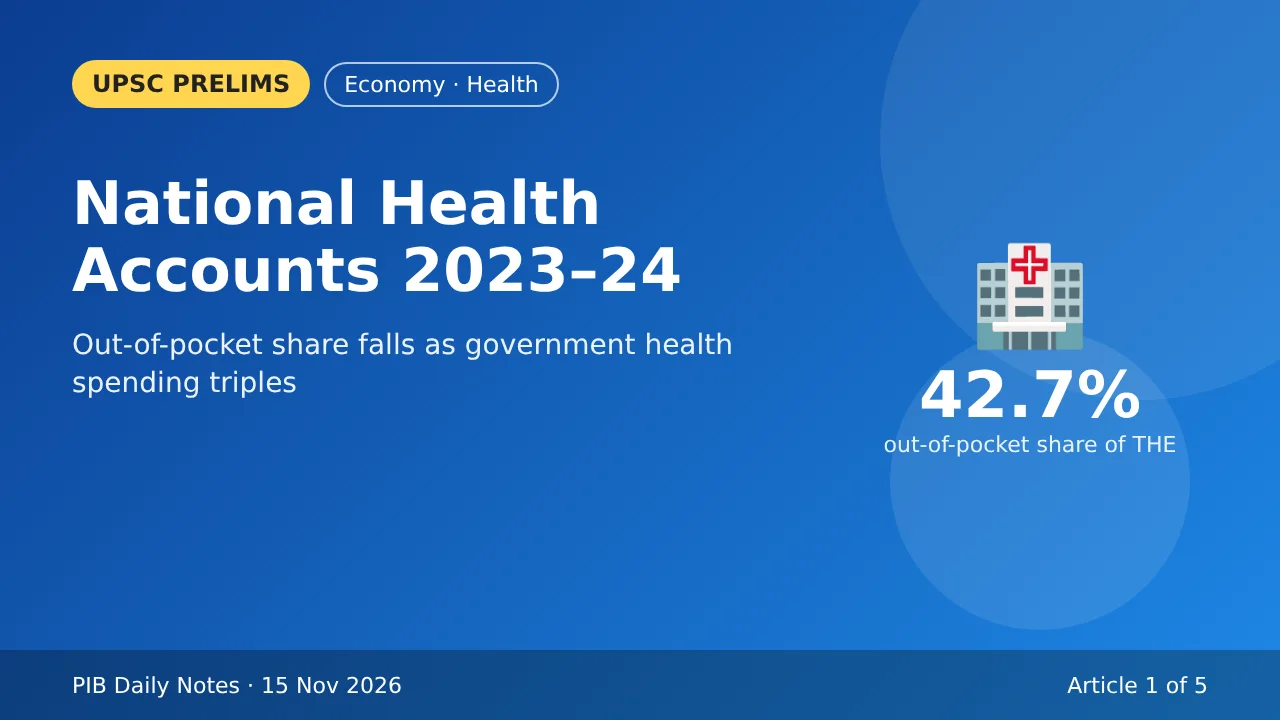
Households' Out-of-Pocket Expenditure (OOPE) fell to 42.7% of Total Health Expenditure
DDecode Civils
· 3 min read
National Health Accounts 2023–24: Out-of-Pocket Spending Falls to 42.7%
Why in News
The Union Health Ministry released the National Health Accounts (NHA) Estimates for India 2023–24 on 15 November 2026. Households' Out-of-Pocket Expenditure (OOPE) fell to 42.7% of Total Health Expenditure, while Government Health Expenditure (GHE) more than tripled over a decade.
News Summary
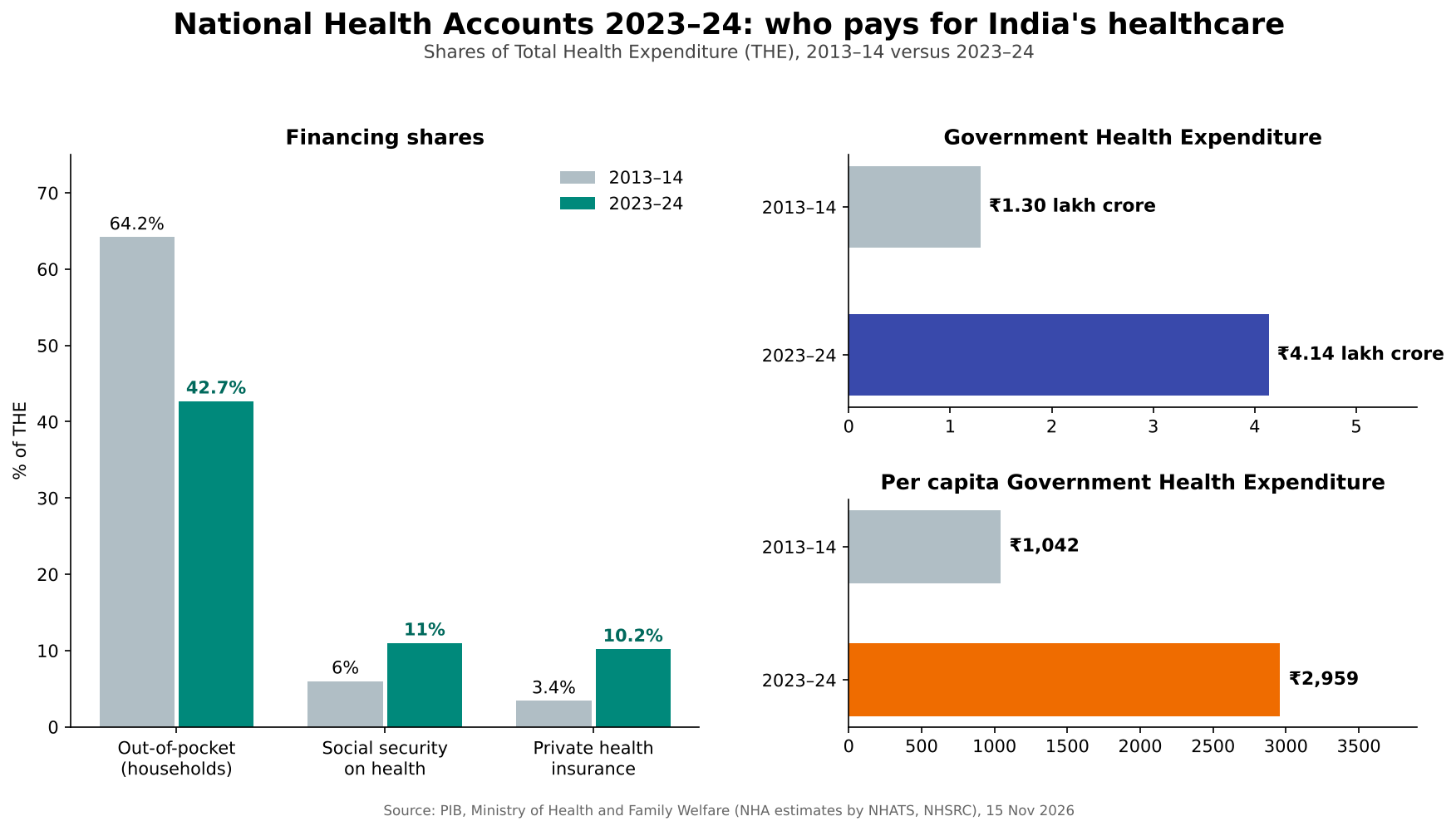
OOPE share fell from 64.2% (2013–14) to 42.7% (2023–24), a drop of 21.5 percentage points. It was 43.4% in 2022–23.
GHE rose from ₹1,29,778 crore to ₹4,14,196 crore, about three times higher.
The government's share of Total Health Expenditure (THE) rose by 14.9 percentage points over the decade.
Per capita GHE rose from ₹1,042 to ₹2,959, about 2.8 times.
Government spending on primary healthcare reached about ₹1.53 lakh crore.
Social security expenditure on health rose from 6% to 11% of THE. Private health insurance rose from 3.4% to 10.2% of THE.
This is the eleventh round of NHA estimates.
Prelims Facts & Static Linkages
What the NHA is
Prepared by: the National Health Accounts Technical Secretariat (NHATS) at the National Health Systems Resource Centre (NHSRC), Ministry of Health and Family Welfare.
Framework: the internationally recognised System of Health Accounts 2011 (SHA 2011), developed by the WHO, OECD and Eurostat.
Purpose: it tracks who pays for healthcare (government, households, insurers, employers, donors), through which schemes, and for which services.
OOPE means payments made directly by households at the point of care, with no insurance or government cover. A high OOPE share pushes families into poverty.
Key terms
Term
Meaning
Total Health Expenditure (THE)
Current plus capital spending on health by all sources
Government Health Expenditure (GHE)
Spending by the Centre, States and local bodies
Out-of-Pocket Expenditure (OOPE)
Direct household payments at the point of service
Social security expenditure
Government-funded insurance, social health insurance and employee medical schemes
Schemes named in the release
AB PM-JAY: cashless hospital cover of ₹5 lakh per family per year, launched in 2018.
Ayushman Arogya Mandirs: the renamed Health and Wellness Centres that deliver comprehensive primary care, including NCD screening.
Pradhan Mantri Bhartiya Janaushadhi Pariyojana: low-cost generic medicines through Jan Aushadhi Kendras.
AMRIT pharmacies: Affordable Medicines and Reliable Implants for Treatment.
Pradhan Mantri National Dialysis Programme and the Free Drugs and Diagnostics Initiatives.
National Pharmaceutical Pricing Authority (NPPA): fixes and enforces drug prices under the Drugs (Prices Control) Order.
Constitutional and policy linkages
Health ("public health and sanitation; hospitals and dispensaries") is in the State List.
Article 47 (a Directive Principle) makes improving public health a primary duty of the State.
The National Health Policy 2017 aims to raise public health spending to 2.5% of GDP.
Universal Health Coverage (UHC) is part of SDG target 3.8.
Likely Prelims angles
Which body prepares the NHA and on which framework.
The difference between OOPE, GHE and THE.
Matching health schemes with their features.
Quick Revision
NHA 2023–24 is the 11th round, prepared by NHATS at NHSRC.
OOPE share fell from 64.2% to 42.7% between 2013–14 and 2023–24.
GHE rose from ₹1.30 lakh crore to ₹4.14 lakh crore.
Per capita GHE rose from ₹1,042 to ₹2,959.
Social security spending on health rose from 6% to 11% of THE.
Private health insurance rose from 3.4% to 10.2% of THE.
Practice MCQ
Q. With reference to the National Health Accounts (NHA) Estimates for India, consider the following statements:
1. They are prepared by the National Statistics Office.
2. They follow the System of Health Accounts 2011 framework.
3. In 2023–24, Out-of-Pocket Expenditure was less than half of Total Health Expenditure.
Which of the statements given above is/are correct?
(a) 1 and 2 only
(b) 2 and 3 only
(c) 3 only
(d) 1, 2 and 3
Answer: (b). The NHA is prepared by the NHA Technical Secretariat at the NHSRC, under the Health Ministry.
Related PYQs
PYQ 1 (UPSC CSE Prelims 2022)
With reference to Ayushman Bharat Digital Mission, consider the following statements:
1. Private and public hospitals must adopt it.
2. As it aims to achieve universal health coverage, every citizen of India should be part of it ultimately.
3. It has seamless portability across the country.
Which of the statements given above is/are correct?



 28
Nov 2026
 28
Nov 2026
 28
Nov 2026














0 comments
Discussion
No comments yet. Be the first.