Stand-Up India and the Mudra Credit Guarantee Fund Extended to 2031
Stand-Up India will support 2.5 lakh more women, Scheduled Caste (SC) and Scheduled Tribe (ST)
DDecode Civils
· 3 min read
Stand-Up India and the Mudra Credit Guarantee Fund Extended to 2031
Why in News
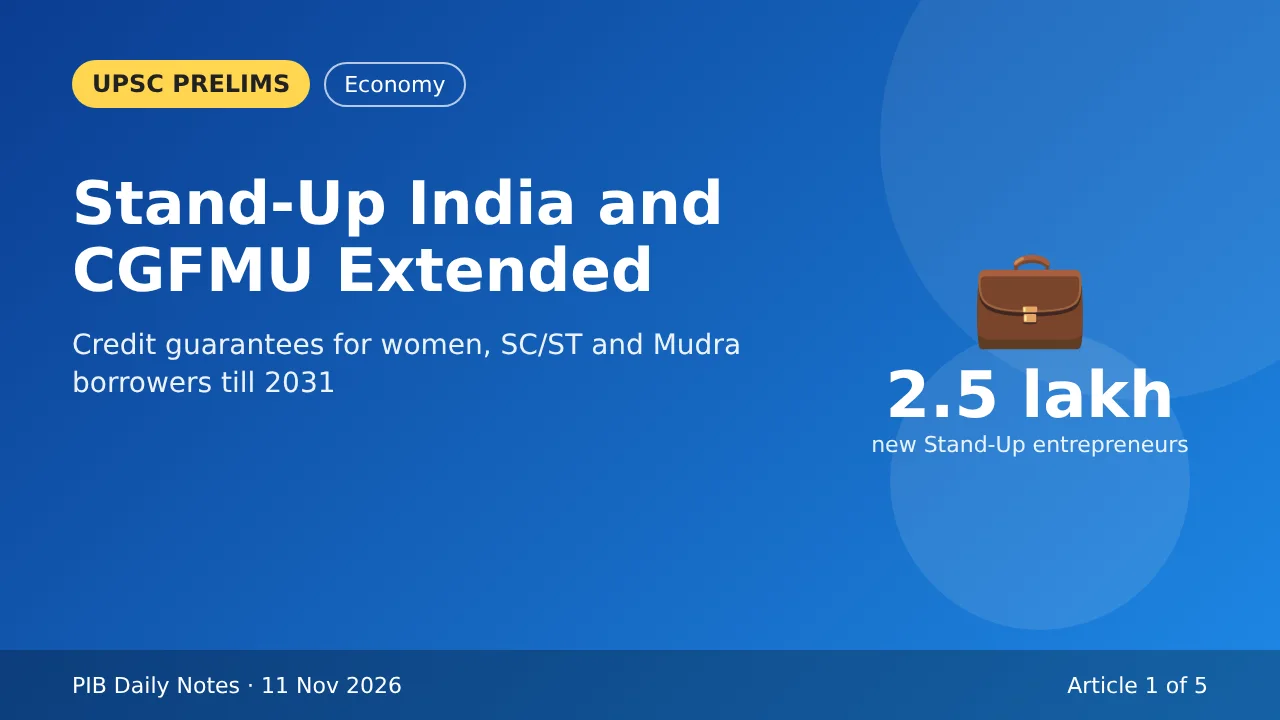
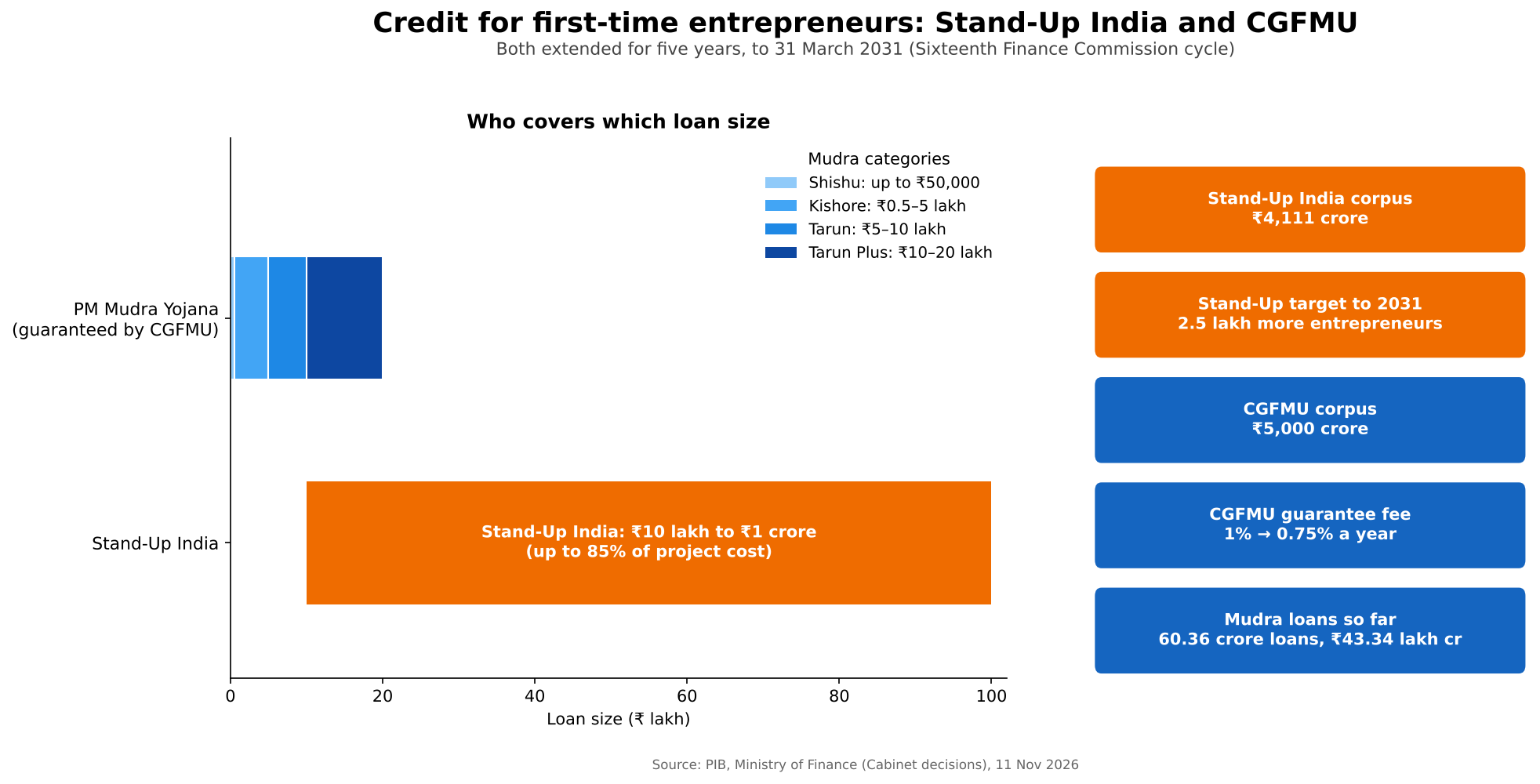
On 11 November 2026, the Union Cabinet approved the continuation of two credit schemes for small and first-time entrepreneurs until 31 March 2031: the Stand-Up India Scheme, with a credit guarantee corpus of ₹4,111 crore, and the Credit Guarantee Fund for Micro Units (CGFMU), with a corpus of ₹5,000 crore.
News Summary
Stand-Up India will support 2.5 lakh more women, Scheduled Caste (SC) and Scheduled Tribe (ST) entrepreneurs over five years. Since April 2016, it has backed loans to over 2.75 lakh such borrowers.
It funds greenfield enterprises in manufacturing, services, trading and agri-allied activities.
Loans run from above ₹10 lakh up to ₹1 crore, covering up to 85% of project cost, as a composite loan (term loan plus working capital) or a term loan.
Stand-Up loans carry an 85% credit guarantee at a 0.50% fee.
CGFMU guarantees lending institutions against default on loans under the Pradhan Mantri Mudra Yojana (PMMY). It is run by the National Credit Guarantee Trustee Company (NCGTC).
CGFMU covers Mudra loans up to ₹20 lakh, overdrafts up to ₹10,000 in PM Jan Dhan Yojana accounts, and Self-Help Group (SHG) loans where the portfolio is ₹10 lakh to ₹20 lakh.
The annual guarantee fee falls from 1% to 0.75%. SHG loans keep paying 0.25% in the first year and 0.50% after that.
Over 60.36 crore Mudra loans worth ₹43.34 lakh crore have been sanctioned; the extension should enable ₹12.6 lakh crore more.
Prelims Facts & Static Linkages
How a credit guarantee works
A bank hesitates to lend without collateral to a borrower with no credit history.
A guarantee fund promises to repay most of the loss if the loan turns bad.
The bank pays a small guarantee fee.
With the risk shared, banks lend more freely, so a small corpus supports far more credit.
CGFMU coverage now follows the amount disbursed or outstanding, matching the lender's real risk.
Stand-Up India and PMMY compared
Feature
Stand-Up India
PM Mudra Yojana
Launched
April 2016
April 2015
Who can borrow
Women, SC and ST entrepreneurs
Any non-farm micro enterprise
Loan size
Above ₹10 lakh to ₹1 crore
Up to ₹20 lakh
Enterprise type
Greenfield only
New or existing
Guarantee fund
Credit Guarantee Fund for Stand-Up India
CGFMU
Guarantee manager
NCGTC
NCGTC
Mudra loan categories
Shishu: up to ₹50,000.
Kishore: ₹50,000 to ₹5 lakh.
Tarun: ₹5 lakh to ₹10 lakh.
Tarun Plus: ₹10 lakh to ₹20 lakh, for borrowers who have repaid earlier Tarun loans (Union Budget 2024-25).
Institutions to know
MUDRA (Micro Units Development & Refinance Agency): a subsidiary of SIDBI that refinances lenders. It does not lend directly to borrowers.
NCGTC: set up in 2014 by the Department of Financial Services, Ministry of Finance, to manage several guarantee funds.
CGTMSE: a separate trust (2000) of the Ministry of MSME and SIDBI for collateral-free MSE loans.
Quick Revision
Stand-Up India and CGFMU are extended to 31 March 2031.
Stand-Up India: women, SC and ST entrepreneurs; greenfield units; above ₹10 lakh to ₹1 crore.
Stand-Up corpus is ₹4,111 crore; guarantee cover is 85% at a 0.50% fee.
CGFMU corpus is ₹5,000 crore; its fee falls from 1% to 0.75% a year.
CGFMU covers Mudra loans up to ₹20 lakh, Jan Dhan overdrafts up to ₹10,000 and some SHG loans.
NCGTC runs the guarantee funds.
Practice MCQ
Q. With reference to the Stand-Up India Scheme, consider the following statements:
1. It finances only greenfield enterprises.
2. Loans under it range from ₹50,000 to ₹10 lakh.
3. Its credit guarantee fund is managed by the National Credit Guarantee Trustee Company.
Which of the statements given above is/are correct?
(a) 1 only
(b) 1 and 3 only
(c) 2 and 3 only
(d) 1, 2 and 3
Answer: (b). Stand-Up India loans run from above ₹10 lakh to ₹1 crore. Loans up to ₹20 lakh fall under the Mudra scheme.
Related PYQs
PYQ 1 (UPSC CSE Prelims 2026)
Which of the following statements about M1xchange's role in Micro, Small & Medium Enterprises (MSMEs) financing is/are correct?
1. M1xchange provides collateral based loans to MSMEs.
2. M1xchange facilitates discounting of invoices and Bills of Exchange for MSMEs.
3. M1xchange functions as a credit rating agency for MSMEs.



 28
Nov 2026
 28
Nov 2026
 28
Nov 2026














0 comments
Discussion
No comments yet. Be the first.