1 November: Formation Day of Six States and Haryana's Hirak Jayanti
On 1 November 2026, the Prime Minister greeted Kerala, Karnataka, Tamil Nadu, Madhya Pradesh, Haryana and Chhattisgarh
DDecode Civils
· 3 min read
1 November: Formation Day of Six States and Haryana's Hirak Jayanti
Why in News
On 1 November 2026, the Prime Minister greeted Kerala, Karnataka, Tamil Nadu, Madhya Pradesh, Haryana and Chhattisgarh on their formation days. President Droupadi Murmu attended the 'Hirak Jayanti' (diamond jubilee) celebration at Kurukshetra marking the 60th year of Haryana.
News Summary
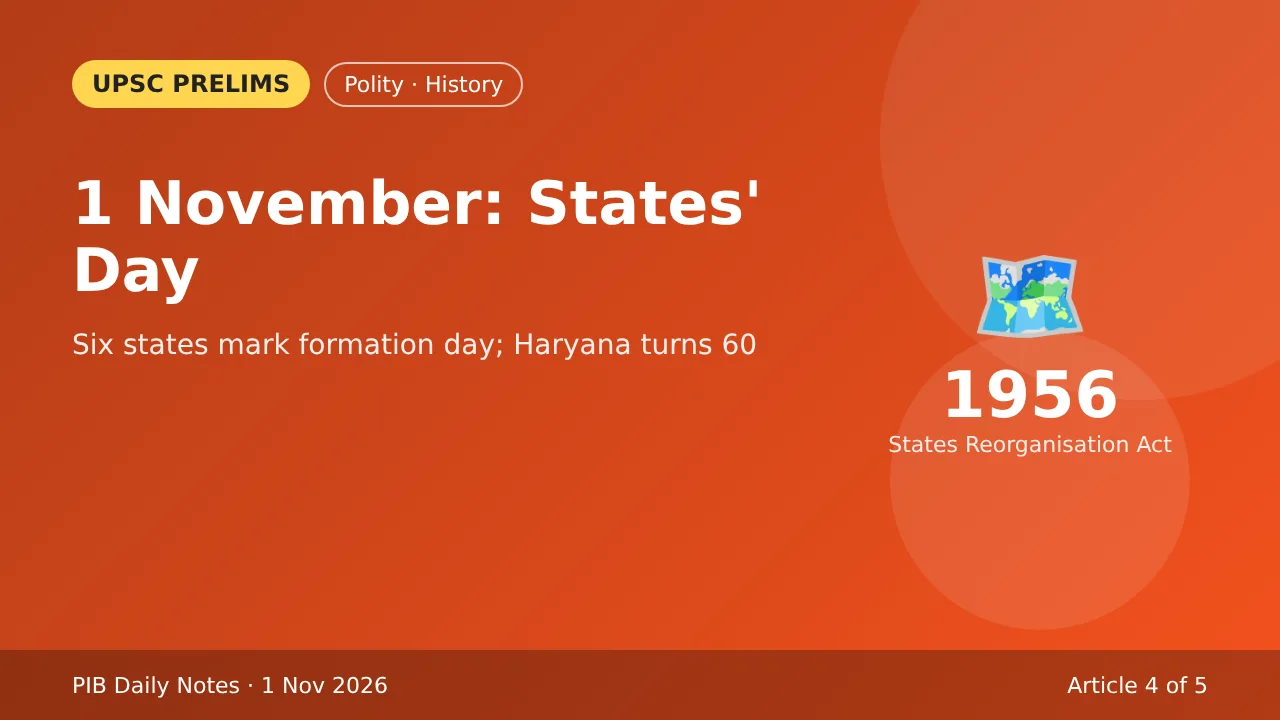
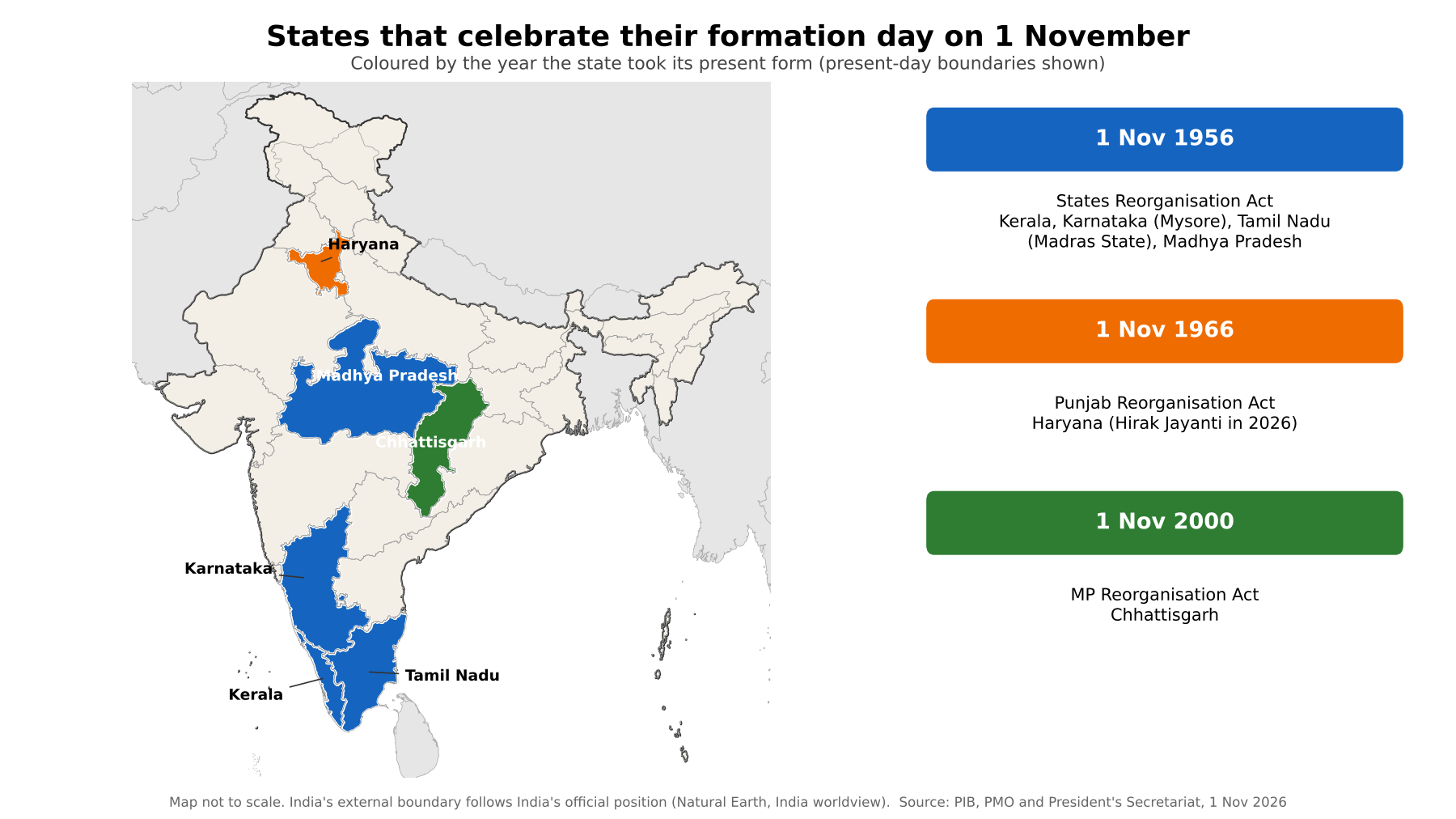
Four of these states trace their present shape to the States Reorganisation Act, 1956, which took effect on 1 November 1956.
Haryana was carved out of Punjab on 1 November 1966, and Chhattisgarh out of Madhya Pradesh on 1 November 2000.
The President recalled that Beti Bachao, Beti Padhao was launched from Panipat in January 2015, and noted Haryana's rise in sex ratio at birth.
The PM's greetings used Keralappiravi for Kerala and Kannada Rajyotsava for Karnataka, the local names of the day.
Prelims Facts & Static Linkages
The road to linguistic states
Dhar Commission (1948): preferred administrative convenience and advised against linguistic states.
JVP Committee (1948–49): Jawaharlal Nehru, Vallabhbhai Patel and Pattabhi Sitaramayya also advised caution.
Andhra State (1 October 1953): the first linguistic state, formed after Potti Sriramulu died following a fast.
States Reorganisation Commission (1953–55): chaired by Fazl Ali, with K. M. Panikkar and H. N. Kunzru as members. It accepted language as a basis but rejected "one language, one state".
1956: the States Reorganisation Act and the 7th Constitutional Amendment ended the Part A, B, C and D classification and created 14 states and 6 Union Territories.
What happened to each state
State
Formed or reshaped
Key fact
Kerala
1 Nov 1956
Travancore-Cochin merged with Malabar
Karnataka
1 Nov 1956
Enlarged Mysore State; renamed Karnataka in 1973
Tamil Nadu
1 Nov 1956
Madras State reshaped; renamed Tamil Nadu in 1969
Madhya Pradesh
1 Nov 1956
Madhya Bharat, Vindhya Pradesh and Bhopal merged
Haryana
1 Nov 1966
Punjab Reorganisation Act, 1966
Chhattisgarh
1 Nov 2000
Madhya Pradesh Reorganisation Act, 2000
How new states are made
Article 3 lets Parliament, by an ordinary law, form new states and change their areas, boundaries or names.
The Bill needs the President's recommendation. The President refers it to the affected state legislature for its views, but Parliament is not bound by them.
Such laws are not amendments under Article 368 (Article 4).
Haryana links
Kurukshetra is linked with the Mahabharata and the Bhagavad Gita.
Panipat saw three famous battles in 1526, 1556 and 1761.
Chandigarh, a Union Territory, is the shared capital of Punjab and Haryana.
Haryana's boundaries were drawn on the advice of the Shah Commission (1966).
Likely Prelims angles
Chronology of linguistic reorganisation, from the Dhar Commission to the 1956 Act.
Members of the Fazl Ali Commission.
The procedure under Articles 3 and 4, and the role of the state legislature.
Old and new names of states, such as Mysore and Madras State.
Lakshadweep, then called the Laccadive, Minicoy and Amindivi Islands, also became a Union Territory on 1 November 1956.
Quick Revision
1 November is the formation day of Kerala, Karnataka, Tamil Nadu, Madhya Pradesh, Haryana and Chhattisgarh.
The States Reorganisation Act, 1956 took effect on 1 November 1956.
The Fazl Ali Commission reported in 1955.
Haryana turned 60 in 2026; Chhattisgarh was formed in 2000.
Mysore became Karnataka in 1973, and Madras State became Tamil Nadu in 1969.
Article 3 needs only a simple majority in Parliament.
Practice MCQ
Q. Which of the following states were formed or reorganised on 1 November 1956?
1. Kerala
2. Haryana
3. Madhya Pradesh
4. Chhattisgarh
Select the correct answer using the code given below:
(a) 1 and 3 only
(b) 2 and 4 only
(c) 1, 2 and 3 only
(d) 1, 3 and 4 only
Answer: (a). Haryana came in 1966 and Chhattisgarh in 2000.
Related PYQs
PYQ 1 (UPSC CSE Prelims 2025)
Consider the following pairs:
State
Description
I. Arunachal Pradesh
The capital is named after a fort, and the State has two National Parks
II. Nagaland
The State came into existence on the basis of a Constitutional Amendment Act
III. Tripura
Initially a Part 'C' State, it became a centrally administered territory with the reorganization of States in 1956 and later attained the status of a full-fledged State
How many of the above pairs are correctly matched?



 28
Nov 2026
 28
Nov 2026
 28
Nov 2026














0 comments
Discussion
No comments yet. Be the first.