Digi Yatra Goes International: Trials at Seven Airports
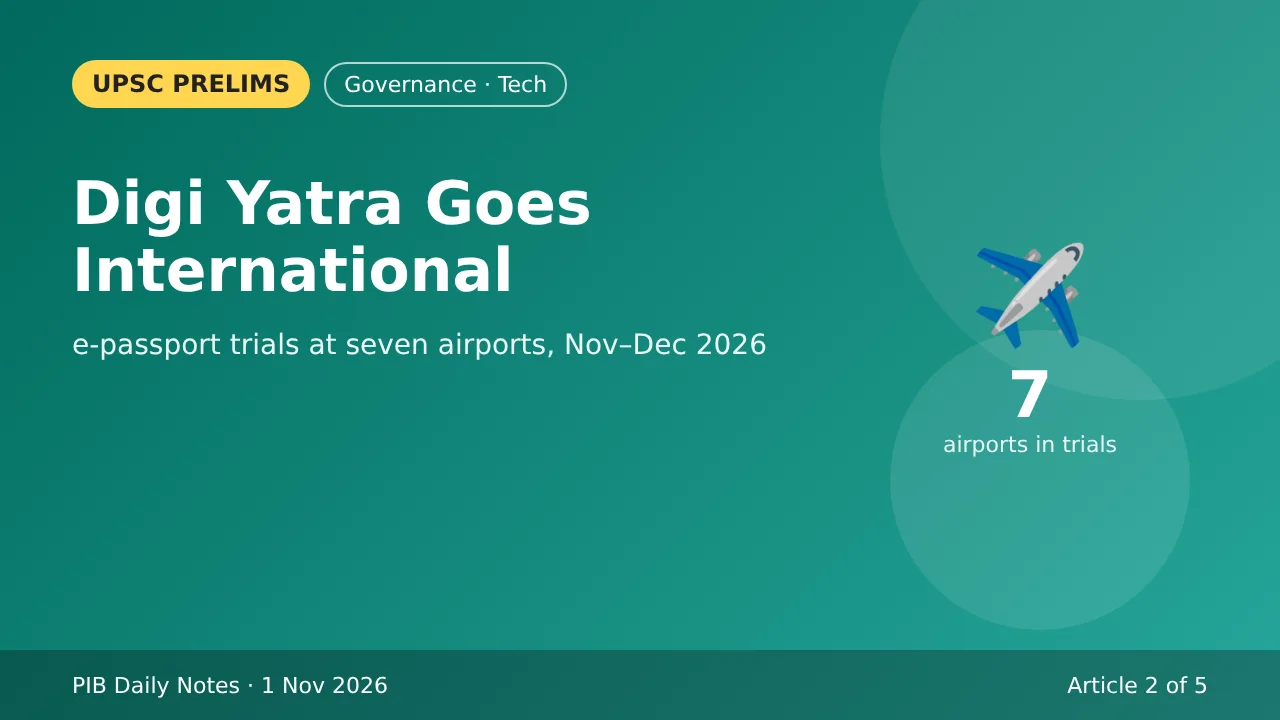
Digi Yatra, India's face-based paperless boarding system, began trials for international passengers at seven airports on 1 November 2026
DDecode Civils
· 3 min read
Digi Yatra Goes International: Trials at Seven Airports
Why in News
Digi Yatra, India's face-based paperless boarding system, began trials for international passengers at seven airports on 1 November 2026. The trials run from November to December 2026, and a wider rollout is planned for 2027.
News Summary
The trials are at Delhi, Bengaluru, Hyderabad, Cochin, Mumbai, Chennai and Amritsar airports.
They are open to Indian nationals holding e-passports on select international flights of Air India and IndiGo.
Passengers can use it at terminal entry, the Security Hold Area and boarding gates, where the equipment is in place.
The facility adds to, and does not replace, existing checks. Passengers must still carry their documents and clear immigration and airline checks.
Digi Yatra has over 26.5 million users and has enabled more than 110 million journeys at 39 domestic airports. Another 25 airports are to be added by 2027.
Prelims Facts & Static Linkages
How a passenger creates an e-passport credential
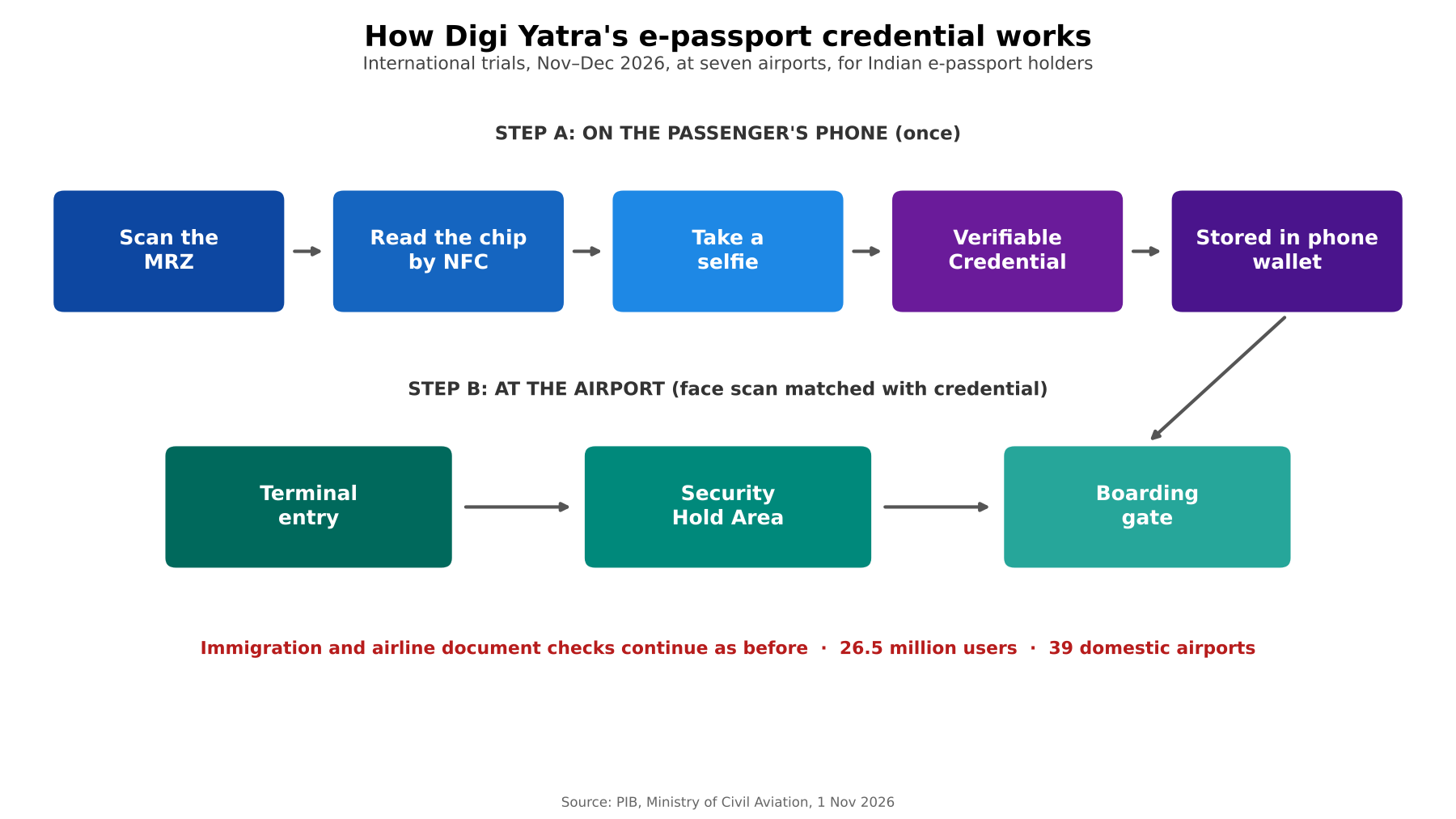
Download the Digi Yatra app and scan the Machine Readable Zone (MRZ) of the e-passport.
Read the passport's embedded chip with the phone's Near Field Communication (NFC) feature.
Take a selfie, which is matched with the photo stored on the chip.
The app issues a Verifiable Credential (VC), stored in the passenger's Digi Yatra wallet on the phone.
At airport touchpoints, a face scan is matched with the credential, so no paper or ID card is needed.
Digi Yatra at a glance
Feature
Detail
Ministry
Ministry of Civil Aviation
Run by
Digi Yatra Foundation, a not-for-profit company
Launched
1 December 2022 at Delhi, Bengaluru and Varanasi
Technology
Facial Recognition Technology (FRT)
Data model
Self-sovereign identity: data stays on the user's phone, not in a central database
Use
Voluntary
Key terms
e-passport: a passport with an embedded electronic chip that holds the holder's personal and biometric details. It follows ICAO standards.
MRZ: the two lines of coded text at the bottom of a passport's data page, read by machines.
NFC: short-range wireless technology that lets a phone read a chip a few centimetres away.
Verifiable Credential: a digitally signed proof of identity that a checker can verify without contacting the issuer each time.
Self-sovereign identity: the user, not the service, holds and controls personal data.
Static linkages
ICAO (International Civil Aviation Organization): a UN specialised agency set up under the Chicago Convention, 1944, with its headquarters in Montreal. It sets global passport and aviation standards.
Airports Authority of India (AAI): a statutory body under the AAI Act, 1994. It is a shareholder in the Digi Yatra Foundation along with major airport operators.
Privacy: the Supreme Court's Puttaswamy judgment (2017) made privacy a fundamental right under Article 21. Personal data is now governed by the Digital Personal Data Protection Act, 2023.
Why it matters
Ease of Flying: fewer queues and faster movement through security and gates.
Digital public infrastructure: builds on India's digital identity model.
Concerns: consent, data security and accuracy of face matching need safeguards.
Quick Revision
International trials began on 1 November 2026 at seven airports.
Only Indian e-passport holders are eligible during the trials.
The credential is made by scanning the MRZ, reading the chip by NFC and taking a selfie.
Data is stored in a wallet on the passenger's phone.
Digi Yatra covers 39 domestic airports with over 26.5 million users.
Immigration checks continue as before.
Practice MCQ
Q. With reference to Digi Yatra, consider the following statements:
1. It is based on Facial Recognition Technology.
2. Under the international trials, it replaces immigration checks for e-passport holders.
3. Passenger credentials are stored in a wallet on the passenger's own device.
Which of the statements given above is/are correct?
(a) 1 only
(b) 1 and 3 only
(c) 2 and 3 only
(d) 1, 2 and 3
Answer: (b). Immigration and other mandatory checks still apply.
Related PYQs
PYQ 1 (UPSC CSE Prelims 2024)
Consider the following airports:
1. Donyi Polo Airport
2. Kushinagar International Airport
3. Vijayawada International Airport
In the recent past, which of the above have been constructed as Greenfield projects?



 28
Nov 2026
 28
Nov 2026
 28
Nov 2026














0 comments
Discussion
No comments yet. Be the first.