Swami Shraddhanand: Centenary of a Reformer's Martyrdom
President Droupadi Murmu attended the Balidan Shatabdi Samaroh of Swami Shraddhanand at the Gurukul, Kurukshetra, on 1 November 2026
DDecode Civils
· 3 min read
Swami Shraddhanand: Centenary of a Reformer's Martyrdom
Why in News
President Droupadi Murmu attended the Balidan Shatabdi Samaroh of Swami Shraddhanand at the Gurukul, Kurukshetra, on 1 November 2026. The event marks the centenary of his martyrdom in 1926.
News Summary
The President traced his journey from Munshiram to Mahatma Munshiram and finally to Swami Shraddhanand.
She said he devoted his life to the Vedas and to social upliftment.
He spoke from the pulpit of Delhi's Jama Masjid with a message of mutual goodwill and national unity.
He saw the removal of untouchability and the upliftment of Dalits as essential to India's progress, and held untouchability to be against Vedic principles.
He revived the Gurukul system of education, a cause championed by Swami Dayanand Saraswati, founder of the Arya Samaj.
Prelims Facts & Static Linkages
Life and work
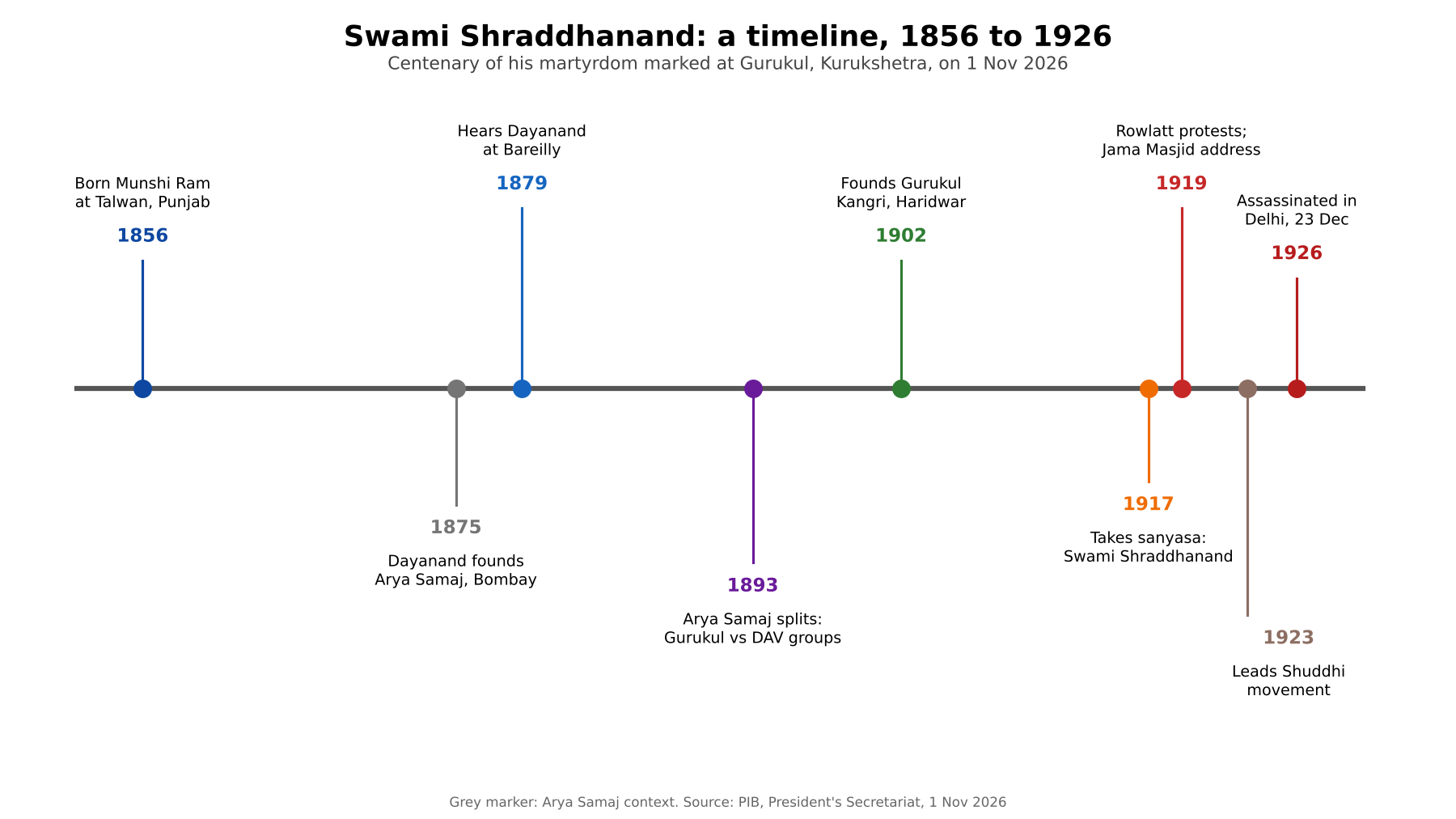
Born as Munshi Ram in 1856 at Talwan in the Jalandhar district of Punjab.
Turned to reform after hearing Dayanand Saraswati at Bareilly in 1879, and joined the Arya Samaj.
When the Punjab Arya Samaj split in 1893, he led the Gurukul (Mahatma) group. The College group of Lala Hansraj ran the DAV institutions.
Founded Gurukul Kangri near Haridwar in 1902. It is now Gurukul Kangri (Deemed to be University).
Took sanyasa in 1917 and became Swami Shraddhanand.
Led protests in Delhi during the Rowlatt Satyagraha (1919) and addressed the Jama Masjid gathering that April.
Chaired the reception committee of the Amritsar session of the Congress in December 1919.
Led the Shuddhi (reconversion) movement in the 1920s.
Was assassinated in Delhi on 23 December 1926.
The Arya Samaj at a glance
Feature
Detail
Founder
Swami Dayanand Saraswati (born Mool Shankar, Tankara, Gujarat)
Founded
1875, Bombay
Key text
Satyarth Prakash (1875)
Slogan
"Go back to the Vedas"
Stand
Against idol worship, caste rigidity, child marriage and untouchability; for women's education and widow remarriage
Gurukul and DAV models compared
Feature
Gurukul (Kangri)
DAV
Leader
Munshi Ram
Lala Hansraj
Medium
Hindi and Sanskrit
English with Vedic values
Aim
Revive ancient residential learning
Blend modern and Vedic education
First institution
Gurukul Kangri, 1902
DAV School, Lahore, 1886
Other reformers against untouchability
Jyotiba Phule: founded the Satyashodhak Samaj in 1873.
Sree Narayana Guru: founded the SNDP Yogam in Kerala in 1903.
B. R. Ambedkar: led the Mahad Satyagraha in 1927.
Gandhi: founded the Harijan Sevak Sangh in 1932, after the Poona Pact.
Why he matters today
Education: the Gurukul model joined Indian languages, moral training and modern subjects, an idea echoed in the National Education Policy, 2020, which stresses learning in the mother tongue.
Social justice: he campaigned for the entry of Dalits into temples, schools and wells. B. R. Ambedkar praised him as a sincere champion of the depressed classes.
National unity: his Jama Masjid address in 1919 is remembered as a rare moment of Hindu–Muslim solidarity during the Rowlatt protests.
Likely Prelims angles
Matching reformers with the organisations they founded.
The Gurukul and DAV split in the Arya Samaj.
Events of 1919: the Rowlatt Act, Jallianwala Bagh and the Amritsar Congress.
Quick Revision
Swami Shraddhanand was born Munshi Ram in 1856.
He founded Gurukul Kangri near Haridwar in 1902.
He became Swami Shraddhanand in 1917.
He addressed the Jama Masjid gathering during the 1919 Rowlatt protests.
He was assassinated in Delhi on 23 December 1926.
The Arya Samaj was founded by Dayanand Saraswati in Bombay in 1875.
Practice MCQ
Q. With reference to Swami Shraddhanand, consider the following statements:
1. He founded the Gurukul at Kangri near Haridwar.
2. He founded the Arya Samaj in 1875.
3. He was associated with the Shuddhi movement.
Which of the statements given above is/are correct?
(a) 1 only
(b) 1 and 3 only
(c) 2 and 3 only
(d) 1, 2 and 3
Answer: (b). The Arya Samaj was founded by Swami Dayanand Saraswati.
Related PYQs
PYQ 1 (UPSC CSE Prelims 2025)
Subsequent to which one of the following events, Gandhiji, who consistently opposed untouchability and appealed for its eradication from all spheres, decided to include the upliftment of 'Harijans' in his political and social programme?
(a) The Poona Pact
(b) The Gandhi-Irwin Agreement (Delhi Pact)
(c) Arrest of Congress leadership at the time of the Quit India Movement
(d) Promulgation of the Government of India Act, 1935



 28
Nov 2026
 28
Nov 2026
 28
Nov 2026














0 comments
Discussion
No comments yet. Be the first.