Aditya-L1's VELC Shows a Solar Eruption Expanding Unevenly
The team studied the CME of 5 August 2024, launched from an active region near the Sun's western limb.
DDecode Civils
· 4 min read
Aditya-L1's VELC Shows a Solar Eruption Expanding Unevenly
Why in News
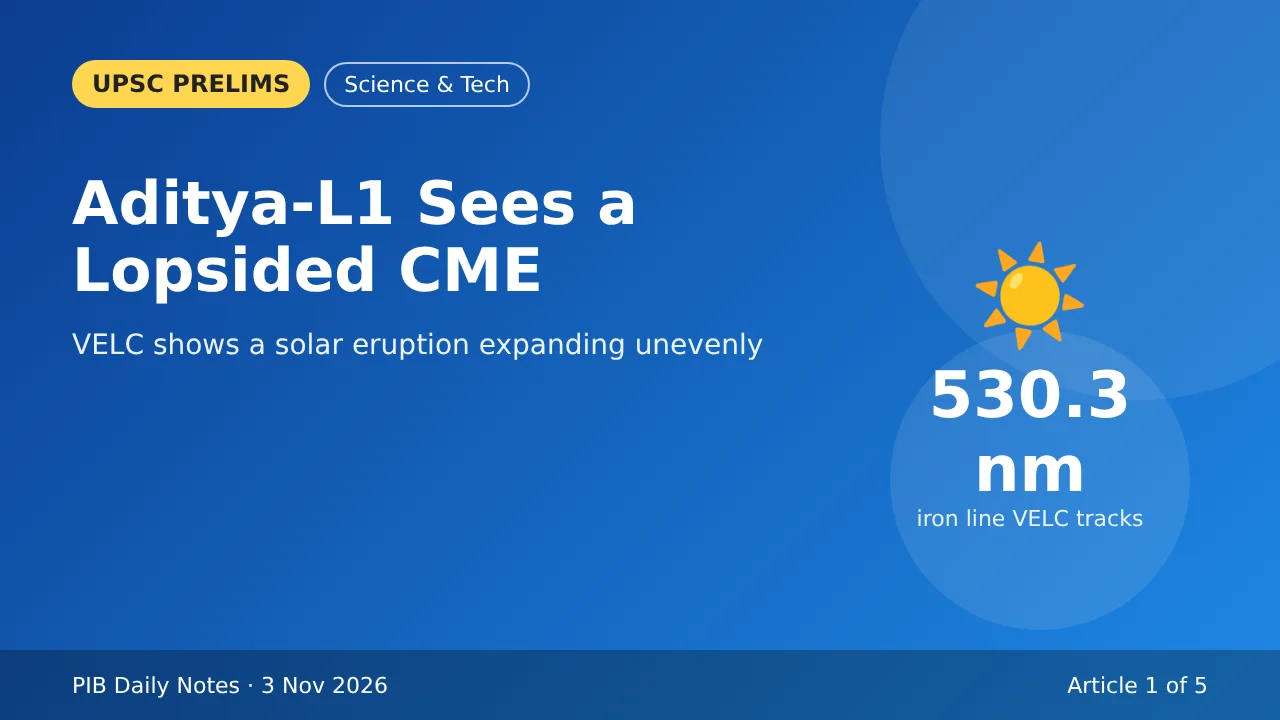
Scientists of the Indian Institute of Astrophysics (IIA), Bengaluru, an autonomous institute of the Department of Science and Technology (DST), used the Visible Emission Line Coronagraph (VELC) on Aditya-L1 to show that a coronal mass ejection (CME) did not expand like a simple, symmetric bubble. It grew unevenly and took an asymmetric shape. The study appeared in The Astrophysical Journal Letters.
News Summary
The team studied the CME of 5 August 2024, launched from an active region near the Sun's western limb.
VELC data were combined with images from the Atmospheric Imaging Assembly (AIA) on NASA's Solar Dynamics Observatory (SDO) and with 3-D modelling.
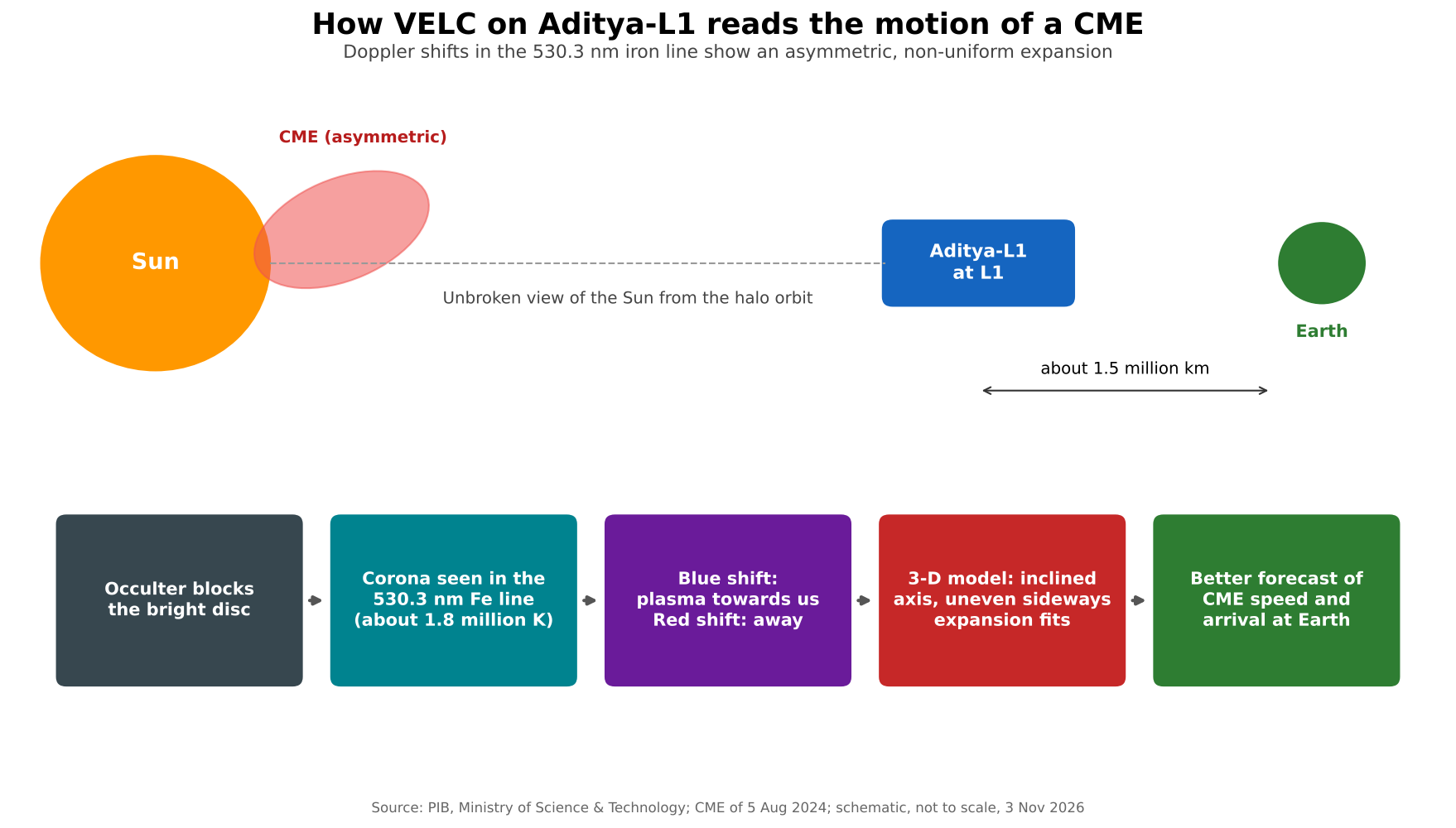
VELC recorded two branches of emission: one blue-shifted (plasma moving towards us) and one red-shifted (plasma moving away).
A model with symmetric expansion could not reproduce this pattern. A model with an inclined CME axis and uneven sideways expansion did.
The shape of an early CME affects the drag it meets in the solar wind, and so its speed and arrival time at Earth.
The method can track CME motion along the line of sight without multi-spacecraft imaging.
Prelims Facts & Static Linkages
How VELC reads a CME
A coronagraph blocks the bright solar disc so that the faint corona can be seen. VELC is internally occulted, meaning the blocking happens inside the telescope.
VELC studies the 530.3 nm green emission line of highly ionised iron atoms in the corona.
This line traces hot coronal plasma at about 1.8 million Kelvin.
The Doppler shift of the line gives the plasma's speed towards or away from the observer.
VELC was built at IIA's MGK Menon Lab for Space Sciences, CREST campus, Hosakote, with ISRO support.
Aditya-L1 at a glance
Feature
Detail
Launch
2 September 2023, PSLV-C57, Sriharikota
Orbit
Halo orbit around the Sun–Earth L1 point, reached January 2024
Distance
About 1.5 million km from Earth, roughly 1% of the Earth–Sun distance
In-situ:ASPEX and PAPA (solar wind particles) and a magnetometer.
Key concepts to revise
Lagrange points: five points where the pull of two large bodies balances a small object's orbital motion. L1 gives an unbroken view of the Sun, with no eclipses.
Corona: the Sun's outer atmosphere, far hotter than the surface (about 5,500°C), a puzzle called the coronal heating problem.
CME: a huge cloud of magnetised plasma thrown out from the corona. CMEs can trigger geomagnetic storms and auroras.
Space weather can disturb satellites, GPS, radio links and power grids.
Blue shift means a source is moving towards the observer. Red shift means it is moving away.
Likely Prelims angles
Payload and institute matches, such as VELC with IIA and SUIT with IUCAA.
Why L1 suits a solar observatory.
IIA runs the Kodaikanal Solar Observatory and Vainu Bappu Observatory, Kavalur.
Quick Revision
VELC on Aditya-L1 showed that the 5 August 2024 CME expanded asymmetrically.
VELC uses the 530.3 nm iron line to measure Doppler shifts.
Aditya-L1 is India's first space-based solar observatory, at L1.
VELC is the primary payload of seven.
A CME's shape affects its speed and arrival time at Earth.
Practice MCQ
Q. With reference to the Aditya-L1 mission, consider the following statements:
1. It is placed in a halo orbit around the Sun–Earth L1 point.
2. Its primary payload, VELC, was developed by the Indian Institute of Astrophysics.
3. From L1, the spacecraft's view of the Sun is blocked by the Earth for part of every year.
Which of the statements given above are correct?
(a) 1 and 2 only
(b) 2 and 3 only
(c) 1 and 3 only
(d) 1, 2 and 3
Answer: (a). L1 gives an uninterrupted view of the Sun, without eclipses.
Related PYQs
PYQ 1 (UPSC CSE Prelims 2025)
Consider the following statements:
Statement I: Scientific studies suggest that a shift is taking place in the Earth's rotation and axis.
Statement II: Solar flares and associated coronal mass ejections bombarded the Earth's outermost atmosphere with tremendous amount of energy.
Statement III: As the Earth's polar ice melts, the water tends to move towards the equator.
Which one of the following is correct in respect of the above statements?
(a) Both Statement II and Statement III are correct and both of them explain Statement I
(b) Both Statement II and Statement III are correct but only one of them explains Statement I
(c) Only one of the Statements II and III is correct and that explains Statement I
(d) Neither Statement II nor Statement III is correct



 28
Nov 2026
 28
Nov 2026
 28
Nov 2026














0 comments
Discussion
No comments yet. Be the first.