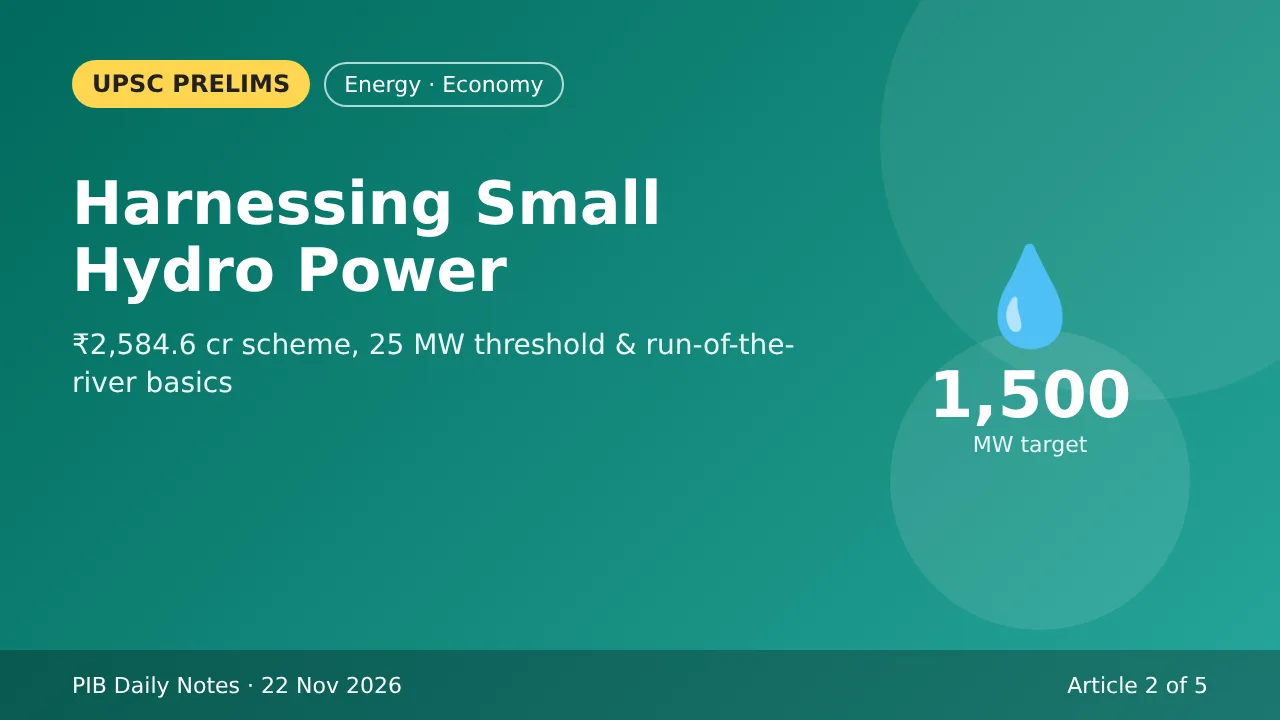
PIB released a backgrounder on Small Hydro Power (SHP) after the approval of the SHP Development Scheme (FY 2026-27 to 2030-31).
DDecode Civils
· 4 min read
Harnessing Small Hydro Power
Why in News
PIB released a backgrounder on Small Hydro Power (SHP) after the approval of the SHP Development Scheme (FY 2026-27 to 2030-31).
News Summary
Outlay: ₹2,584.60 crore. Target: about 1,500 MW of new capacity.
Priority areas: hilly, North-Eastern and border regions.
Central support:
NE states and international border districts: ₹3.6 crore/MW or 30% of project cost, whichever is lower (cap ₹30 crore per project).
Other areas: up to 20% of project cost (cap ₹20 crore per project).
DPR support for at least 200 projects (₹30 crore set aside).
Expected outcomes: about ₹15,000 crore of investment and 51 lakh person-days of employment.
Prelims Facts & Static Linkages
Parameter
Small hydro
Large hydro
Capacity
Up to 25 MW
Above 25 MW
Nodal ministry
MNRE
Ministry of Power
Renewable status
Always counted as renewable
Declared renewable in March 2019
Potential (as of 30 Sep 2026)
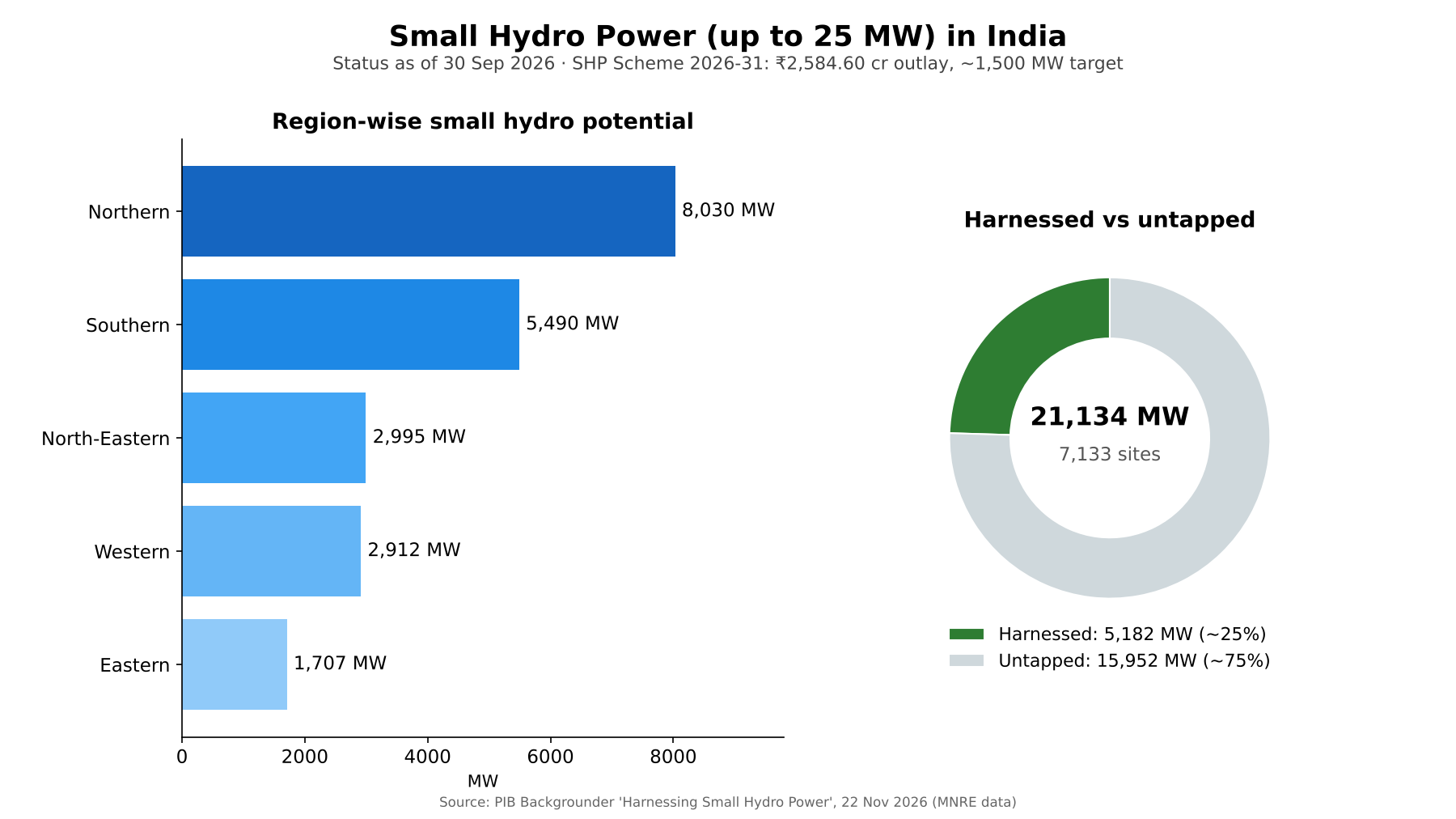
Total: 21,134 MW across 7,133 sites
Harnessed: about 5,182 MW (~25%)
Highest state potential: Karnataka (3,726 MW), then Himachal Pradesh (3,460 MW) and Arunachal Pradesh (2,065 MW), the largest in the North-East
Related concept: Pumped-storage hydropower. Water is pumped uphill when power is surplus and released through turbines at peak demand. It works as long-duration storage that balances solar and wind power.
Benefits and challenges
Benefits
Challenges
Decentralised power close to where it is used, so lower transmission losses
Seasonal swings in river flow
Needs no fuel and emits nothing
Difficult terrain and access roads
Little land needed and little displacement
High cost per MW and delays in clearances
Local jobs in remote and border areas
Weak grid links in the North-East
Global link: hydropower is the world's largest source of renewable electricity. India's commitments under its updated NDC include 50% of installed power capacity from non-fossil sources by 2030 and the Panchamrit target of 500 GW of non-fossil capacity by 2030.
Likely Prelims angles
The 25 MW threshold and which ministry handles which projects
Run-of-the-river versus storage projects
Which state has the highest SHP potential (Karnataka)
Hydro projects India supports in its neighbourhood, such as Mangdechhu, Punatsangchhu and Chukha in Bhutan
Small hydro means up to 25 MW and falls under MNRE.
India has 21,134 MW of potential, and about a quarter of it is harnessed.
Karnataka has the largest potential. Arunachal Pradesh leads the North-East.
North-Eastern and border projects get support of 30% of project cost or ₹3.6 crore/MW, whichever is lower.
Large hydro has been classed as renewable since March 2019.
Hydropower Purchase Obligations (HPO) were added to the Renewable Purchase Obligation framework in 2019, so distribution companies must buy a set share of hydropower.
Practice MCQ
Q. With reference to Small Hydro Power in India, consider the following statements:
Projects up to 25 MW are administered by the Ministry of Power.
Run-of-the-river projects need large storage reservoirs.
Which of the above is/are correct? (a) 1 only (b) 2 only (c) Both 1 and 2 (d) Neither 1 nor 2
Answer: (d). These projects fall under MNRE, and run-of-the-river projects avoid large reservoirs.
Related PYQs
PYQ 1 (UPSC CSE Prelims 2024)
Recently, the term "pumped-storage hydropower" is actually and appropriately discussed in the context of which one of the following?
(a) Irrigation of terraced crop fields
(b) Lift irrigation of cereal crops
(c) Long duration energy storage
(d) Rainwater harvesting system
Answer: (c)
PYQ 2 (UPSC CSE Prelims 2025)
Consider the following statements about 'PM Surya Ghar Muft Bijli Yojana':
I. It targets installation of one crore solar rooftop panels in the residential sector.
II. The Ministry of New and Renewable Energy aims to impart training on installation, operation, maintenance and repairs of solar rooftop systems at grassroot levels.
III. It aims to create more than three lakhs skilled manpower through fresh skilling, and up-skilling, under scheme component of capacity building.
Which of the statements given above are correct?
(a) I and II only
(b) I and III only
(c) II and III only
(d) I, II and III
Answer: (d). All three match the scheme guidelines.
PYQ 3 (UPSC CSE Prelims 2026)
Match List I with List II and select the answer using the code given below the Lists:
List I (Project Supported by India)
List II (Country)
A. Mangdechhu Hydroelectric Project
1. Maldives
B. Restoration of Stor Palace
2. Afghanistan
C. District Hospital at Dickoya
3. Bhutan
D. Institute of Security and Law Enforcement Studies



 23
Nov 2026
 23
Nov 2026
 23
Nov 2026














0 comments
Discussion
No comments yet. Be the first.