At Bharat Mandapam, the Lok Sabha Speaker called for a Jan Andolan to keep the Yamuna clean
DDecode Civils
· 4 min read
People's Movement to Clean the Yamuna
Why in News
At Bharat Mandapam, the Lok Sabha Speaker called for a Jan Andolan to keep the Yamuna clean and flowing (nirmal and aviral). He spoke at a national campaign organised by the Yamuna Parivar Council.
News Summary
Called for scientific treatment of sewage and industrial waste before it enters the river.
Said that development must not come at the cost of the environment.
Promoted lifestyle-based action, such as "Ek Ped Maa Ke Naam" (launched on 5 June 2024).
Called for basin-wide management: rainwater harvesting, groundwater recharge, protecting tributaries and catchments.
Prelims Facts & Static Linkages
Fact
Detail
Length
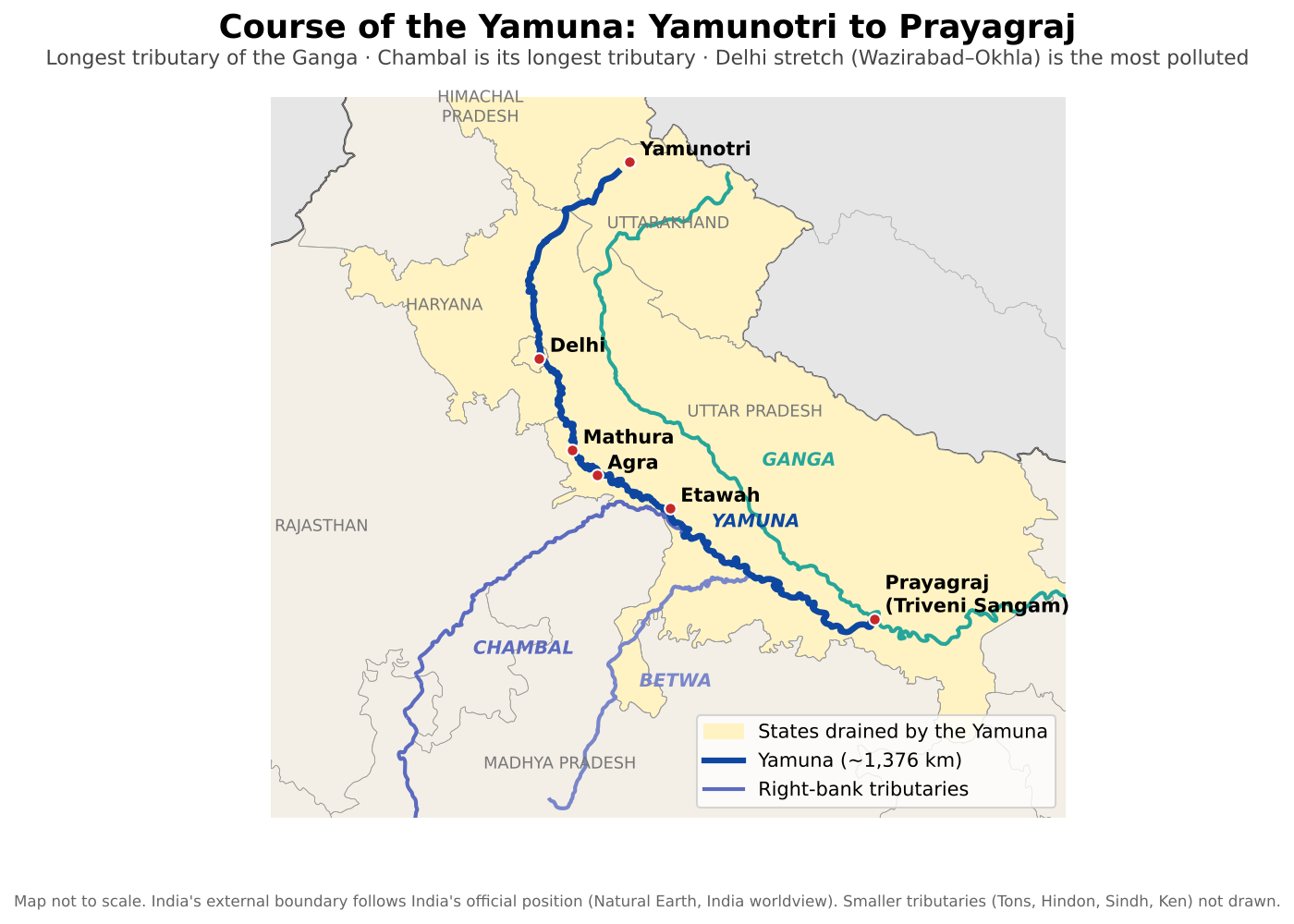
About 1,376 km; the longest tributary of the Ganga
Chambal (Gandhi Sagar, Rana Pratap Sagar, Jawahar Sagar and Kota Barrage are on it)
Largest Himalayan tributary
Tons
Programmes
Yamuna Action Plan (from 1993, with Japanese/JICA support); Namami Gange, run by the NMCG
Why the Yamuna is polluted
Untreated sewage from Delhi drains, mainly the Najafgarh and Shahdara drains
Low environmental flow, because water is taken out at the Hathnikund and Wazirabad barrages
Industrial effluents from clusters in Haryana, Delhi and UP
Floodplain encroachment and solid waste
Key concepts to revise
Aviral means uninterrupted flow (e-flows). Nirmal means unpolluted water.
BOD (Biochemical Oxygen Demand): a high BOD means less dissolved oxygen in the water. The Yamuna's Delhi stretch often shows near-zero dissolved oxygen.
Toxic foam at Okhla and Kalindi Kunj comes from surfactants and phosphates in untreated sewage.
Legal angle: in 2017 the Uttarakhand High Court declared the Ganga and the Yamuna "living entities". The Supreme Court stayed that order the same year.
Institutions: the Upper Yamuna River Board shares water among five basin states. The National Green Tribunal has set up committees to monitor Yamuna cleanup.
Likely Prelims angles: arranging the Yamuna's tributaries in order (Chambal, Sindh, Betwa, Ken from west to east), the source glacier, the cities on its banks (Delhi, Mathura, Agra, Etawah), and Ganga tributaries joining from the north versus the south.
Quick Revision
The Yamuna rises at the Yamunotri Glacier (Bandarpunch range) and joins the Ganga at Prayagraj.
Chambal is its longest tributary, and Tons is its largest Himalayan tributary.
Its right-bank tributaries, from west to east, are Chambal, Sindh, Betwa and Ken.
Delhi's Wazirabad–Okhla stretch carries most of the river's pollution load.
The Yamuna Action Plan began in 1993 with Japanese assistance.
The Hathnikund Barrage in Haryana diverts Yamuna water into the Western and Eastern Yamuna Canals, which cuts the river's lean-season flow downstream.
Namami Gange was launched in 2014. NMCG is registered as a society, and the National Ganga Council is chaired by the Prime Minister.
Practice MCQ
Q. Which one of the following is NOT a right-bank tributary of the Yamuna? (a) Chambal (b) Betwa (c) Hindon (d) Ken
Answer: (c). The Hindon joins from the left bank.
Related PYQs
PYQ 1 (UPSC CSE Prelims 2024)
With reference to the Himalayan rivers joining the Ganga downstream of Prayagraj from West to East, which one of the following sequences is correct?
(a) Ghaghara – Gomati – Gandak – Kosi
(b) Gomati – Ghaghara – Gandak – Kosi
(c) Ghaghara – Gomati – Kosi – Gandak
(d) Gomati – Ghaghara – Kosi – Gandak
Answer: (b)
PYQ 2 (UPSC CSE Prelims 2026)
Consider the following assertion: In the Pleistocene period either the Yamuna once flowed into the Indus, or the Sutlej flowed into the Yamuna and one major tributary of either had shifted from the Ganga to the Indus or vice versa.
Which of the following is/are the basis of the above assertion?
The Nadi-Sukta of the Rigveda
The explorations of the Sutlej and the Yamuna by Robert Bruce Foote
The presence of the same species of dolphins in both the Indus and the Ganga river systems
Select the answer using the code given below:
(a) 1 only
(b) 2 only
(c) 1 and 2
(d) 3
PYQ 3 (UPSC CSE Prelims 2026)
Identify the river of the Indian sub-continent on the basis of the following information:
It has an antecedent drainage system.
It flows through three countries.
It originates in the Tibetan Plateau and is an important river for irrigation.
It does not form distributaries.
Select the answer from the following:
(a) Brahmaputra
(b) Indus
(c) Sutlej
(d) Teesta
Answer: (c). The Sutlej rises near Rakas Tal in Tibet, flows through China, India and Pakistan, and joins the Chenab, so it forms no distributaries.



 23
Nov 2026
 23
Nov 2026
 23
Nov 2026














0 comments
Discussion
No comments yet. Be the first.