Commerce Minister met tea industry stakeholders at Kurseong (Darjeeling) in a meeting organised by the Tea Board India
DDecode Civils
· 3 min read
Revitalising Darjeeling Tea and Tea Exports
Why in News
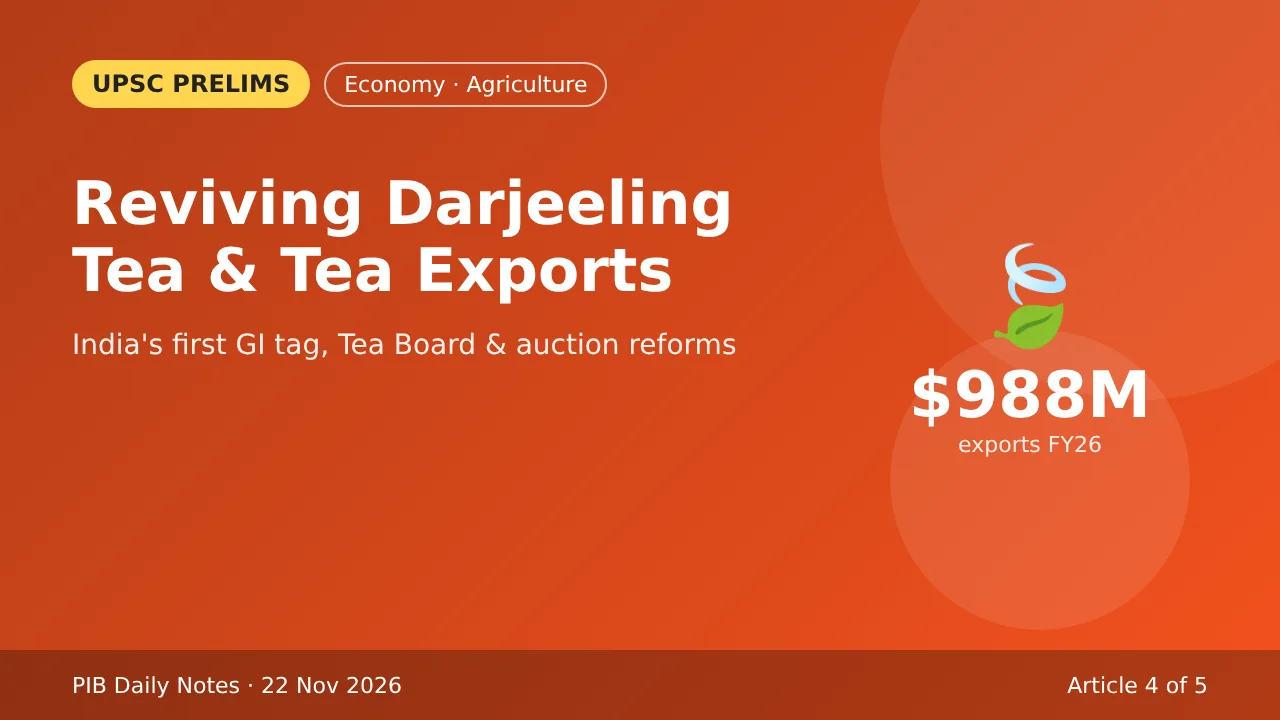
The Union Commerce Minister met tea industry stakeholders at Kurseong (Darjeeling) in a meeting organised by the Tea Board India. They discussed reviving Darjeeling tea, reforming tea auctions and raising exports.
News Summary
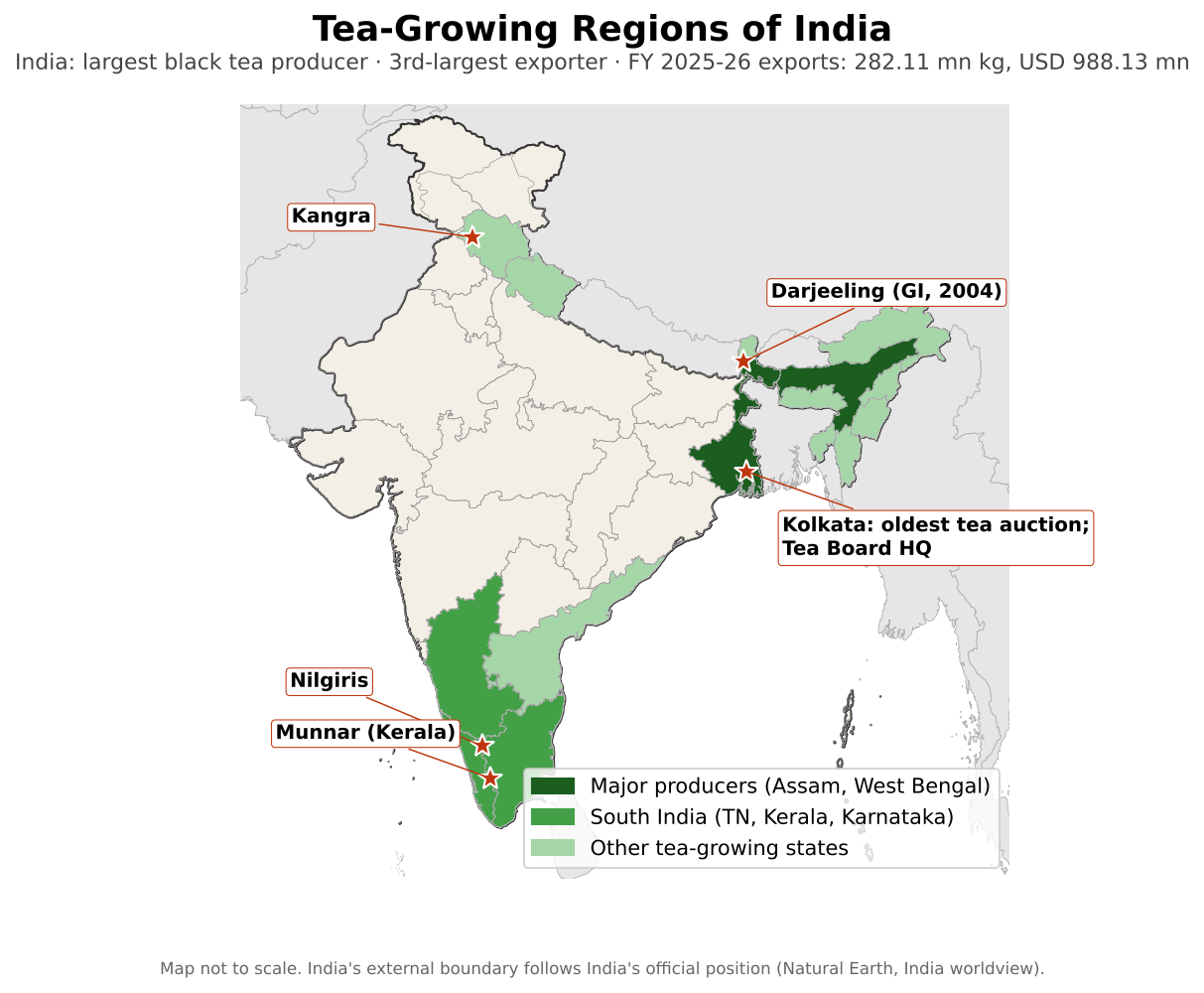
India is the world's largest producer of black tea and the 3rd-largest tea exporter.
FY 2025-26 exports: 282.11 million kg, worth USD 988.13 million.
Agenda:
Faster, more transparent tea auction system
Ease of Doing Business across the value chain
Export push under the Export Promotion Mission (EPM)
Tea research services extended to small tea growers
Worker welfare through the Pradhan Mantri Cha Shramik Protsahan Yojana (PMCSPY), focused on women workers and their children in West Bengal
Prelims Facts & Static Linkages
Item
Fact
Tea Board
Statutory body under the Tea Act, 1953; Ministry of Commerce; HQ Kolkata
Darjeeling Tea
India's first GI-tagged product (2004-05)
Top producing states
Assam, then West Bengal
World position
2nd-largest tea producer overall (after China)
Growing conditions
Temperature 20–30 °C + Rainfall 150–300 cm, evenly spread │ Well-drained, slightly acidic, humus-rich soil on slopes (no waterlogging) │ Labour-intensive plucking ──► Processing: CTC / Orthodox / Green
Darjeeling tea is mostly orthodox; Assam produces mainly CTC.
Kolkata has the oldest tea auction centre. Other auction centres include Guwahati, Siliguri, Kochi, Coonoor and Coimbatore.
Major tea regions of India
Region
Areas
North-East
Assam (Brahmaputra and Barak valleys), Tripura, Arunachal Pradesh
West Bengal
Darjeeling hills, Dooars, Terai
South India
Nilgiris (Tamil Nadu), Munnar and Wayanad (Kerala), Karnataka
Cheaper Nepali tea sold under the "Darjeeling" name, which dilutes the GI
Climate stress: erratic rainfall and pests
Low wages for workers and estates being closed or abandoned
Export snapshot: the main buyers of Indian tea include the UAE, Russia, Iraq, Iran, the USA and the UK. India's main competitors in exports are Kenya, China and Sri Lanka. Tea is also covered under the Plantations Labour Act, 1951, which now falls under the new Labour Codes.
Likely Prelims angles: GI-tagged teas (Darjeeling, Assam Orthodox, Nilgiri Orthodox, Kangra), the difference between CTC and Orthodox processing, and the statutory status of the Tea Board.
Quick Revision
India is the largest producer of black tea and the 3rd-largest tea exporter.
Darjeeling Tea was India's first GI-tagged product.
The Tea Board was set up under the Tea Act, 1953. It is headquartered in Kolkata and works under the Ministry of Commerce.
Tea needs 150–300 cm of evenly spread rain and well-drained, acidic soil on slopes.
PMCSPY supports tea workers' welfare, especially women workers and their children, in West Bengal.
CTC (Crush, Tear, Curl) gives strong, quick-brewing tea for the mass market. Orthodox processing keeps the leaf whole and gives a premium, aromatic tea such as Darjeeling.
Practice MCQ
Q. Consider the following statements about tea in India:
Assam is the largest tea-producing state.
Tea grows best on flat, waterlogged land.
The Tea Board is a statutory body.
Which of the above are correct? (a) 1 and 2 only (b) 1 and 3 only (c) 2 and 3 only (d) 1, 2 and 3
Answer: (b). Tea needs good drainage, so waterlogged land does not suit it.
Related PYQs
PYQ 1 (UPSC CSE Prelims 2022)
Consider the following States:
Andhra Pradesh
Kerala
Himachal Pradesh
Tripura
How many of the above are generally known as tea-producing States?



 23
Nov 2026
 23
Nov 2026
 23
Nov 2026














0 comments
Discussion
No comments yet. Be the first.