Bal Vivah Mukt Bharat: Two Years of the Campaign Against Child Marriage
A PIB Backgrounder released on 6 November 2026 reviewed Bal Vivah Mukt Bharat (BVMB), the national campaign against child marriage
DDecode Civils
· 4 min read
Bal Vivah Mukt Bharat: Two Years of the Campaign Against Child Marriage
Why in News
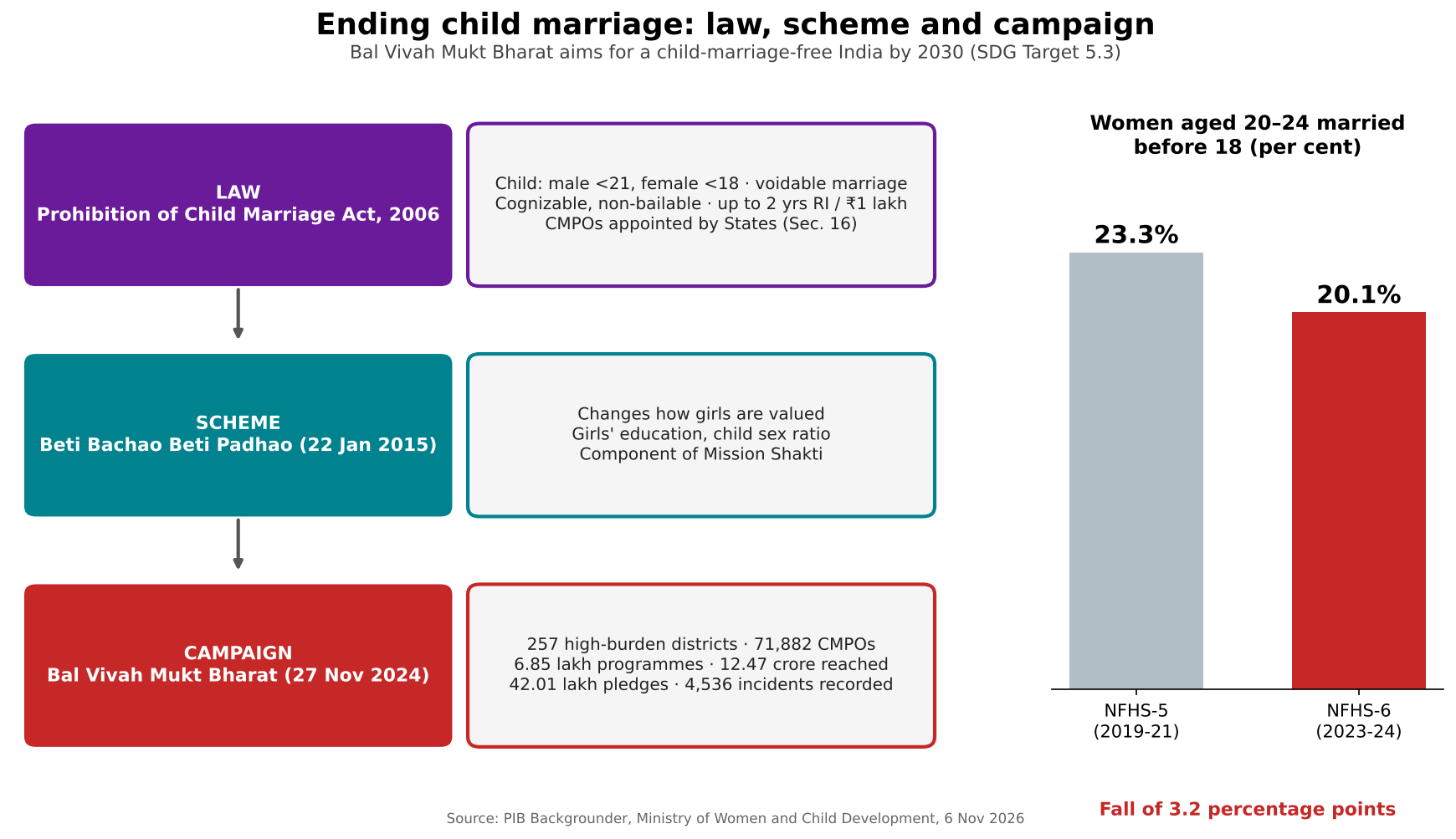
A PIB Backgrounder released on 6 November 2026 reviewed Bal Vivah Mukt Bharat (BVMB), the national campaign against child marriage, as it nears two years (launched 27 November 2024). The share of women aged 20–24 married before 18 fell from 23.3% in NFHS-5 (2019-21) to 20.1% in NFHS-6 (2023-24).
News Summary
BVMB was launched by the Ministry of Women and Child Development (MWCD), which fully funds it. The goal is a child-marriage-free India by 2030, in line with SDG Target 5.3.
Priority goes to 257 high-burden districts, where NFHS-5 prevalence was at or above the national average.
Reach so far:6.85 lakh awareness programmes, 12.47 crore participants and 42.01 lakh pledges (40.96 lakh on the BVMB Portal and 1.05 lakh on MyGov).
71,882 Child Marriage Prohibition Officers (CMPOs) are listed on the portal, 59,686 of them at the Gram Panchayat level. 4,536 incidents have been recorded.
A 100-Day Intensive Awareness Campaign (27 November 2025 to 8 March 2026) ran in three spells: schools and colleges, then faith leaders and wedding service providers, then Panchayats and wards passing child-marriage-free resolutions.
Prelims Facts & Static Linkages
Prohibition of Child Marriage Act, 2006 (PCMA)
It replaced the Child Marriage Restraint Act, 1929 (Sarda Act), moving from restraining to prohibiting child marriage.
Child: a male below 21 years or a female below 18 years.
Status: a child marriage is voidable at the option of the party who was a child (petition to the District Court, generally within two years of attaining majority). It is void where the child was trafficked, taken by force or deceit, or used for immoral purposes.
Offences are cognizable and non-bailable. Punishment is rigorous imprisonment up to 2 years and/or a fine up to ₹1 lakh. Women offenders are not liable to imprisonment.
Relief: maintenance, residence and custody, and children of such marriages remain legitimate.
Prevention:Judicial Magistrates can issue injunctions to stop an impending marriage. Section 16 lets State Governments appoint CMPOs.
Three layers of the response
Layer
Instrument
Role
Law
PCMA, 2006
Prohibits, punishes, gives relief
Scheme
Beti Bachao Beti Padhao (22 January 2015)
Changes how girls are valued; part of Mission Shakti
Campaign
BVMB (27 November 2024)
Community action, CMPO access, reporting
Supreme Court framework (October 2024)
In Society for Enlightenment and Voluntary Action v. Union of India, the Court asked States and UTs for dedicated, full-time CMPOs, special units, training and databases of at-risk areas.
The judgment shifts the focus from punishment to prevention, protection and empowerment.
Likely Prelims angles
Age limits under the PCMA, and the difference between void and voidable marriages.
Who appoints CMPOs (State Governments).
Akshaya Tritiya as a high-risk period for mass marriages.
The Prohibition of Child Marriage (Amendment) Bill, 2021, which proposed raising the age for women to 21, lapsed with the dissolution of the 17th Lok Sabha.
Quick Revision
BVMB was launched by MWCD on 27 November 2024 for a child-marriage-free India by 2030.
Prevalence among women aged 20–24 fell from 23.3% (NFHS-5) to 20.1% (NFHS-6).
PCMA 2006 replaced the Sarda Act of 1929.
Offences are cognizable and non-bailable, with up to 2 years' rigorous imprisonment.
The portal is stopchildmarriage.wcd.gov.in.
Practice MCQ
Q. With reference to the Prohibition of Child Marriage Act, 2006, consider the following statements:
1. Every child marriage under the Act is void from the beginning.
2. Offences under the Act are cognizable and non-bailable.
3. Child Marriage Prohibition Officers are appointed by the State Government.
Which of the statements given above is/are correct?
(a) 1 and 2 only
(b) 2 and 3 only
(c) 1 and 3 only
(d) 1, 2 and 3
Answer: (b). A child marriage is generally voidable at the option of the child party; it is void only in specified cases such as trafficking or force.
Related PYQs
PYQ 1 (UPSC CSE Prelims 2024)
With reference to the 'Pradhan Mantri Surakshit Matritva Abhiyan', consider the following statements:
1. This scheme guarantees a minimum package of antenatal care services to women in their second and third trimesters of pregnancy and six months post-delivery health care service in any government health facility.
2. Under this scheme, private sector health care providers of certain specialities can volunteer to provide services at nearby government health facilities.
Which of the statements given above is/are correct?



 28
Nov 2026
 28
Nov 2026
 28
Nov 2026














0 comments
Discussion
No comments yet. Be the first.