Ban on Islamic Research Foundation Extended under UAPA
MHA extended the ban on the Islamic Research Foundation (IRF), led by Zakir Naik
DDecode Civils
· 3 min read
Ban on Islamic Research Foundation Extended under UAPA
Why in News
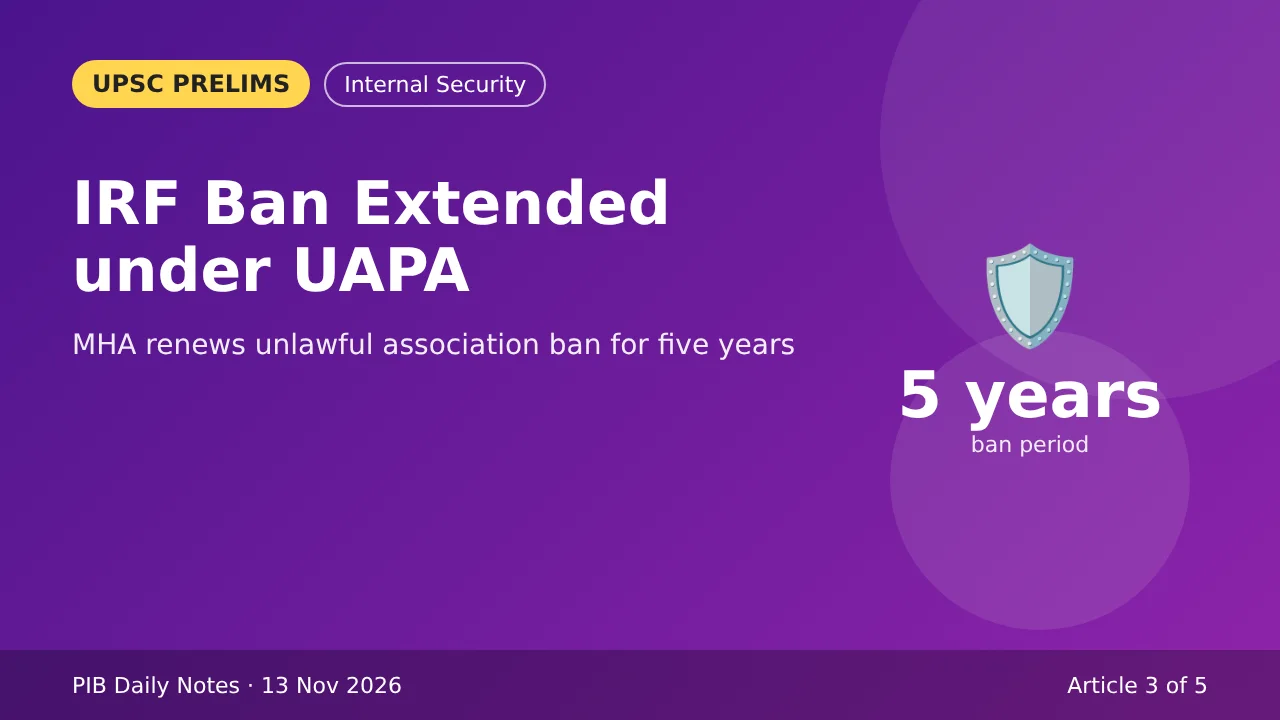
The Ministry of Home Affairs (MHA) extended the ban on the Islamic Research Foundation (IRF), led by Zakir Naik, as an unlawful association under the Unlawful Activities (Prevention) Act (UAPA), 1967.
News Summary
The MHA said the group was promoting terrorism and separatism, inciting communal hatred and encouraging the regrouping of absconding terrorists.
The extension follows the government's stated policy of zero tolerance towards terrorism.
IRF was first banned in 2016, and the ban was renewed in 2021. This is the second five-year extension.
Prelims Facts & Static Linkages
How a ban under UAPA works
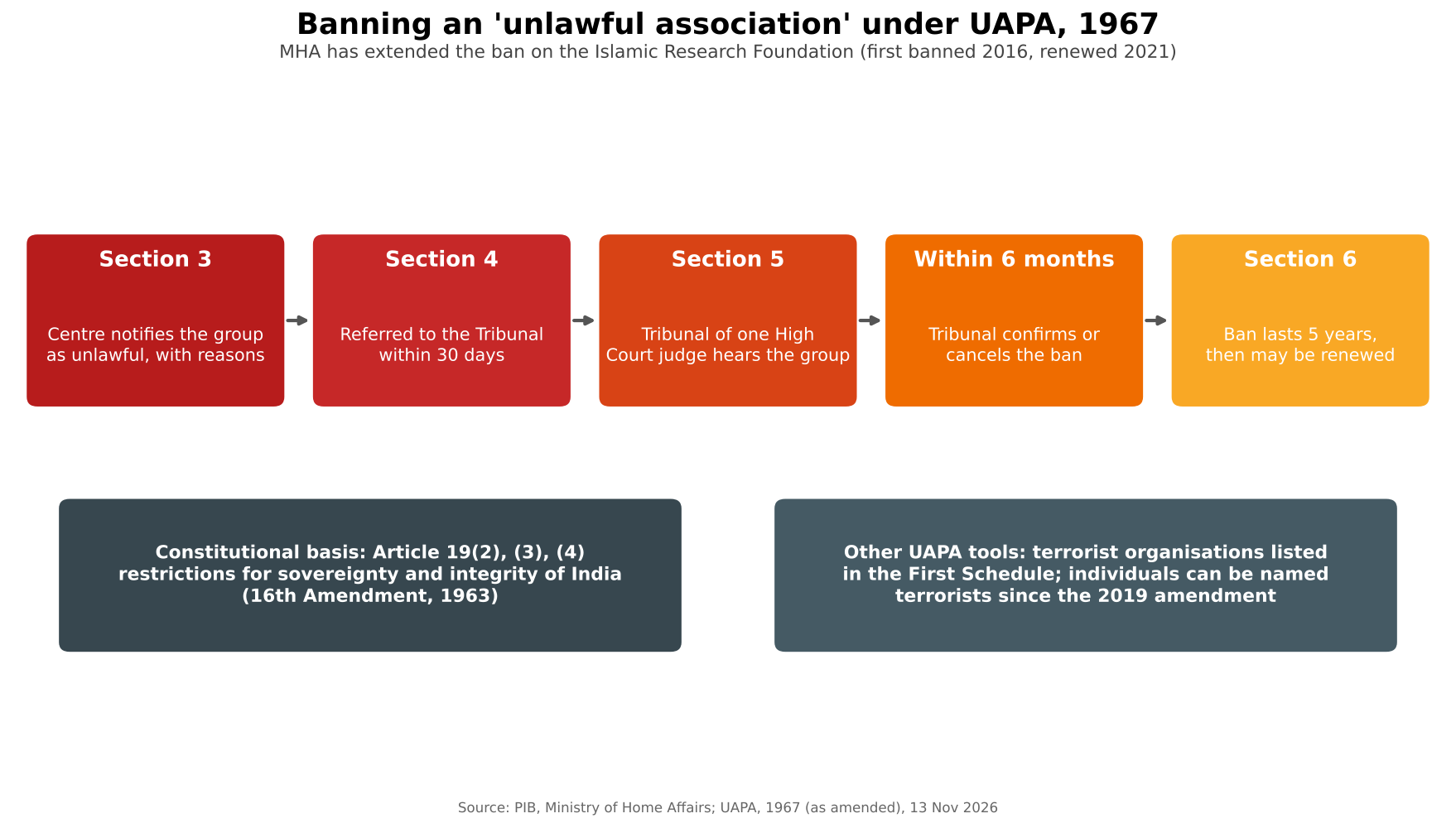
Section 3: the Central Government declares a group an unlawful association by a notification in the Official Gazette, giving reasons.
Section 4: the notification is sent to the UAPA Tribunal within 30 days.
Section 5: the Tribunal has one sitting High Court judge. It hears the group and decides within six months whether there is sufficient cause.
Section 6: a confirmed ban lasts five years (raised from two years in 2013), unless cancelled earlier.
Being a member of, or helping, an unlawful association is an offence.
Unlawful association versus terrorist organisation
Point
Unlawful association
Terrorist organisation
Provision
Chapter II (Sections 3–8)
Chapter VI, listed in the First Schedule
Basis
Secession or disrupting sovereignty and integrity
Involvement in terrorism
Duration
Five years, then renewed
Until removed from the Schedule
Review
UAPA Tribunal
Review committee on application
Constitutional and legal roots
Article 19(2), (3) and (4) allow reasonable restrictions on speech, assembly and association in the interest of the sovereignty and integrity of India. These words were added by the 16th Amendment, 1963.
The UAPA was passed in 1967 on the advice of the Committee on National Integration and Regionalism.
The 2019 amendment allows individuals to be named as terrorists and lets the NIA seize property linked to terrorism.
The National Investigation Agency (NIA) was created by the NIA Act, 2008, after the 26/11 attacks.
Other groups banned under UAPA
Students Islamic Movement of India (SIMI): first banned in 2001, renewed since.
Popular Front of India (PFI) and its affiliates: banned in September 2022 for five years; the Tribunal upheld it in 2023.
Jamaat-e-Islami (J&K) and JKLF (Yasin Malik faction) were banned in 2019.
Safeguards and debates
The group must be told the grounds and given a hearing before the Tribunal.
Courts have held that mere membership of a banned group can be an offence under UAPA (Supreme Court, 2023).
Critics point to low conviction rates and long pre-trial detention under the Act.
Likely Prelims angles
Who sits on the UAPA Tribunal and how long a ban lasts.
The 2019 amendment on designating individuals.
Article 19 grounds for restricting the freedom of association.
Quick Revision
IRF's ban as an unlawful association was extended.
Bans are notified under Section 3 and reviewed by a one-judge Tribunal.
A ban lasts five years.
The 16th Amendment added "sovereignty and integrity" to Article 19.
Individuals can be named as terrorists since 2019.
Practice MCQ
Q. With reference to the Unlawful Activities (Prevention) Act, 1967, consider the following statements:
1. A declaration of an association as unlawful is reviewed by a Tribunal consisting of a High Court judge.
2. A declaration, once confirmed, remains in force for five years.
3. Only organisations, not individuals, can be designated as terrorists under the Act.
Which of the statements given above is/are correct?
(a) 1 only
(b) 1 and 2 only
(c) 2 and 3 only
(d) 1, 2 and 3
Answer: (b). The 2019 amendment allows individuals to be designated as terrorists.
Related PYQs
PYQ 1 (UPSC CSE Prelims 2024)
Which of the following statements about 'Exercise Mitra Shakti-2023' are correct?
1. This was a joint military exercise between India and Bangladesh.
2. It commenced in Aundh (Pune).
3. Joint response during counter-terrorism operations was a goal of this operation.



 28
Nov 2026
 28
Nov 2026
 28
Nov 2026














0 comments
Discussion
No comments yet. Be the first.