NPPA Enforces Trade Margin Cap on 137 Anti-Cancer Drugs
Revised price lists, based on company submissions up to 11 November, are on the NPPA website
DDecode Civils
· 4 min read
NPPA Enforces Trade Margin Cap on 137 Anti-Cancer Drugs
Why in News
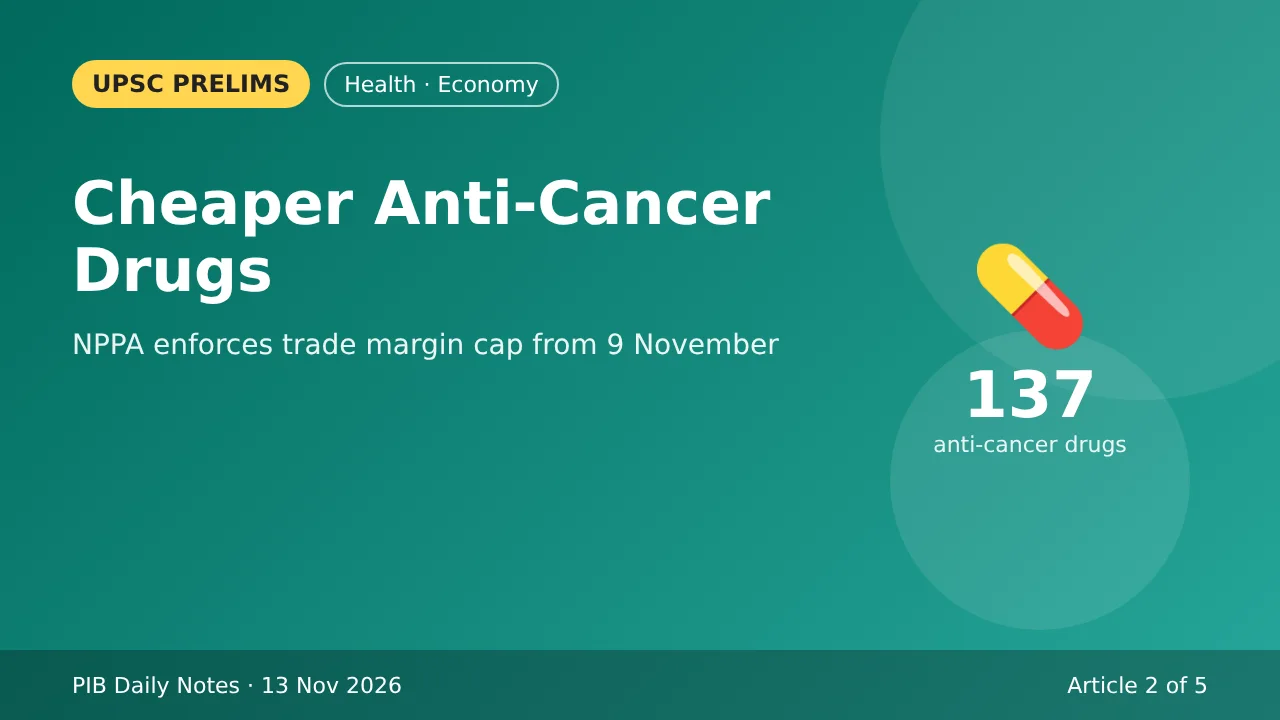
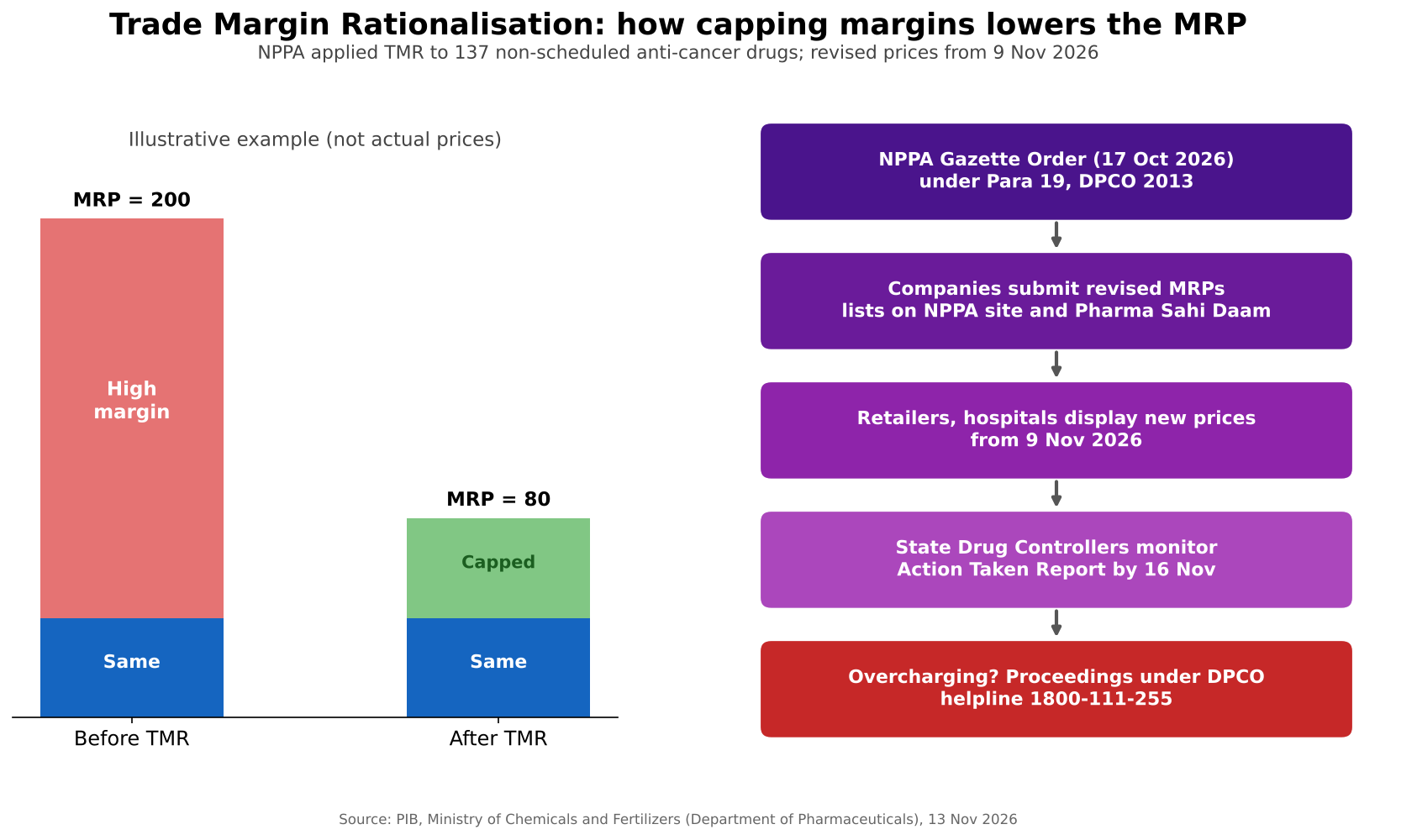
The National Pharmaceutical Pricing Authority (NPPA) directed State Drug Controllers to strictly monitor Trade Margin Rationalisation (TMR) on 137 non-scheduled anti-cancer drugs. The Gazette Order is dated 17 October 2026, and revised prices took effect on 9 November 2026.
News Summary
Revised price lists, based on company submissions up to 11 November, are on the NPPA website and the Pharma Sahi Daam app.
Manufacturers, retailers, stockists, hospitals and medical institutions must follow the new prices and display the price lists.
Violations may attract overcharging proceedings under the Drugs (Prices Control) Order (DPCO), 2013.
Complaints can be made on Pharma Sahi Daam, the NPPA helpline (1800-111-255) or email.
State Drug Controllers had to send Action Taken Reports by 16 November 2026.
Prelims Facts & Static Linkages
How drug prices are controlled in India
Legal base: the DPCO is issued under the Essential Commodities Act, 1955.
Scheduled drugs: medicines in the National List of Essential Medicines (NLEM) form Schedule I of the DPCO. NPPA fixes a ceiling price for them.
Non-scheduled drugs: makers set the launch price, but may raise the MRP by at most 10% a year.
Trade margin: the gap between the price at which a maker sells to the trade and the MRP paid by the patient. Very high margins on cancer drugs kept MRPs high.
TMR: capping this margin pulls down the MRP without fixing the drug's base price. NPPA first did this in 2019 for 42 anti-cancer drugs, using its special powers under Paragraph 19 of the DPCO (public interest).
Institutions to remember
Body
Role
Ministry
NPPA (1997)
Fixes and enforces drug prices
Chemicals & Fertilizers (Dept. of Pharmaceuticals)
CDSCO, headed by DCGI
Approves drugs and devices, sets quality standards
Health & Family Welfare
State Drug Controllers
Licensing and enforcement in States
State governments
PMBI
Runs Jan Aushadhi Kendras for generic medicines
Dept. of Pharmaceuticals
Key facts
NPPA was set up by a government resolution in 1997. It is not a statutory body.
Price Monitoring and Resource Units (PMRUs) help NPPA at the State level.
Cancer care is also supported under Ayushman Bharat PM-JAY and Jan Aushadhi.
Why cancer drugs are a policy focus
Cancer care is long and costly, and most anti-cancer drugs are non-scheduled, so their prices are not capped by a ceiling.
High out-of-pocket spending on medicines pushes families into debt.
Capping trade margins lowers the MRP at once, while makers keep their own selling price.
The 2019 pilot on 42 drugs cut MRPs of hundreds of brands, which made a wider rollout possible.
Likely Prelims angles
Scheduled versus non-scheduled drugs.
Which ministry NPPA and CDSCO fall under.
Meaning of trade margin and MRP.
Quick Revision
TMR now covers 137 non-scheduled anti-cancer drugs.
New prices apply from 9 November 2026.
DPCO 2013 is issued under the Essential Commodities Act, 1955.
NPPA is under the Department of Pharmaceuticals.
Pharma Sahi Daam shows drug prices to the public.
Practice MCQ
Q. Consider the following statements about drug pricing in India:
1. The National Pharmaceutical Pricing Authority is a statutory body created by an Act of Parliament.
2. Ceiling prices are fixed for medicines listed in the National List of Essential Medicines.
3. The Drugs (Prices Control) Order is issued under the Essential Commodities Act, 1955.
Which of the statements given above is/are correct?
(a) 1 and 2 only
(b) 2 and 3 only
(c) 3 only
(d) 1, 2 and 3
Answer: (b). NPPA was set up in 1997 by a government resolution.
Related PYQs
PYQ 1 (UPSC CSE Prelims 2025)
With reference to monoclonal antibodies, often mentioned in news, consider the following statements:
I. They are man-made proteins.
II. They stimulate immunological function due to their ability to bind to specific antigens.
III. They are used in treating viral infections like that of Nipah virus.
Which of the statements given above are correct?
(a) I and II only
(b) II and III only
(c) I and III only
(d) I, II and III
PYQ 2 (UPSC CSE Prelims 2026)
Which of the following statements with regard to genetic medicine is/are correct?
1. Genetic medicines correct/compensate for the faulty genes responsible for disease.
2. Engineered viruses and lipid nanoparticles are used as carriers of the genetic medicine.
3. Genetic medicines alter the entire DNA sequence.



 28
Nov 2026
 28
Nov 2026
 28
Nov 2026














0 comments
Discussion
No comments yet. Be the first.