Prime Minister Narendra Modi inaugurated the COSMOS-Mysuru Planetarium in Mysuru
DDecode Civils
· 3 min read
COSMOS-Mysuru: India's First LED Dome Planetarium
Why in News
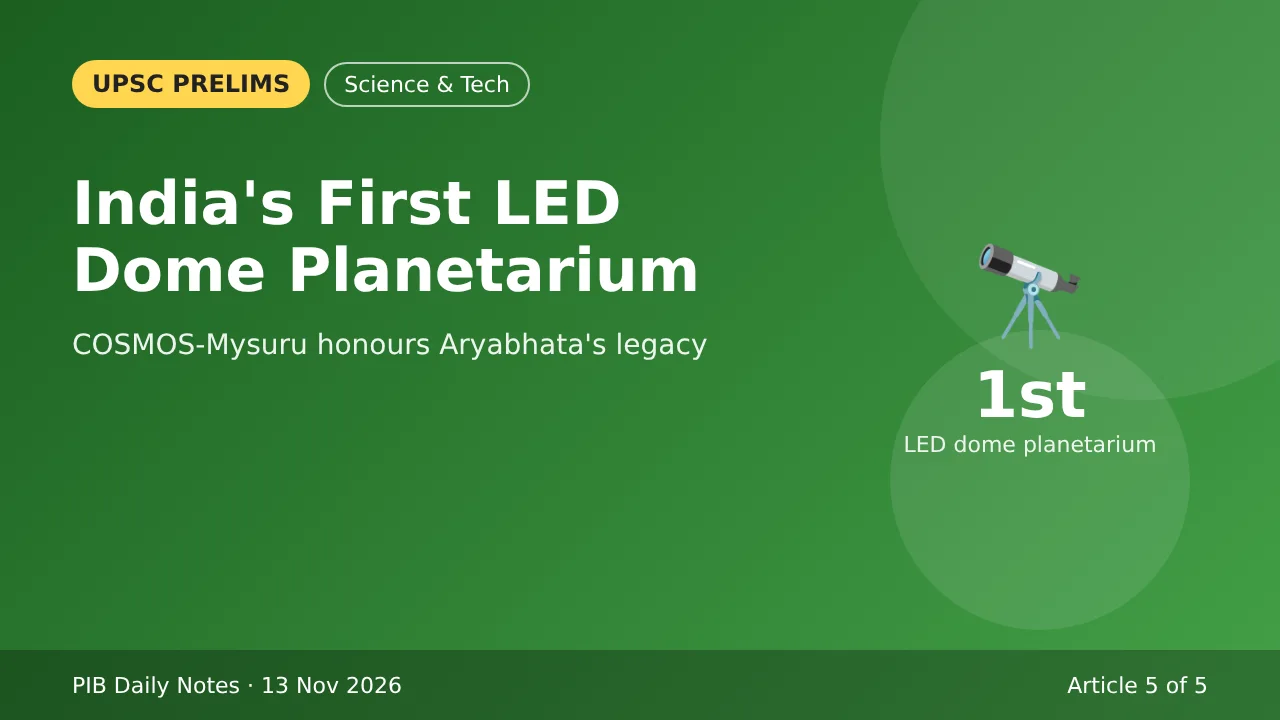
Prime Minister Narendra Modi inaugurated the COSMOS-Mysuru Planetarium in Mysuru, Karnataka, India's first LED dome planetarium. It was built with the Indian Institute of Astrophysics (IIA) and the University of Mysore.
News Summary
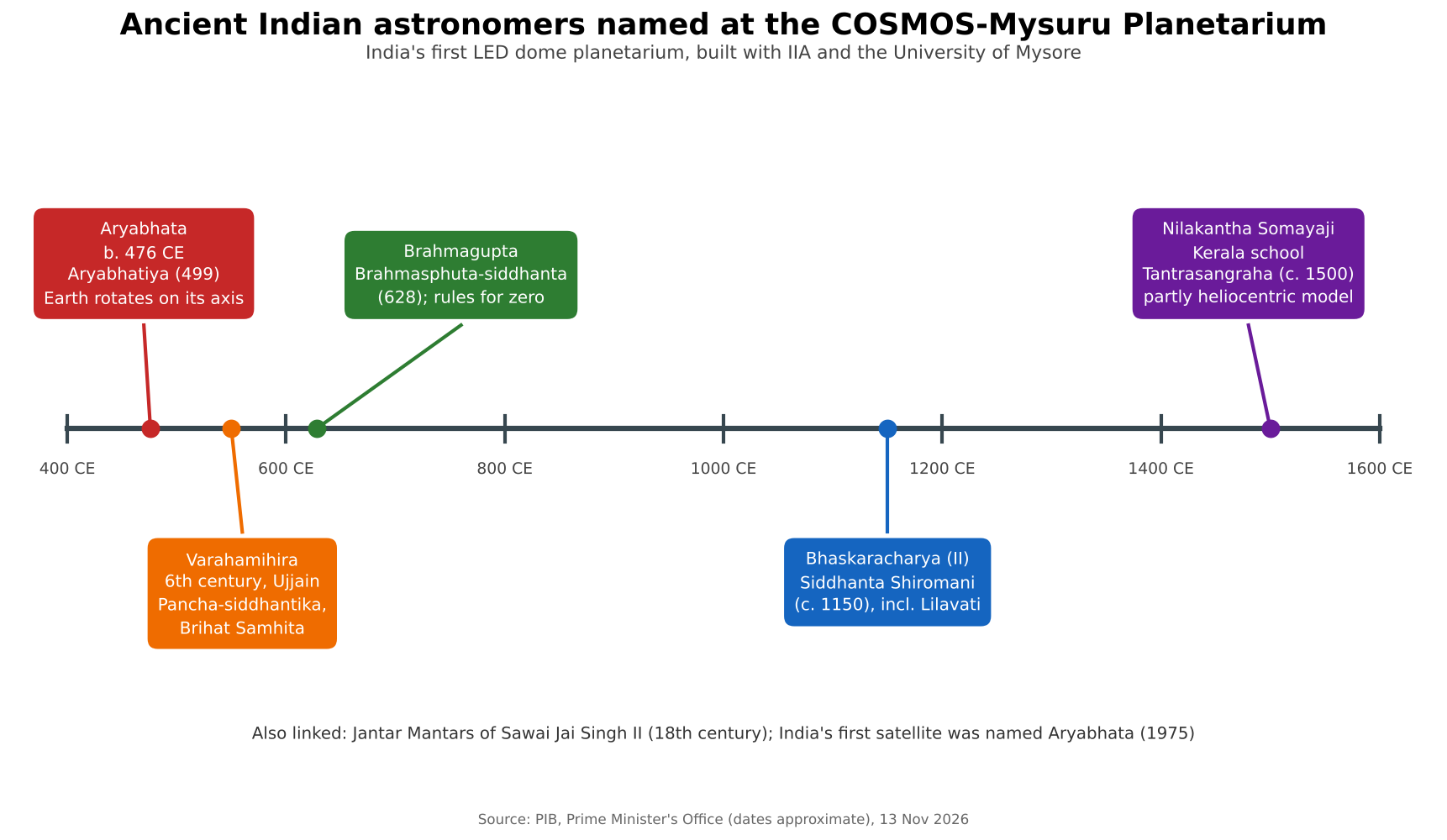
The PM recalled India's astronomers Aryabhata, Varahamihira, Bhaskaracharya and Nilakantha Somayaji, who made discoveries without modern instruments.
He noted Mysuru's role in learning: the University of Mysore under Nalwadi Krishnaraja Wadiyar, and the Wadiyars' support for the Indian Institute of Science (IISc), Bengaluru.
Indian students won four gold and one silver at the International Olympiad on Astronomy and Astrophysics in Vietnam, a year after Mumbai hosted it.
Space milestones cited: Chandrayaan-3 near the lunar south pole, Aditya-L1, and space docking, which made India the fourth country to do it.
Science programmes cited: Atal Tinkering Labs (10,000+), One Nation One Subscription, the Anusandhan National Research Foundation and the ₹1 lakh crore RDI Scheme.
Prelims Facts & Static Linkages
Ancient Indian astronomers
Aryabhata (5th century CE): wrote the Aryabhatiya (499 CE). He said the Earth rotates on its axis and explained eclipses by shadows.
Varahamihira (6th century CE): wrote the Pancha-siddhantika, summarising five schools, and the Brihat Samhita. He is linked with Ujjain.
Brahmagupta (7th century CE): wrote the Brahmasphuta-siddhanta (628 CE), with rules for working with zero.
Bhaskaracharya (Bhaskara II, 12th century CE): wrote the Siddhanta Shiromani, which includes Lilavati.
Nilakantha Somayaji (15th–16th century CE): of the Kerala school, wrote the Tantrasangraha, with a partly heliocentric planetary model.
Astronomy institutions to know
Institution
Fact
Indian Institute of Astrophysics
Bengaluru, autonomous body under DST
Indian Astronomical Observatory
Hanle, Ladakh (run by IIA)
Vainu Bappu Observatory
Kavalur, Tamil Nadu (run by IIA)
Jantar Mantar
Built by Sawai Jai Singh II in Jaipur, Delhi, Ujjain, Varanasi and Mathura
Science and space milestones in the speech
Item
Fact
Chandrayaan-3 (2023)
First landing near the Moon's south pole
Aditya-L1
India's first space solar observatory, at Lagrange point L1
SpaDeX
Space docking; India the fourth country to do it
Axiom-4
Indian astronaut's trip to the International Space Station
Gaganyaan
India's human spaceflight programme
Anusandhan NRF
Created by the ANRF Act, 2023, to fund research
Mysuru's knowledge heritage
The University of Mysore (1916) was the first university set up by an Indian princely state.
The Wadiyars granted land and funds for IISc, Bengaluru (1909), founded on Jamsetji Tata's plan.
Mysuru also hosts the Central Food Technological Research Institute (CFTRI).
Why an LED dome
A normal planetarium projects light onto a dome. An LED dome is made of light-emitting panels, giving brighter images and deeper blacks.
It allows sharper full-dome shows for school and college students, the planetarium's main audience.
Key terms
Planetarium: a theatre that shows the night sky and space on a domed ceiling.
Light-year: the distance light travels in one year, about 9.46 trillion km. It is a unit of distance, not time.
Astronomical Unit (AU): the mean Earth–Sun distance, about 150 million km.
Lagrange point: a spot where the pull of two large bodies balances, letting a spacecraft hold its position. Aditya-L1 sits at L1, about 1.5 million km from Earth.
Likely Prelims angles
Matching astronomers with their texts.
Aryabhata as India's first satellite (1975).
Quick Revision
COSMOS-Mysuru is India's first LED dome planetarium.
It was built with IIA and the University of Mysore.
Aryabhata wrote the Aryabhatiya.
Varahamihira wrote the Pancha-siddhantika.
Nilakantha Somayaji belonged to the Kerala school.
Practice MCQ
Q. Consider the following pairs:
1. Aryabhata : Aryabhatiya
2. Varahamihira : Lilavati
3. Nilakantha Somayaji : Tantrasangraha
How many of the pairs given above are correctly matched?
(a) Only one
(b) Only two
(c) All three
(d) None
Answer: (b). Lilavati is part of Bhaskara II's Siddhanta Shiromani.
Related PYQs
PYQ 1 (UPSC CSE Prelims 2025)
Fa-hien (Faxian), the Chinese pilgrim, travelled to India during the reign of
(a) Samudragupta
(b) Chandragupta II
(c) Kumaragupta I
(d) Skandagupta
Answer: (b).
PYQ 2 (UPSC CSE Prelims 2025)
Consider the following space missions:
I. Axiom-4
II. SpaDeX
III. Gaganyaan
How many of the space missions given above encourage and support microgravity research?



 28
Nov 2026
 28
Nov 2026
 28
Nov 2026














0 comments
Discussion
No comments yet. Be the first.