India aims for a US$ 300 billion bioeconomy by 2030 and US$ 1 trillion by 2047
DDecode Civils
· 3 min read
BRIC Targets a US$ 1 Trillion Bioeconomy by 2047
Why in News
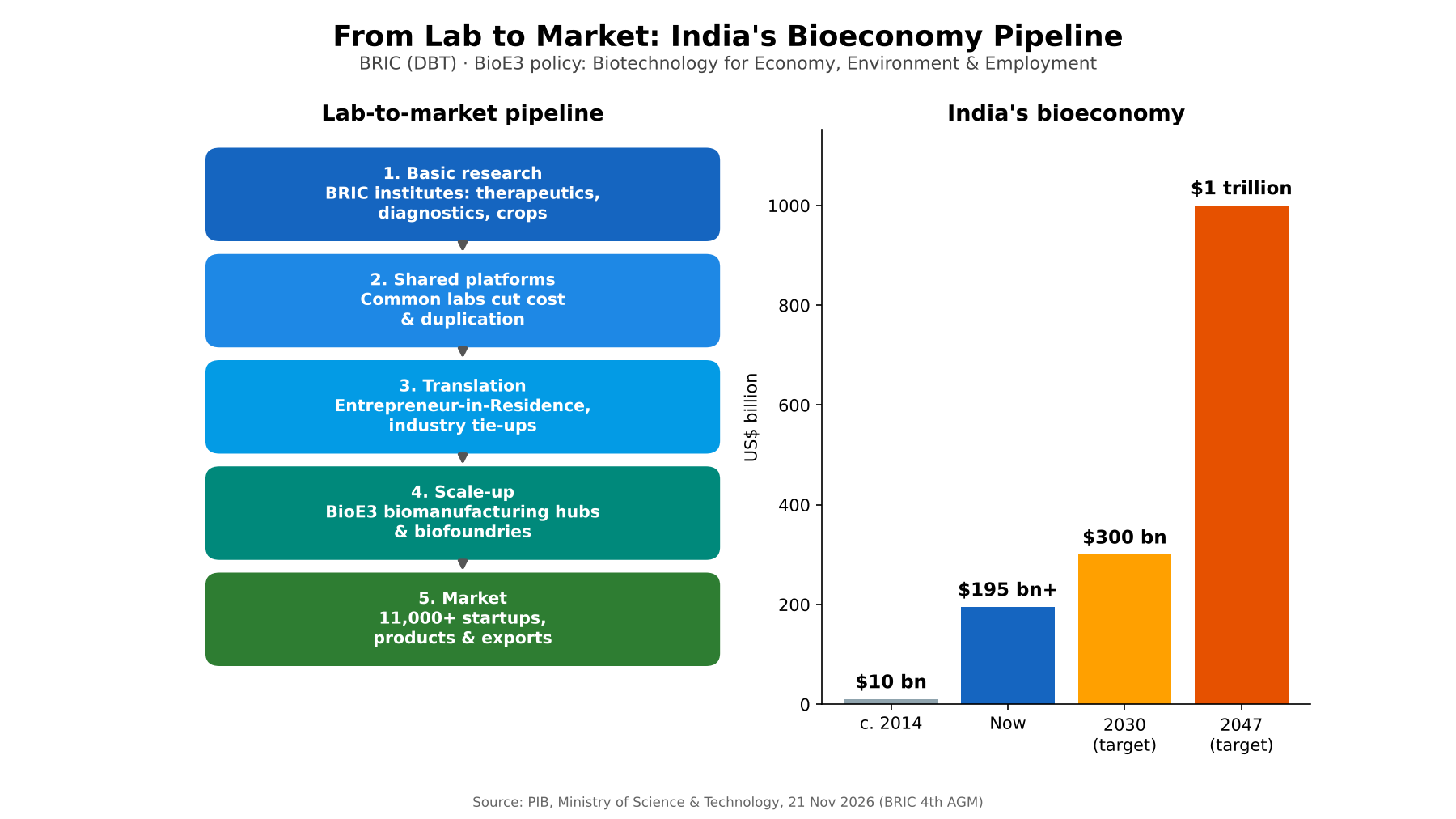
At the 4th Annual General Meeting of the Biotechnology Research and Innovation Council (BRIC), the Union Science Minister said India aims for a US$ 300 billion bioeconomy by 2030 and US$ 1 trillion by 2047.
News Summary
India's bioeconomy has grown from about US$ 10 billion to over US$ 195 billion.
BRIC brings the Department of Biotechnology's (DBT) autonomous institutes under one society with shared infrastructure and integrated governance. It was among the first such institutional mergers in government.
Nature Index India ranks BRIC 1st among government institutions in health sciences and 2nd in biological sciences, for the second year running.
India now has more than 11,000 biotech startups.
The D.E.S.I.G.N. for BioE3 Challenge received over 6,000 proposals from school students and citizens.
The Minister called for faster lab-to-market translation, more industry partnerships, and bringing scientists in the diaspora back through Vaibhav Connect.
Prelims Facts & Static Linkages
Key institutions and policies
Item
Fact
DBT
Set up in 1986 under the Ministry of Science and Technology
BIRAC
Biotechnology Industry Research Assistance Council (2012), a DBT public sector enterprise that funds biotech startups
BRIC
A society that merges DBT's autonomous institutes; DBT's Secretary is its Director General
BioE3 Policy (2024)
Biotechnology for Economy, Environment and Employment; promotes high-performance biomanufacturing
Genome India Project
DBT-funded; sequenced 10,000 genomes of Indians to map the population's genetic diversity
How research becomes a product (BRIC's model)
Basic research: BRIC institutes work on therapeutics, diagnostics and climate-resilient crops.
Shared platforms: common labs and equipment cut costs and duplication.
Translation: Entrepreneur-in-Residence programmes and industry tie-ups.
Scale-up: biomanufacturing hubs under BioE3.
Market: startups, products and exports, which feed the bioeconomy.
Bioeconomy sectors
Sector
Examples
Bio-pharma
Vaccines, biosimilars, diagnostics (the largest share)
Bio-agri
GM crops such as Bt cotton, biofertilisers
Bio-industrial
Enzymes, biofuels, bioplastics
Bio-IT and services
Contract research, bioinformatics
Concepts to revise
Biosimilars are near-copies of biological drugs. Generics are exact copies of small-molecule drugs.
Biomanufacturing uses living cells such as microbes to make chemicals, materials and food.
Biofoundries are automated labs that design, build and test engineered organisms at speed. BioE3 plans a network of them.
Vaibhav (Vaishvik Bharatiya Vaigyanik) links scientists of Indian origin abroad with Indian institutions.
Gene editing (CRISPR-Cas9) makes precise cuts in DNA. India exempts SDN-1 and SDN-2 genome-edited plants that contain no foreign DNA from GM rules.
Why the bioeconomy matters for India
Green growth: bio-based fuels, plastics and chemicals replace fossil-based ones and support net zero by 2070.
Health security: home-grown vaccines and diagnostics, as shown during COVID-19.
Farm resilience: climate-resilient seeds and biofertilisers.
Jobs: biomanufacturing hubs in tier-2 cities, plus startups.
Likely Prelims angles
The full form and aims of BioE3
BIRAC versus BRIC
The Genome India Project and who funds it
Quick Revision
India's bioeconomy targets are US$ 300 bn by 2030 and US$ 1 trillion by 2047.
The bioeconomy has grown from about US$ 10 bn to over US$ 195 bn.
BRIC brings DBT's autonomous institutes under one society.
BioE3 stands for Economy, Environment and Employment.
India has more than 11,000 biotech startups.
Practice MCQ
Q. The "BioE3" policy of the Government of India stands for:
(a) Biotechnology for Energy, Ecology and Education
(b) Biotechnology for Economy, Environment and Employment
(c) Bio-Economy, Ethics and Exports
(d) Biofuels for Energy, Environment and Equity
Answer: (b)
Related PYQs
PYQ 1 (UPSC CSE Prelims 2020)
Consider the following statements:
Genetic changes can be introduced in the cells that produce eggs or sperms of a prospective parent.
A person's genome can be edited before birth at the early embryonic stage.
Human induced pluripotent stem cells can be injected into the embryo of a pig.
Which of the statements given above is/are correct?
(a) 1 only
(b) 2 and 3 only
(c) 2 only
(d) 1, 2 and 3
Answer: (d)
PYQ 2 (UPSC CSE Prelims 2026)
Which of the following statements with regard to GenomeIndia Project is/are correct?
It is a part of the Human Genome Project.
The project is funded by the Department of Biotechnology (DBT), Government of India.
Its primary aim is to build a catalogue of genetic diversity of the Indian population.
Select the answer using the code given below:
(a) 1 only
(b) 2 and 3 only
(c) 1 and 2 only
(d) 1, 2 and 3
Answer: (b). GenomeIndia is a separate Indian project, not part of the international Human Genome Project.



 24
Nov 2026
 24
Nov 2026
 24
Nov 2026














0 comments
Discussion
No comments yet. Be the first.