The sixth round of negotiations on the India–Canada Comprehensive Economic Partnership Agreement (CEPA)...
DDecode Civils
· 3 min read
India–Canada CEPA: Sixth Round of Talks
Why in News
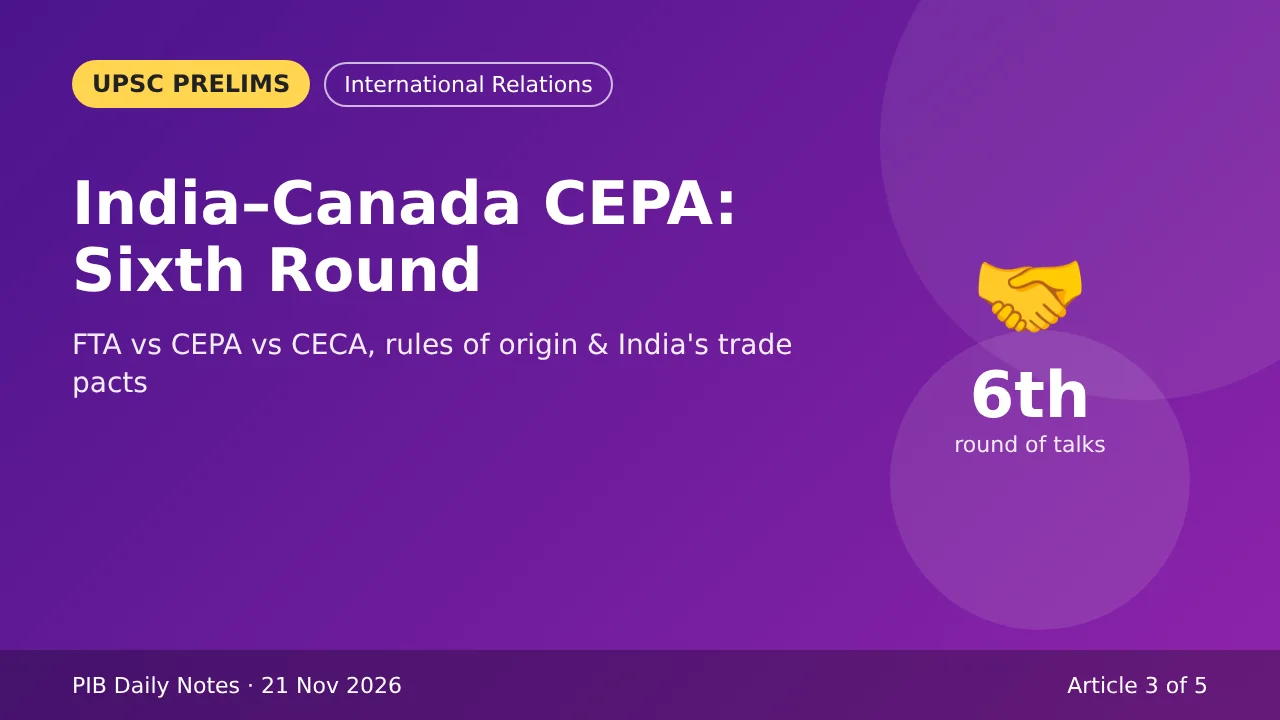
The sixth round of negotiations on the India–Canada Comprehensive Economic Partnership Agreement (CEPA) ended in New Delhi. It ran from 11 to 20 November 2026.
News Summary
The Indian side was led by Chief Negotiator Dr Brij Mohan Mishra, and the Canadian side by Ms Mary-Catherine Speirs.
The round covered trade in goods, trade in services, rules of origin, trade remedies, intellectual property and investment promotion.
India's Commerce Minister and Canada's Minister of International Trade, Maninder Sidhu, opened the round. Both called for a balanced agreement that is good for both sides.
The Commerce Secretary and Canada's Vice Minister of International Trade, Glenn Purves, reviewed progress at the end of the round.
Both sides aim to finish within the "ambitious timelines" set by their leaders, with gains for farmers, MSMEs and supply chains.
Goods, services, investment, IPR and regulatory cooperation, the widest scope
Key terms negotiated
Rules of origin: criteria that decide which country a product "comes from". They stop third countries routing goods through a partner to dodge tariffs.
Trade remedies: anti-dumping duties, countervailing duties and safeguards against unfair or sudden import surges.
Intellectual property: patents and data exclusivity, which are sensitive for India's generic medicines industry.
Investment promotion: a stable regime for two-way investment, where Canadian pension funds are big investors in India.
Both are members of the G20 and the Commonwealth. Canada is also a G7 member.
Canada is home to one of the largest Indian diasporas in the world.
India imports pulses (lentils), potash and uranium from Canada. A uranium supply deal was signed in 2015.
Canada is a member of CPTPP (the Comprehensive and Progressive Agreement for Trans-Pacific Partnership) and USMCA (with the USA and Mexico). India is in neither.
Canadian pension funds such as CPP Investments are among the largest foreign investors in Indian infrastructure.
Canada shares the world's longest international border with the USA.
Sensitive issues in trade talks
Agriculture and dairy: India protects these sectors to safeguard small farmers' livelihoods.
Professional mobility: India wants easier visas for its IT and services workers.
Non-tariff barriers: sanitary and phytosanitary (SPS) rules, for example on Indian pulses and mangoes.
Data and digital trade: rules on cross-border data flows.
Likely Prelims angles
The differences between FTA, CEPA and CECA
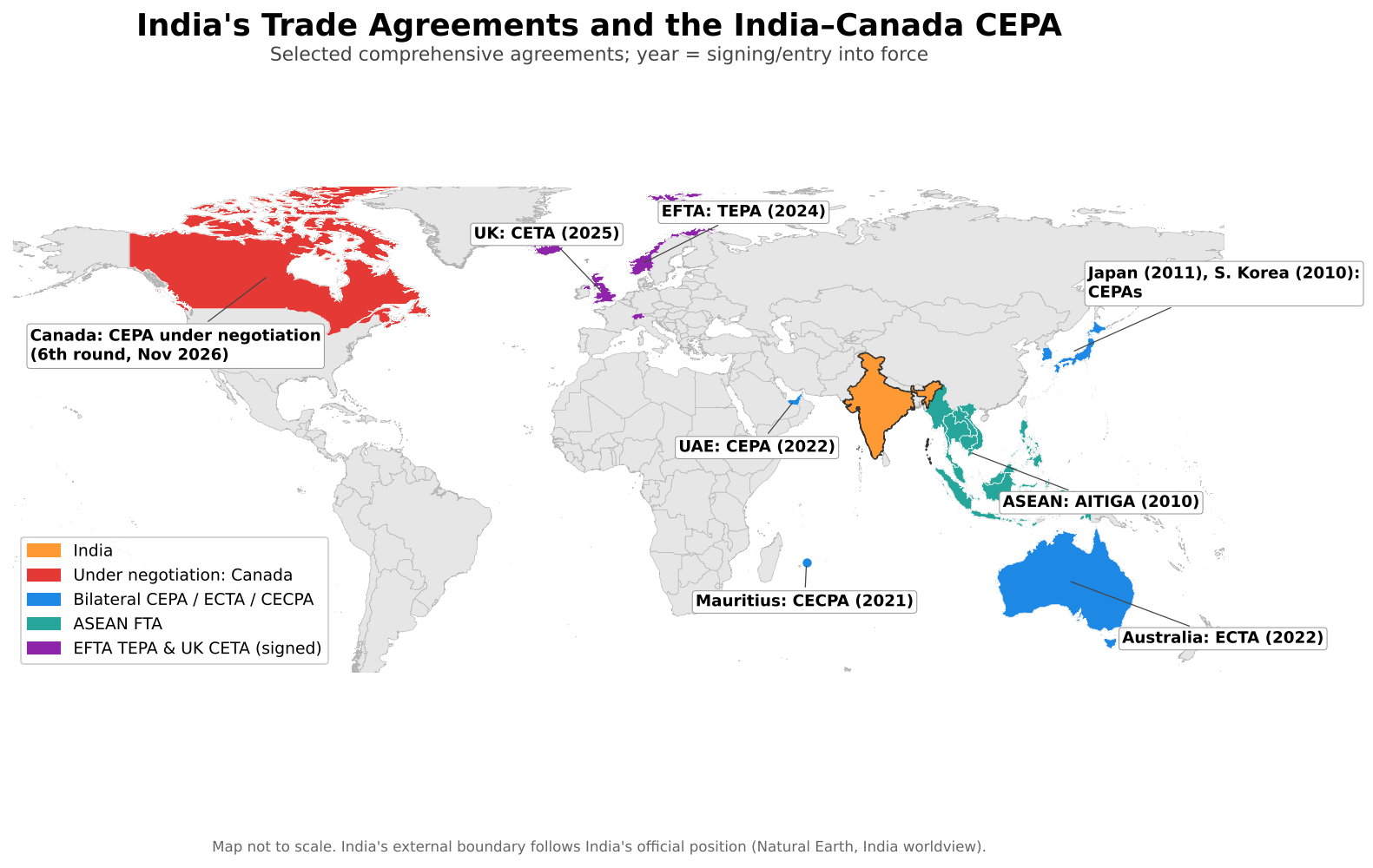
Which of India's agreements are with blocs (ASEAN, EFTA)
The meaning of rules of origin and anti-dumping duty
Quick Revision
The sixth CEPA round was held in New Delhi from 11 to 20 November 2026.
A CEPA is broader than an FTA, covering investment and IPR.
Rules of origin stop goods being routed through third countries.
India's TEPA with EFTA and CETA with the UK are its most recent agreements with developed economies.
Canada supplies pulses, potash and uranium to India.
Practice MCQ
Q. Which of the following groups is the European Free Trade Association (EFTA)?
(a) France, Germany, Italy, Spain
(b) Switzerland, Norway, Iceland, Liechtenstein
(c) UK, Ireland, Norway, Denmark
(d) Austria, Switzerland, Sweden, Finland
Answer: (b)
Related PYQs
PYQ 1 (UPSC CSE Prelims 2024)
The longest border between any two countries in the world is between:



 24
Nov 2026
 24
Nov 2026
 24
Nov 2026














0 comments
Discussion
No comments yet. Be the first.