Operation Monsoon Thunder: India–US Action on Drugs
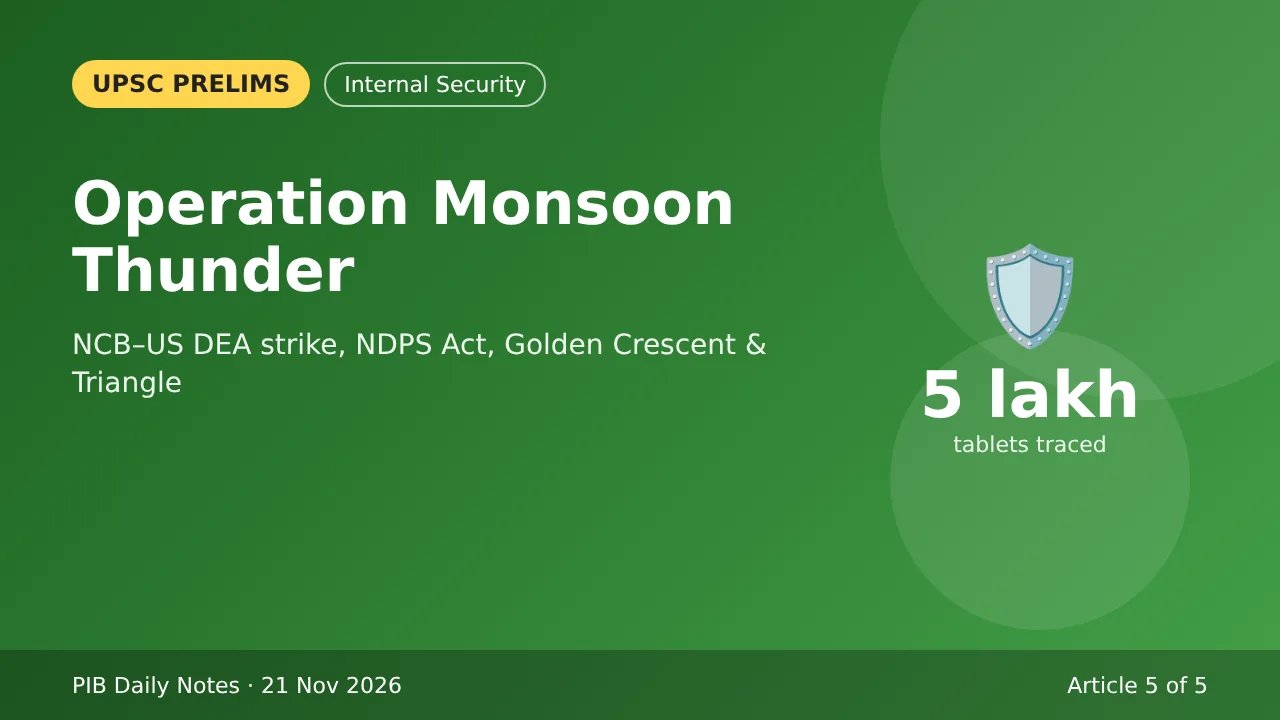
Operation Monsoon Thunder, a joint operation that broke up a transnational drug-trafficking network
DDecode Civils
· 3 min read
Operation Monsoon Thunder: India–US Action on Drugs
Why in News
The Union Home Minister praised India's Narcotics Control Bureau (NCB) and the US Drug Enforcement Administration (DEA) for Operation Monsoon Thunder, a joint operation that broke up a transnational drug-trafficking network.
News Summary
The network was shipping illegal pharmaceutical tablets to consumers across the United States.
Results:
6 people arrested in 4 Indian cities
About 3,000 parcels, holding nearly 5 lakh tablets, identified as shipped within the USA
Data on more than 59,000 US subjects shared with the DEA
2 live consignments intercepted by the DEA
Investigators are now tracing the masterminds, "dropshippers" and money trail behind the network.
The US Ambassador to India called it an example of the India–US partnership in action.
Prelims Facts & Static Linkages
India's legal and institutional framework
Item
Key fact
NDPS Act, 1985
The main law on narcotic drugs and psychotropic substances
NCB
Set up in 1986 under the NDPS Act; works under the Ministry of Home Affairs
PITNDPS Act, 1988
Allows preventive detention of traffickers
NCORD
A four-tier coordination mechanism between the Centre and the states on drugs
Nasha Mukt Bharat Abhiyaan
Launched in 2020 by the Ministry of Social Justice and Empowerment
MANAS
National narcotics helpline 1933
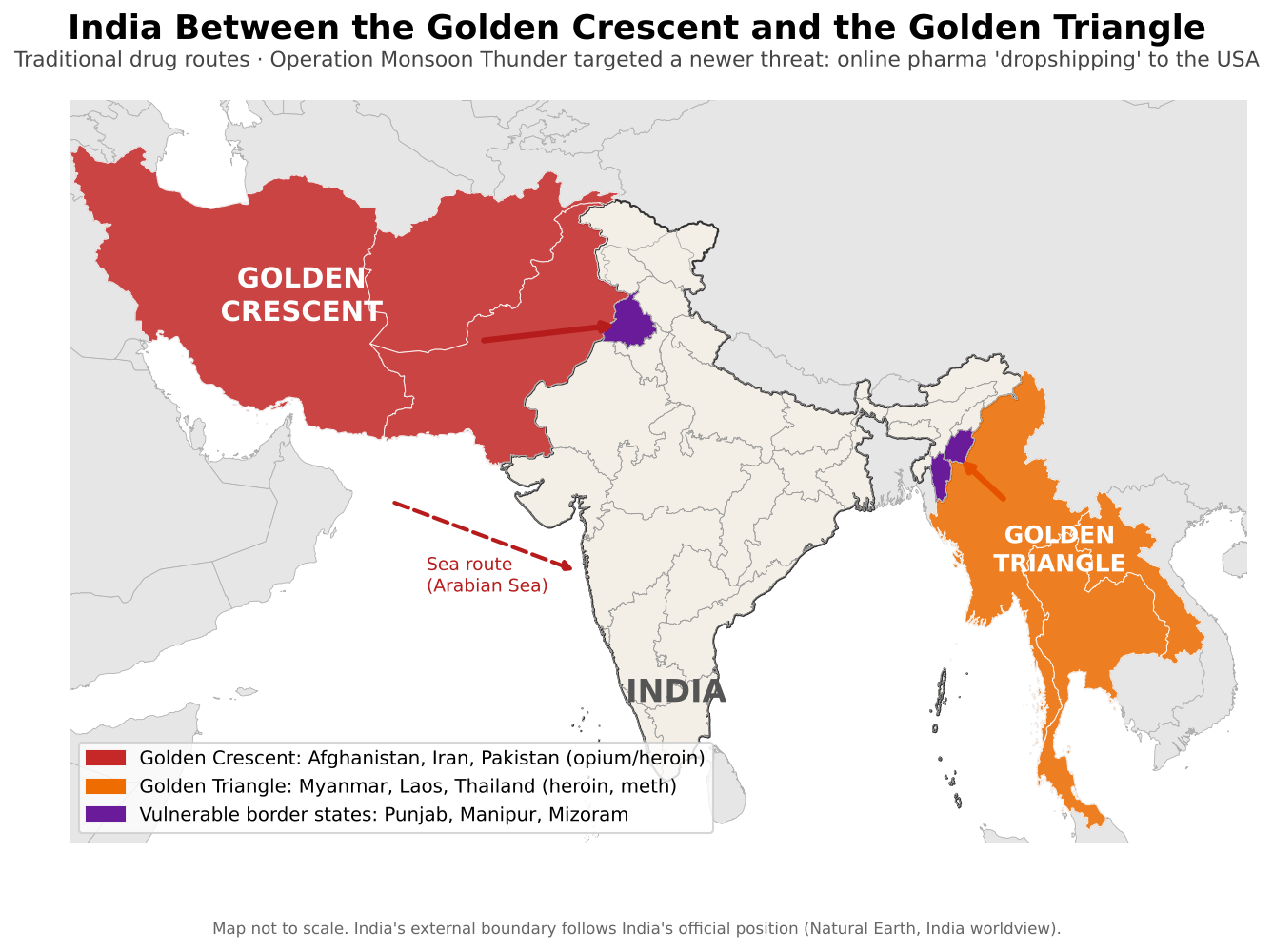
India's vulnerability: the "two golden zones"
Golden Crescent:Afghanistan, Iran and Pakistan. It is a major source of opium and heroin, which enter India through the western border (Punjab and Rajasthan) and by sea.
Golden Triangle:Myanmar, Laos and Thailand. It supplies methamphetamine and heroin through the north-east (Manipur and Mizoram).
New threats: synthetic drugs, darknet markets, cryptocurrency payments and online pharmacy "dropshipping", which this operation targeted.
International conventions India has ratified
Convention
Focus
UN Single Convention on Narcotic Drugs, 1961
Plant-based narcotics: opium, cannabis, coca
Convention on Psychotropic Substances, 1971
Synthetic drugs
UN Convention against Illicit Traffic, 1988
Trafficking, money laundering and precursor chemicals
The UNODC (UN Office on Drugs and Crime, Vienna) publishes the World Drug Report.
The US DEA works under the US Department of Justice.
26 June is the International Day against Drug Abuse and Illicit Trafficking.
The Central Bureau of Narcotics (Gwalior) licenses legal opium farming, while the NCB handles enforcement and coordination.
Why joint operations matter
Drug trafficking crosses borders, so one country's agencies cannot dismantle a network alone.
Sharing intelligence, such as the data on 59,000 US subjects here, makes it possible to act at both ends.
Tracing the money trail connects drug money to money laundering and narco-terror financing, which the PMLA and FATF standards cover.
It builds the India–US security partnership beyond defence trade.
Likely Prelims angles
The countries in the Golden Crescent and the Golden Triangle
Which ministry NCB reports to, and the NDPS Act
The three UN drug conventions
India's licit opium cultivation in Madhya Pradesh, Rajasthan and Uttar Pradesh, which is regulated by the Central Bureau of Narcotics
Quick Revision
Operation Monsoon Thunder was a joint NCB and US DEA operation against pharmaceutical drug trafficking.
It led to 6 arrests and identified about 3,000 parcels holding about 5 lakh tablets.
NCB was set up in 1986 and works under the MHA.
The Golden Crescent is Afghanistan, Iran and Pakistan.
The Golden Triangle is Myanmar, Laos and Thailand.
Practice MCQ
Q. Which of the following countries form the "Golden Triangle"?



 24
Nov 2026
 24
Nov 2026
 24
Nov 2026














0 comments
Discussion
No comments yet. Be the first.