CCPA Fines Ola ₹10 Lakh for a Pre-Ride Tip Dark Pattern
CCPA imposed a penalty of ₹10 lakh on ANI Technologies Pvt. Ltd. (Ola) for asking riders to pay a "tip"
DDecode Civils
· 3 min read
CCPA Fines Ola ₹10 Lakh for a Pre-Ride Tip Dark Pattern
Why in News
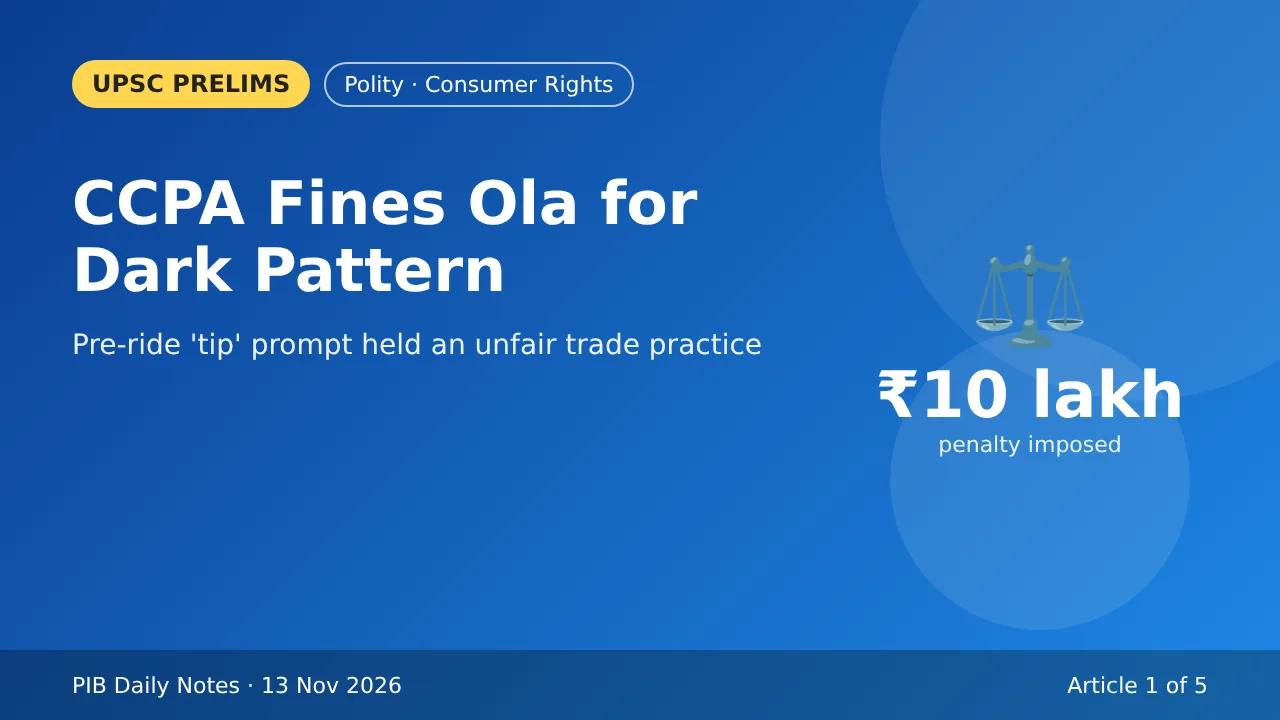
The Central Consumer Protection Authority (CCPA) imposed a penalty of ₹10 lakh on ANI Technologies Pvt. Ltd. (Ola) for asking riders to pay a "tip" or "add-on" before the ride. It held the feature to be an unfair trade practice and a dark pattern, and ordered Ola to stop it at once.
News Summary
The prompt appeared while the app searched for a driver, with lines such as "Tip now to boost the chances of getting a ride sooner".
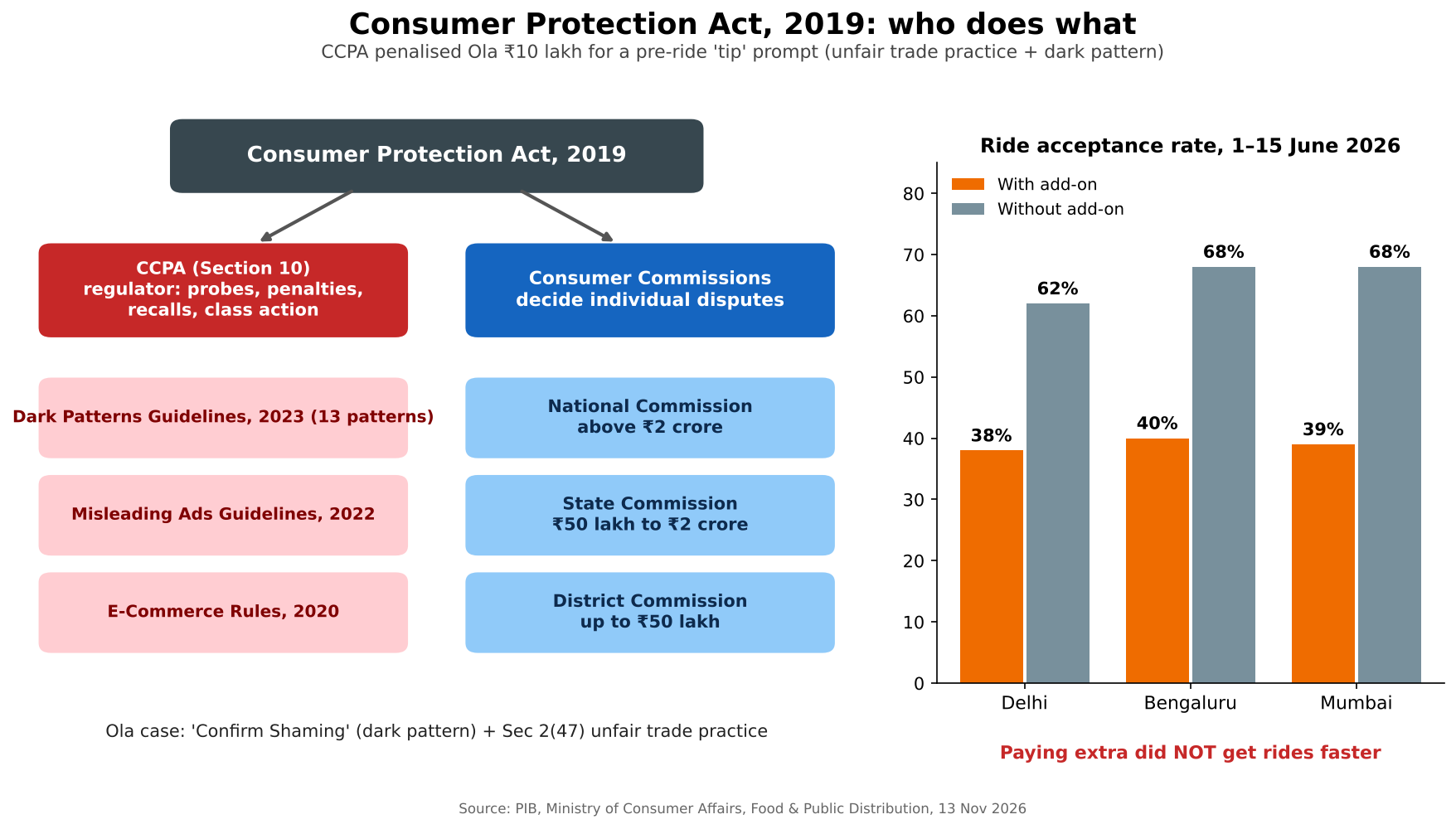
Ola's own data for 1–15 June 2026 showed the opposite. Requests with an add-on were accepted less often (Delhi 38% against 62% without one).
Renaming the "tip" as an "add-on" did not change the practice.
The CCPA found concealment of material information under Section 2(28)(iv) and an unfair trade practice under Section 2(47) of the Consumer Protection Act, 2019.
The design amounted to "Confirm Shaming" under the Guidelines for Prevention and Regulation of Dark Patterns, 2023.
It also breached Clause 14.15 of the Motor Vehicles Aggregators Guidelines, 2025, which allows tipping only after the trip.
Rapido was fined ₹10 lakh earlier. Cases against Uber and Namma Yatri are under investigation.
Prelims Facts & Static Linkages
Consumer Protection Act, 2019 at a glance
Replaced the Consumer Protection Act, 1986, and came into force in July 2020.
Set up the CCPA under Section 10 as a regulator for consumer rights, unfair trade practices and misleading advertisements. It is headed by a Chief Commissioner.
Added product liability, mediation and e-filing of complaints.
Lets consumers file complaints where they live, not only where the seller is.
Recognises six consumer rights, including the rights to safety, information, choice, to be heard, to seek redressal and to consumer education.
Three-tier Consumer Commissions
Level
Pecuniary limit (value of goods or services)
District Commission
Up to ₹50 lakh
State Commission
₹50 lakh to ₹2 crore
National Commission
Above ₹2 crore
Dark patterns to know
Confirm shaming: using guilt or fear to push a choice.
False urgency: fake scarcity or countdowns.
Basket sneaking: adding items without consent.
Drip pricing: hiding charges until the end.
Subscription trap and nagging: making exit hard or repeating requests.
The 2023 Guidelines list 13 such patterns.
CCPA's other powers
It can order recall of unsafe goods and refunds, and start class action on behalf of consumers.
For a false or misleading advertisement, it can fine a maker or endorser up to ₹10 lakh, and up to ₹50 lakh for a repeat offence.
It can bar an endorser from endorsing for up to one year, or three years for a repeat.
Consumer Protection (E-Commerce) Rules, 2020 add duties for online platforms, such as showing the seller's details and the total price.
Likely Prelims angles
Which body enforces the Dark Patterns Guidelines.
Pecuniary limits of Consumer Commissions.
Helpline 1915; National Consumer Day (24 December) and World Consumer Rights Day (15 March).
Quick Revision
CCPA fined Ola ₹10 lakh for a pre-ride tip prompt.
The feature was held to be an unfair trade practice and "confirm shaming".
The CCPA was created under Section 10 of the Consumer Protection Act, 2019.
The Dark Patterns Guidelines date from 2023.
Aggregator rules allow tips only after the journey.
Practice MCQ
Q. With reference to the Central Consumer Protection Authority (CCPA), consider the following statements:
1. It was established under the Consumer Protection Act, 2019.
2. It can impose penalties for misleading advertisements and unfair trade practices.
3. It decides consumer complaints whose value is above ₹2 crore.
Which of the statements given above is/are correct?
(a) 1 only
(b) 1 and 2 only
(c) 2 and 3 only
(d) 1, 2 and 3
Answer: (b). Complaints above ₹2 crore go to the National Consumer Disputes Redressal Commission.
Related PYQs
PYQ 1 (UPSC CSE Prelims 2026)
Which one of the following best describes the key objective of India's 'Open Network for Digital Commerce' (ONDC) initiative?
(a) To allow government control over all digital commerce transactions
(b) To replace private e-commerce players
(c) To break the dominance of large e-commerce platforms by enabling interoperability across networks
(d) To mandate UPI-based payments for all online transactions



 28
Nov 2026
 28
Nov 2026
 28
Nov 2026














0 comments
Discussion
No comments yet. Be the first.