Coal Gasification Scheme: Round 3 Opens After NTPC Bids
The Ministry of Coal closed Round 2 of the ₹37,500 crore Scheme for Promotion of Surface Coal/Lignite Gasification
DDecode Civils
· 3 min read
Coal Gasification Scheme: Round 3 Opens After NTPC Bids
Why in News
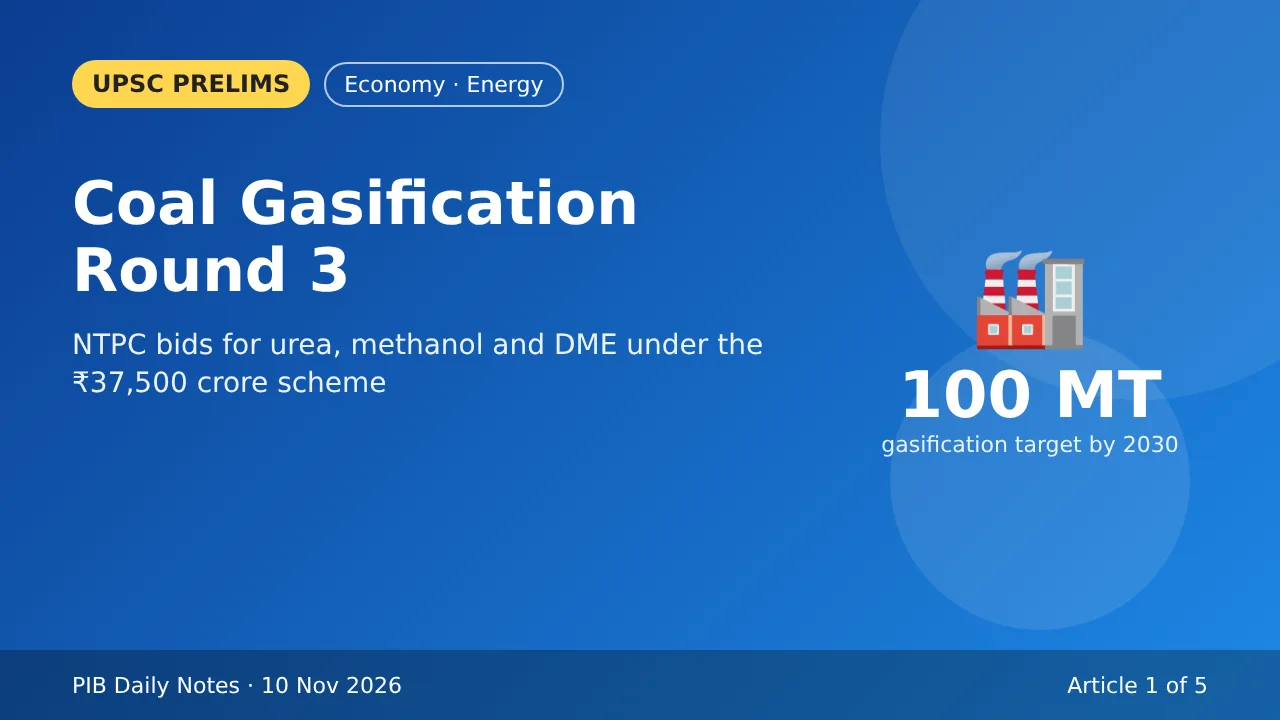
The Ministry of Coal closed Round 2 of the ₹37,500 crore Scheme for Promotion of Surface Coal/Lignite Gasification Projects on 10 November 2026. It received two applications, both from NTPC Limited. Round 3 opened the same day and will accept applications until 11 January 2027.
News Summary
The Union Cabinet approved the scheme on 13 May 2026 with a total outlay of ₹37,500 crore.
It supports surface gasification of coal and lignite.
NTPC's first application is for a urea plant. The second is for methanol and dimethyl ether (DME).
These products show how gasification can make critical industrial chemicals at home from indigenous coal.
Successive rounds aim to draw wider industry participation and investment.
The scheme supports the national target of 100 million tonnes (MT) of coal gasification by 2030.
Prelims Facts & Static Linkages
How coal gasification works
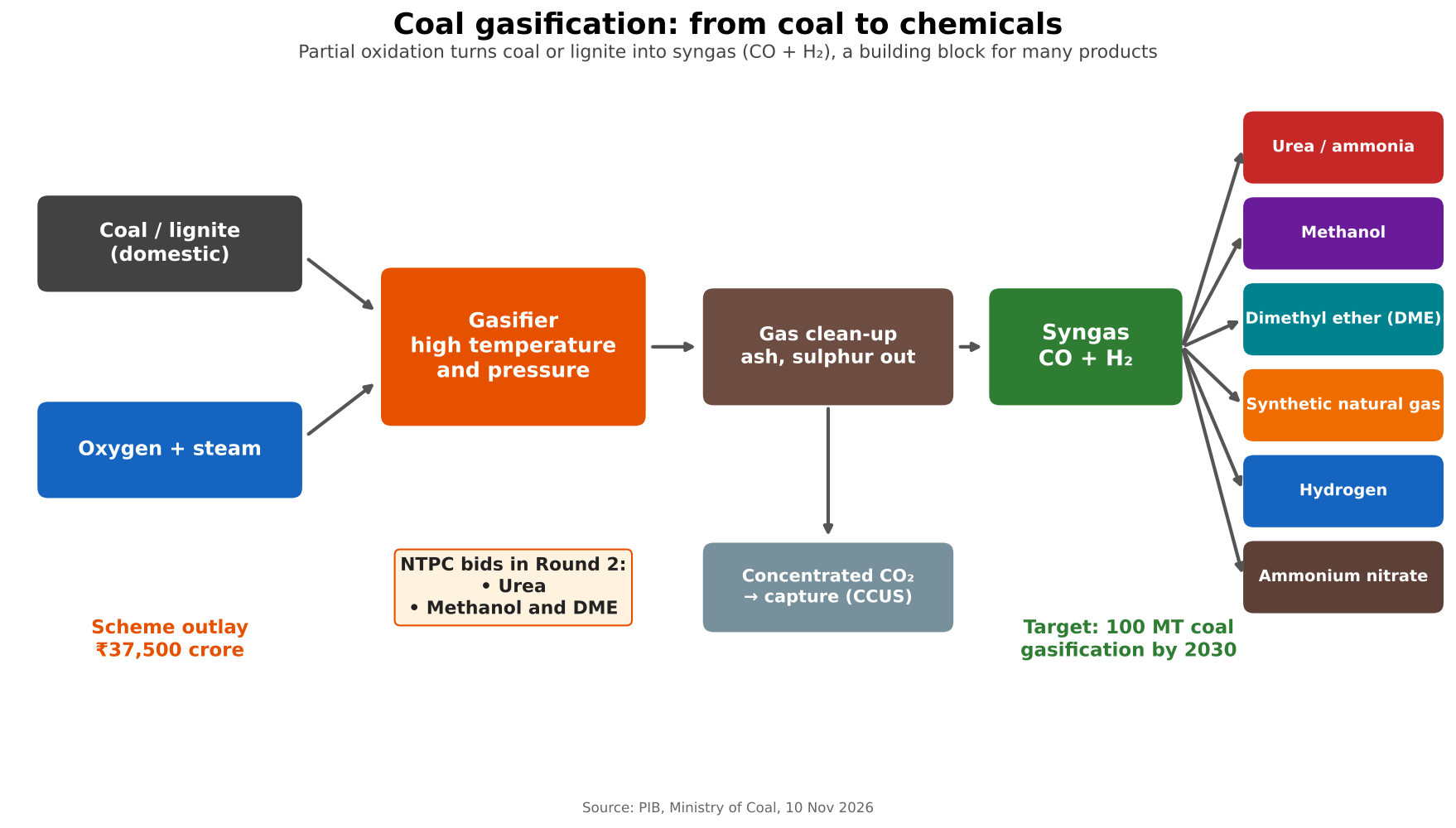
Feed: coal or lignite is reacted with a controlled amount of oxygen (or air) and steam at high temperature and pressure.
Partial oxidation: the coal is not fully burnt. It breaks down into synthesis gas (syngas), mainly carbon monoxide (CO) and hydrogen (H₂).
Clean-up: ash, sulphur and other impurities are removed from the gas. The CO₂ stream is concentrated, which makes carbon capture easier than in a power plant.
Conversion: syngas is the building block for ammonia and urea, methanol, DME, synthetic natural gas (SNG), hydrogen, ammonium nitrate (used in explosives) and olefins for plastics.
Surface versus underground gasification
Feature
Surface gasification
Underground coal gasification (UCG)
Where it happens
In a reactor (gasifier) above ground
Inside the coal seam, in situ
Coal mining
Coal is mined first
No mining; oxidant is injected through wells
Use
Deposits that can be mined
Deep or uneconomic seams
This scheme
Covered
Not covered
Why India is pushing gasification
Energy security: India imports a large share of its natural gas, methanol and ammonia, and part of its urea. Syngas from domestic coal can replace some of these imports.
Large reserves: coal is India's most abundant fossil fuel, so gasification adds value to a resource the country already has.
Cleaner use of coal: gasification is cleaner than burning coal directly, and the CO₂ is easier to capture.
DME blending: DME can be blended with LPG and used as a cooking and transport fuel.
Fertiliser self-reliance: the Talcher Fertilizers project in Odisha is India's flagship plan for coal-gasification-based urea.
Challenges
Indian coal has high ash content, which needs suitable gasifier technology.
Projects are capital-intensive, with long payback periods.
Gasification still emits CO₂ unless it is paired with carbon capture, utilisation and storage (CCUS).
Key terms
Syngas: a fuel gas mixture of CO and H₂.
Methanol: a chemical feedstock and a possible fuel blend (M15, M100).
Coal bed methane (CBM): methane trapped in coal seams. It is extracted, not made by gasification.
Lignite: low-grade brown coal, found mainly in Tamil Nadu (Neyveli), Rajasthan and Gujarat.
Quick Revision
The ₹37,500 crore surface coal/lignite gasification scheme was approved on 13 May 2026.
Round 2 drew two NTPC bids: urea, and methanol with DME.
Round 3 runs from 10 November 2026 to 11 January 2027.
The national target is 100 MT of coal gasification by 2030.
Syngas is mainly carbon monoxide and hydrogen.
Talcher (Odisha) is the coal-to-urea project.
Practice MCQ
Q. With reference to coal gasification, consider the following statements:
1. It involves the complete combustion of coal in excess oxygen.
2. The main components of syngas are carbon monoxide and hydrogen.
3. Syngas can be used to produce methanol and urea.
Which of the statements given above is/are correct?
(a) 1 only
(b) 2 and 3 only
(c) 1 and 3 only
(d) 1, 2 and 3
Answer: (b). Gasification is partial oxidation, not complete combustion.
Related PYQs
PYQ 1 (UPSC CSE Prelims 2025)
Consider the following substances:
1. Ethanol
2. Nitroglycerine
3. Urea
Coal gasification technology can be used in the production of how many of them?



 28
Nov 2026
 28
Nov 2026
 28
Nov 2026














0 comments
Discussion
No comments yet. Be the first.