PLI Scheme for Medical Devices Extended to 2035–36
Production Linked Incentive Scheme for Medical Devices (PLI-MD), which has been extended up to 2035–36
DDecode Civils
· 3 min read
PLI Scheme for Medical Devices Extended to 2035–36
Why in News
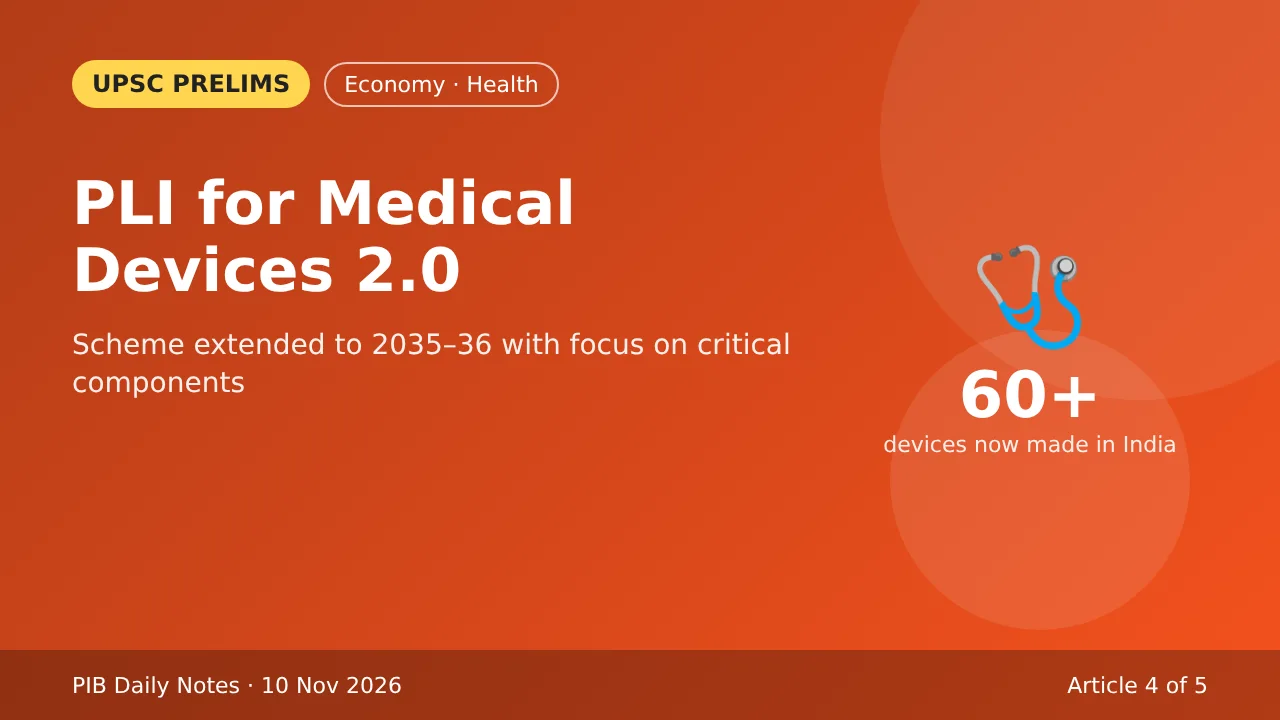
The Department of Pharmaceuticals invited fresh applications on 10 November 2026 under the Production Linked Incentive Scheme for Medical Devices (PLI-MD), which has been extended up to 2035–36. About ₹2,700 crore of the outlay is available, with a new focus on critical components.
News Summary
PLI-MD was launched in 2020-21. It has led to domestic manufacture of over 60 high-end devices and components.
These include X-ray tubes and detectors, 1.5T MRI, LINAC, CT scanners, mammography machines, cath labs, orthopaedic and cardiac implants and dialyzers.
Production under the scheme is worth over ₹16,000 crore.
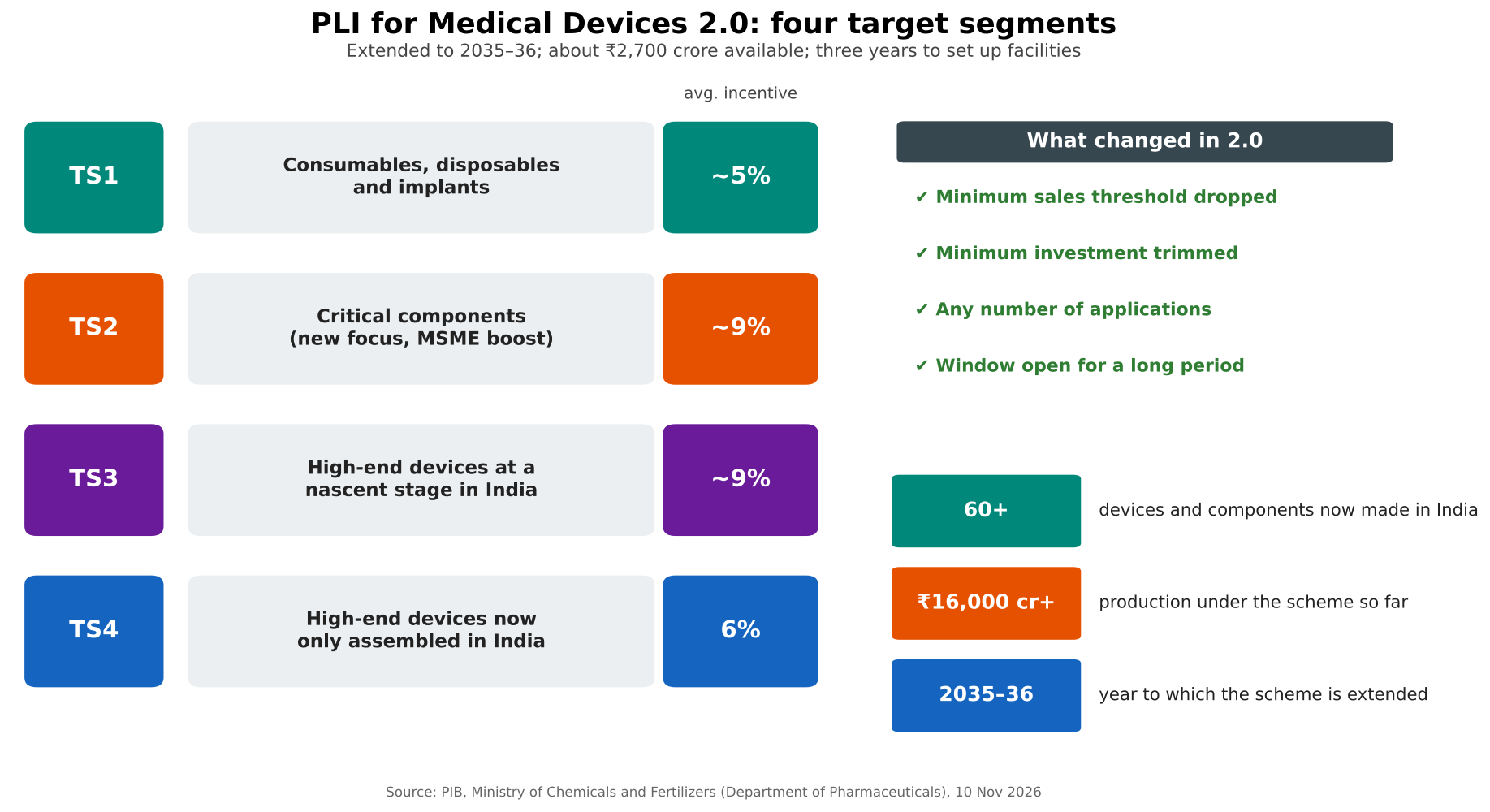
Applicants get three years to set up facilities in any of four Target Segments (TS).
The minimum sales threshold to claim incentives has been dropped, and the minimum investment requirement has been trimmed.
Firms can file any number of applications, and the window will stay open for a long period. An online portal opens within 10 days.
PLI-MD 2.0 aims at deep manufacturing and at devices not yet made in India, such as 3T MRI, PET-CT, ultrasound probes and consoles and high-throughput IVD analysers.
Prelims Facts & Static Linkages
The four Target Segments
TS1: medical consumables, disposables and implants. Average incentive about 5%. Focus on scale and world-class quality.
TS2:critical components. Average incentive about 9%. Helps value-chain integration and MSMEs.
TS3:high-end devices at a nascent stage of domestic manufacture. Average incentive about 9%.
TS4:high-end devices now only assembled in India. Average incentive 6%.
In TS3 and TS4, priority goes to value-chain integration.
How a PLI scheme works
Feature
What it means
Basis
Incentive paid as a percentage of incremental sales of goods made in India
Rate
Usually tapering over the years
Aim
Scale, global competitiveness, exports and fewer imports
Coverage
PLI schemes for 14 key sectors were announced in 2020-21
Key devices in the news
MRI (Magnetic Resonance Imaging): uses strong magnetic fields and radio waves, not ionising radiation. "1.5T" and "3T" give the magnet's strength in tesla.
CT scanner: uses X-rays to make cross-sectional images.
PET-CT: combines a radioactive tracer scan with CT to show metabolic activity, which is useful in cancer care.
LINAC (linear accelerator): produces high-energy X-rays for radiotherapy.
IVD (in vitro diagnostics): tests done on samples such as blood or urine.
Related policy framework
Medical Devices Rules, 2017, under the Drugs and Cosmetics Act, 1940, regulate devices by risk class (A to D). The regulator is the CDSCO.
National Medical Devices Policy, 2023 aims to build the sector's ecosystem.
Scheme for Promotion of Medical Device Parks: common infrastructure in Himachal Pradesh, Madhya Pradesh, Tamil Nadu and Uttar Pradesh.
The Department of Pharmaceuticals is under the Ministry of Chemicals and Fertilizers.
Quick Revision
PLI-MD began in 2020-21 and now runs to 2035–36.
About ₹2,700 crore of outlay is available for new applicants.
There are four target segments; critical components (TS2) are a new focus.
The minimum sales threshold has been removed.
Over 60 high-end devices are now made in India; output exceeds ₹16,000 crore.
Devices not yet made in India include 3T MRI and PET-CT.
Practice MCQ
Q. With reference to the Production Linked Incentive Scheme for Medical Devices, consider the following statements:
1. It is implemented by the Department of Pharmaceuticals.
2. Under its revised guidelines, a minimum sales threshold must be met to claim the incentive.
3. Critical components form one of its target segments.
Which of the statements given above is/are correct?
(a) 1 and 2 only
(b) 1 and 3 only
(c) 2 and 3 only
(d) 1, 2 and 3
Answer: (b). The minimum sales threshold has been discontinued.
Related PYQs
PYQ 1 (UPSC CSE Prelims 2023)
Consider the following statements:
Statement-I: India accounts for 3.2% of global export of goods.
Statement-II: Many local companies and some foreign companies operating in India have taken advantage of India's 'Production-linked Incentive' scheme.
Which one of the following is correct in respect of the above statements?
(a) Both Statement-I and Statement-II are correct and Statement-II is the correct explanation for Statement-I
(b) Both Statement-I and Statement-II are correct and Statement-II is not the correct explanation for Statement-I
(c) Statement-I is correct but Statement-II is incorrect
(d) Statement-I is incorrect but Statement-II is correct



 28
Nov 2026
 28
Nov 2026
 28
Nov 2026














0 comments
Discussion
No comments yet. Be the first.