PLFS July–September 2026: Unemployment Falls to 5.1%
NSO of the Ministry of Statistics and Programme Implementation (MoSPI) released the Periodic Labour Force Survey
DDecode Civils
· 3 min read
PLFS July–September 2026: Unemployment Falls to 5.1%
Why in News
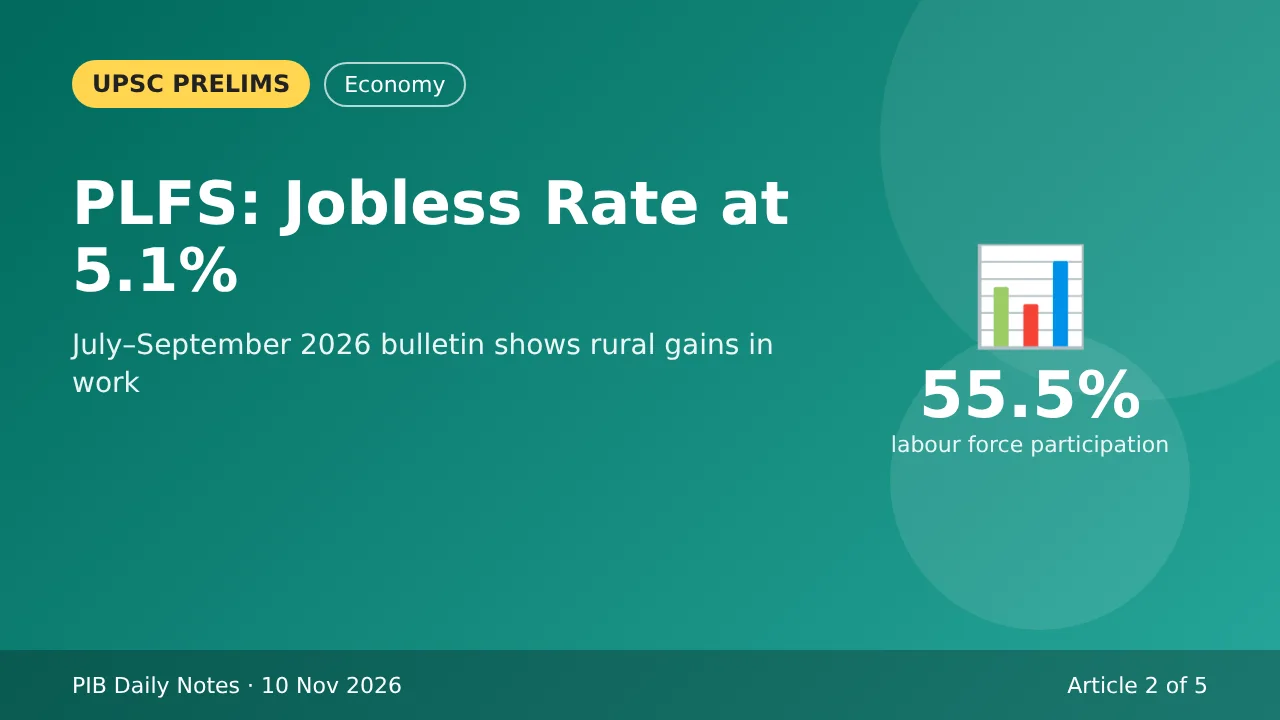
The National Statistics Office (NSO) of the Ministry of Statistics and Programme Implementation (MoSPI) released the Periodic Labour Force Survey (PLFS) Quarterly Bulletin for July–September 2026 on 10 November 2026. It shows higher participation and lower unemployment, mainly in rural areas.
News Summary
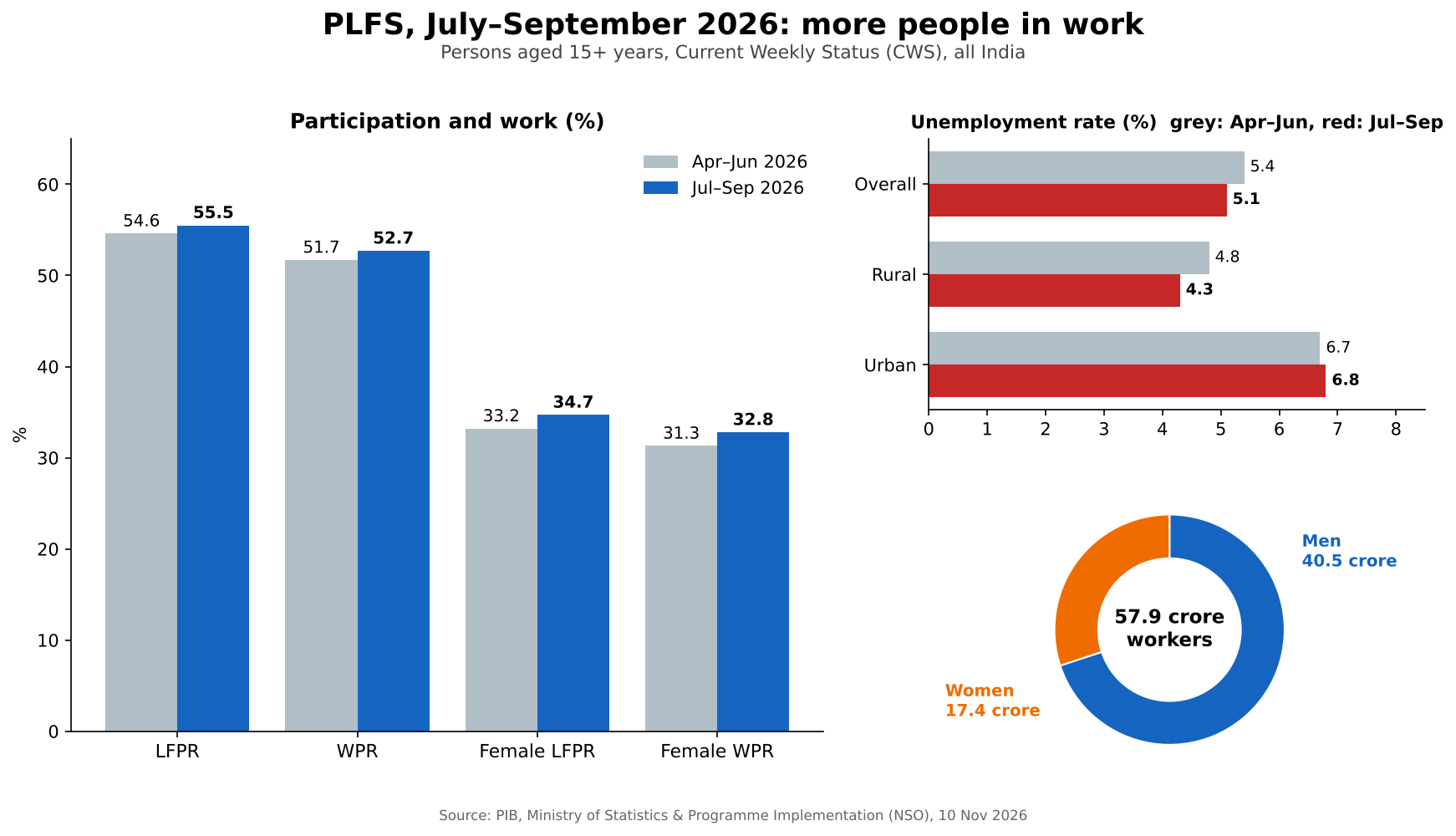
LFPR (persons aged 15+) rose to 55.5%, from 54.6% in the previous quarter. Rural LFPR was 58.1% and urban 50.4%.
Female LFPR rose to 34.7%, from 33.2%.
WPR rose to 52.7%, from 51.7%. Rural WPR was 55.6% and female WPR 32.8%.
Unemployment rate (UR) fell to 5.1%, from 5.4%. Rural UR fell to 4.3%, while urban UR was 6.8%.
Rural self-employment rose to 62.7%, and urban regular wage/salaried work rose to 49.6%.
Casual labour fell in both rural (21.7%) and urban (10.7%) areas.
Agriculture's share of rural workers rose to 56.7%, from 52.9%, a seasonal effect of the kharif season.
About 57.9 crore people aged 15+ were employed (40.5 crore men, 17.4 crore women).
This is the sixth bulletin to cover both rural and urban areas.
Prelims Facts & Static Linkages
Three key labour indicators
Labour Force Participation Rate (LFPR): the share of the population that is working or seeking/available for work.
Worker Population Ratio (WPR): the share of the population that is employed.
Unemployment Rate (UR): the share of the labour force (not the whole population) that is unemployed.
Link between them: labour force = employed + unemployed, so LFPR is always at least as large as WPR.
Activity status approaches
Approach
Reference period
Used for
Usual Status (ps+ss)
Last 365 days (principal plus subsidiary status)
Annual estimates
Current Weekly Status (CWS)
Last 7 days
Monthly, quarterly and annual estimates
About the PLFS
Launched by the NSO in 2017, replacing the NSSO's five-yearly employment–unemployment surveys.
The NSO was formed in 2019 by merging the Central Statistics Office (CSO) and the National Sample Survey Office (NSSO) under MoSPI.
Revamped in January 2025: the survey now gives monthly CWS estimates for rural and urban India, quarterly estimates for rural areas too, and annual estimates in both Usual Status and CWS.
Before this, quarterly bulletins (up to December 2024) covered only urban areas.
Absolute worker numbers use projected population figures of the Ministry of Health and Family Welfare.
Types of employment status
Self-employed: own-account workers, employers and unpaid helpers in household enterprises.
Regular wage/salaried: workers paid regularly, not on a daily or periodic contract basis.
Casual labour: workers paid daily or periodically, usually with no job security.
Types of unemployment to revise
Disguised unemployment: more workers than needed, so the marginal productivity of extra workers is close to zero. It is common in agriculture.
Seasonal unemployment: lack of work in the off-season of farming.
Structural unemployment: a mismatch between the skills workers have and the jobs available.
Frictional unemployment: short gaps while people move between jobs.
Quick Revision
The PLFS is conducted by the NSO under MoSPI.
In July–September 2026, LFPR was 55.5%, WPR 52.7% and UR 5.1%.
Rural UR fell to 4.3%; urban UR was 6.8%.
Female LFPR rose to 34.7%.
CWS has a 7-day reference period; Usual Status uses 365 days.
About 57.9 crore people aged 15+ were employed.
Practice MCQ
Q. With reference to the Periodic Labour Force Survey (PLFS), consider the following statements:
1. The unemployment rate is calculated as a percentage of the total population.
2. The Current Weekly Status approach uses a reference period of the last seven days.
3. Since 2025, quarterly PLFS estimates cover both rural and urban areas.
Which of the statements given above is/are correct?
(a) 1 only
(b) 2 and 3 only
(c) 1 and 3 only
(d) 1, 2 and 3
Answer: (b). The unemployment rate is a share of the labour force, not of the population.



 28
Nov 2026
 28
Nov 2026
 28
Nov 2026














0 comments
Discussion
No comments yet. Be the first.