Odisha's Shree Anna Abhiyan as a National Millet Model
A two-day national event on agro-biodiversity, climate-resilient agriculture and sustainable food systems began in Bhubaneswar
DDecode Civils
· 3 min read
Odisha's Shree Anna Abhiyan as a National Millet Model
Why in News
A two-day national event on agro-biodiversity, climate-resilient agriculture and sustainable food systems began in Bhubaneswar on 10 November 2026. Dr. M.L. Jat, Secretary, DARE and Director General, ICAR, called the Odisha Shree Anna Abhiyan a possible national model for millet-led farming.
News Summary
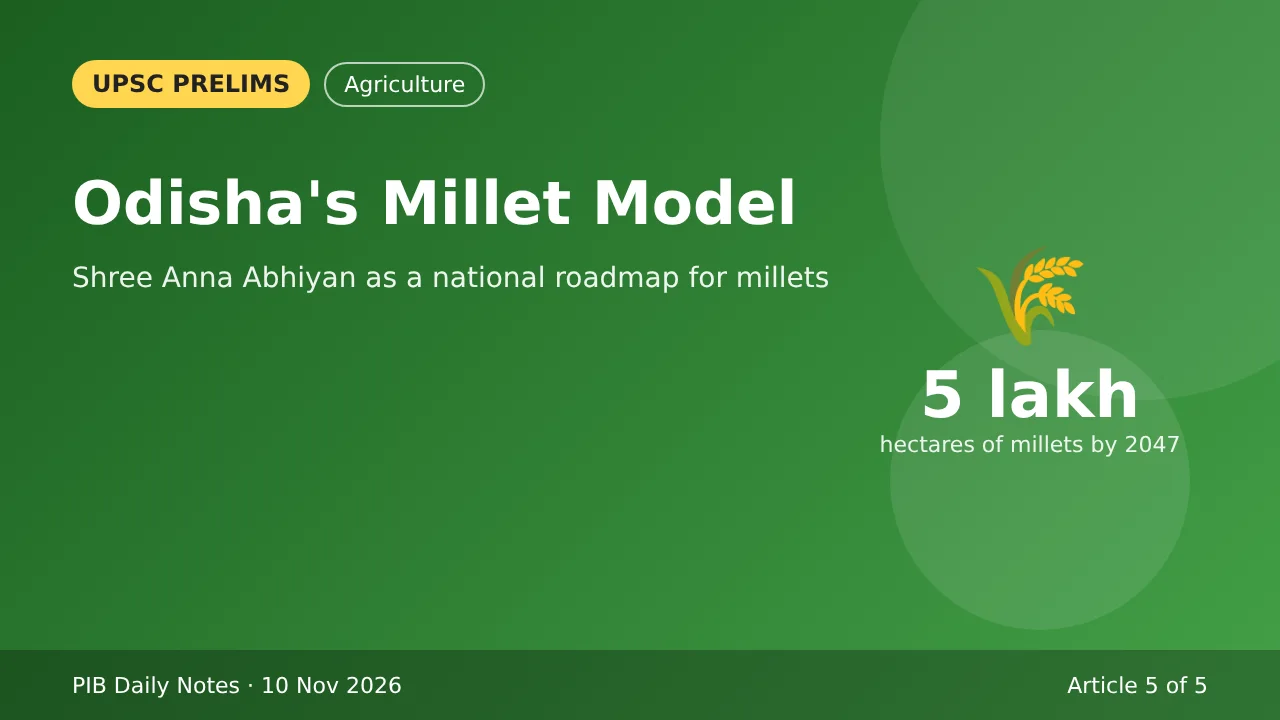
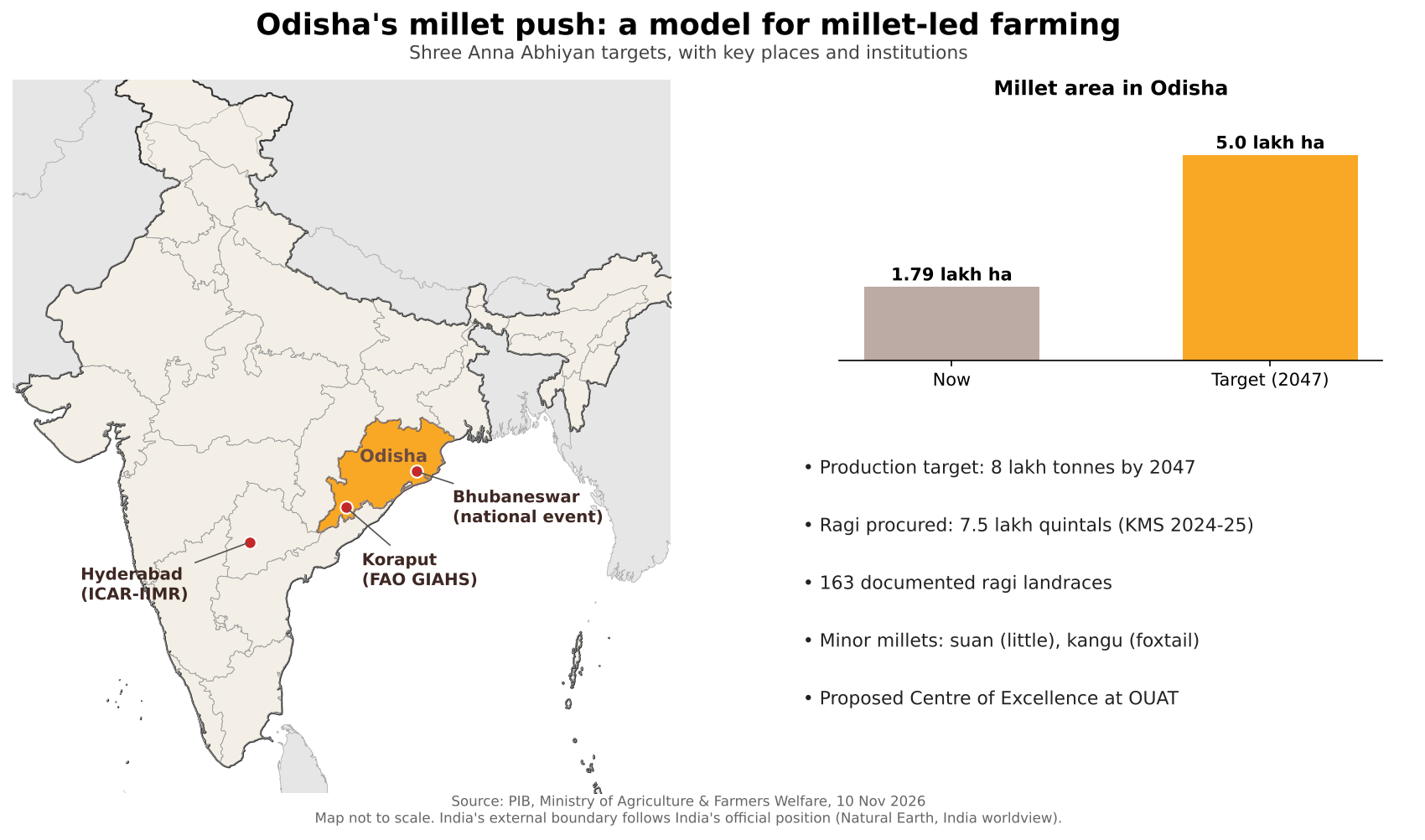
Dr. Jat called for expanding Odisha's millet area from 1.79 lakh ha to 5 lakh ha by 2047, with a production target of 8 lakh tonnes.
Odisha procured 7.5 lakh quintals of ragi in KMS 2024-25, with a target of 8 lakh quintals for 2025-26.
He stressed conserving 163 documented finger millet (ragi) landraces and traditional varieties such as Kalia, Bati, Mami and Bharathi.
He urged promotion of minor millets such as suan (little millet) and kangu (foxtail millet), affordable processing machinery, and stronger FPOs and women's SHGs.
He proposed closer research links with ICAR-IIMR, Hyderabad, and a Centre of Excellence on Millets at the Odisha University of Agriculture and Technology (OUAT).
Dr. Soumya Swaminathan, Chairperson of the M.S. Swaminathan Research Foundation, also attended.
Prelims Facts & Static Linkages
Why millets are "opportunity crops"
Climate resilience: most millets are C4 plants. They tolerate drought and heat and grow on poor soils with little water.
Nutrition: rich in dietary fibre, iron, calcium (especially ragi) and protein. They are gluten-free and have a low glycaemic index.
Soil health: they need few chemical inputs and suit rainfed and tribal farming.
One Health: local millet food systems link human nutrition, soil and environmental health.
Agro-biodiversity: landraces carry genes for stress tolerance that breeders can use.
Major and minor millets
Type
Millet
Common Indian name
Major
Sorghum
Jowar
Major
Pearl millet
Bajra
Major
Finger millet
Ragi / Mandua
Minor
Foxtail millet
Kangni / Kangu
Minor
Little millet
Kutki / Suan
Minor
Kodo millet
Kodo
Minor
Barnyard millet
Sanwa / Jhangora
Minor
Proso millet
Cheena
Policy timeline
2018: India marked a National Year of Millets and notified millets as "Nutri-Cereals".
2017: Odisha launched the Odisha Millet Mission, which is now the Shree Anna Abhiyan.
2021: the UN General Assembly adopted India's proposal to declare 2023 the International Year of Millets.
2023: millets were branded "Shree Anna", and ICAR-IIMR, Hyderabad was named a Global Centre of Excellence.
Odisha links
Koraput in southern Odisha is an FAO-recognised Globally Important Agricultural Heritage System (GIAHS), known for its traditional crop diversity.
Millets are procured at the Minimum Support Price and supplied through the Public Distribution System and nutrition schemes.
Institutions to remember
ICAR-Indian Institute of Millets Research (IIMR), Hyderabad: the national research body for millets, earlier the Directorate of Sorghum Research.
M.S. Swaminathan Research Foundation (MSSRF), Chennai: works on agro-biodiversity, community seed banks and nutrition-sensitive farming.
ICAR and DARE: the Director General of ICAR is also Secretary of the Department of Agricultural Research and Education, under the Ministry of Agriculture and Farmers Welfare.
Likely Prelims angles
Classifying millets as major or minor, and matching local names.
Nutritional traits, such as ragi's high calcium content.
Global events such as the International Year of Millets, and heritage sites such as Koraput.
Quick Revision
Odisha Shree Anna Abhiyan was praised as a model for millet-led farming.
The target is 5 lakh ha and 8 lakh tonnes of millets by 2047.
Odisha has 163 documented ragi landraces.
Suan is little millet and kangu is foxtail millet.
ICAR-IIMR is in Hyderabad.
2023 was the International Year of Millets.
Practice MCQ
Q. Which of the following are minor millets?
1. Foxtail millet
2. Little millet
3. Pearl millet
4. Kodo millet
Select the correct answer using the code given below:
(a) 1 and 2 only
(b) 1, 2 and 4 only
(c) 2, 3 and 4 only
(d) 1, 2, 3 and 4
Answer: (b). Pearl millet (bajra) is a major millet.
Related PYQs
PYQ 1 (UPSC CSE Prelims 2026)
Which among the following is/are the objective(s) of the Rainfed Area Development (RAD) initiative under the National Mission for Sustainable Agriculture (NMSA)?
1. Encouraging monoculture in rainfed areas
2. Increasing rice cultivation in irrigated regions
3. Enhancing productivity and minimising climatic risks through Integrated Farming Systems (IFS)



 28
Nov 2026
 28
Nov 2026
 28
Nov 2026














0 comments
Discussion
No comments yet. Be the first.