Conference of Public Accounts Committees in Thiruvananthapuram
Lok Sabha Speaker Om Birla inaugurated the Conference of Chairpersons of Public Accounts Committees (PACs) of Parliament and State/UT Legislatures
DDecode Civils
· 4 min read
Conference of Public Accounts Committees in Thiruvananthapuram
Why in News
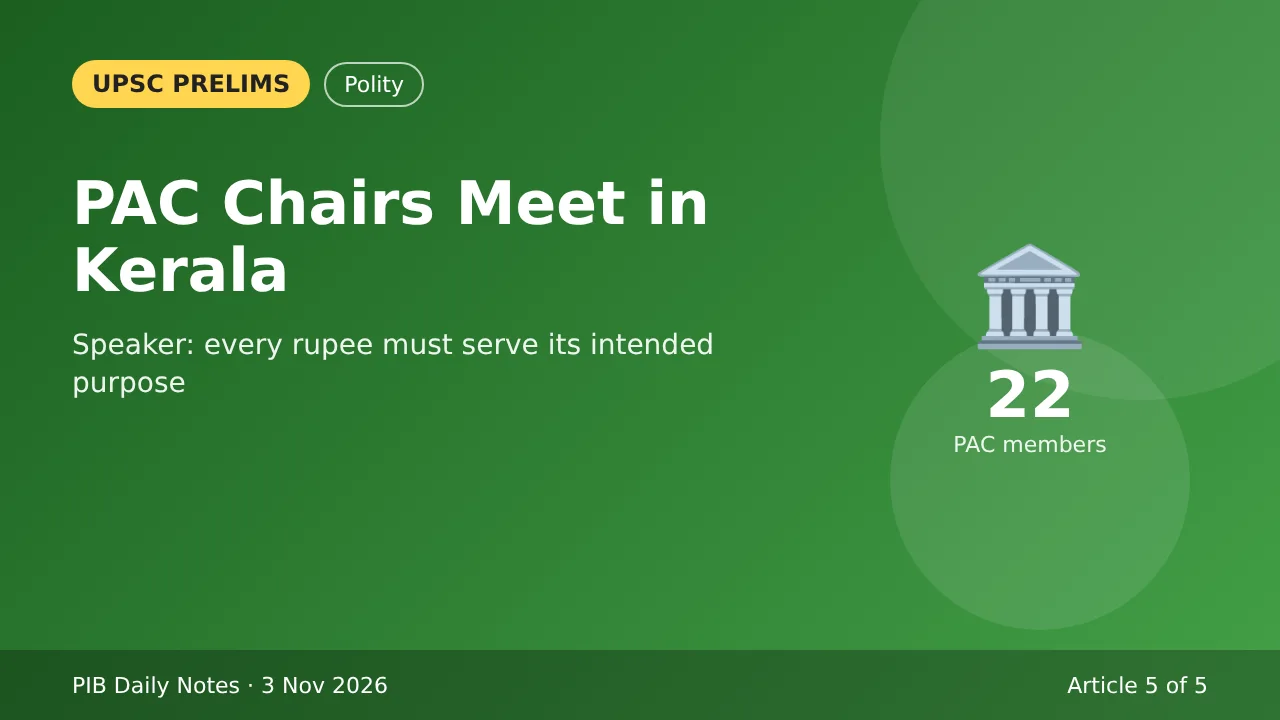
Lok Sabha Speaker Om Birla inaugurated the Conference of Chairpersons of Public Accounts Committees (PACs) of Parliament and State/UT Legislatures in Thiruvananthapuram, Keralam, on 3 November 2026. The theme was "Audit, Accountability and Good Governance – The Evolving Role of the PAC".
News Summary
The Speaker said every rupee of public money must be accounted for and used for its intended purpose, and that the real test of spending is its impact on citizens' lives.
He flagged audit observations pending for 10, 15 or even 20 years and called for a time-bound action plan to clear them.
PACs should judge outcomes, not just spending. For infrastructure, they could visit project sites.
He praised the convention of an Opposition member chairing the PAC.
He urged PACs to use AI and data analytics to spot irregularities and to scrutinise Centre–State and PPP schemes.
PAC Chairman K. C. Venugopal proposed that at least one PAC report, with the Government's Action Taken, be discussed in every session of Parliament.
A PAC Conference Souvenir 2026 was released.
Prelims Facts & Static Linkages
How the PAC holds the executive to account
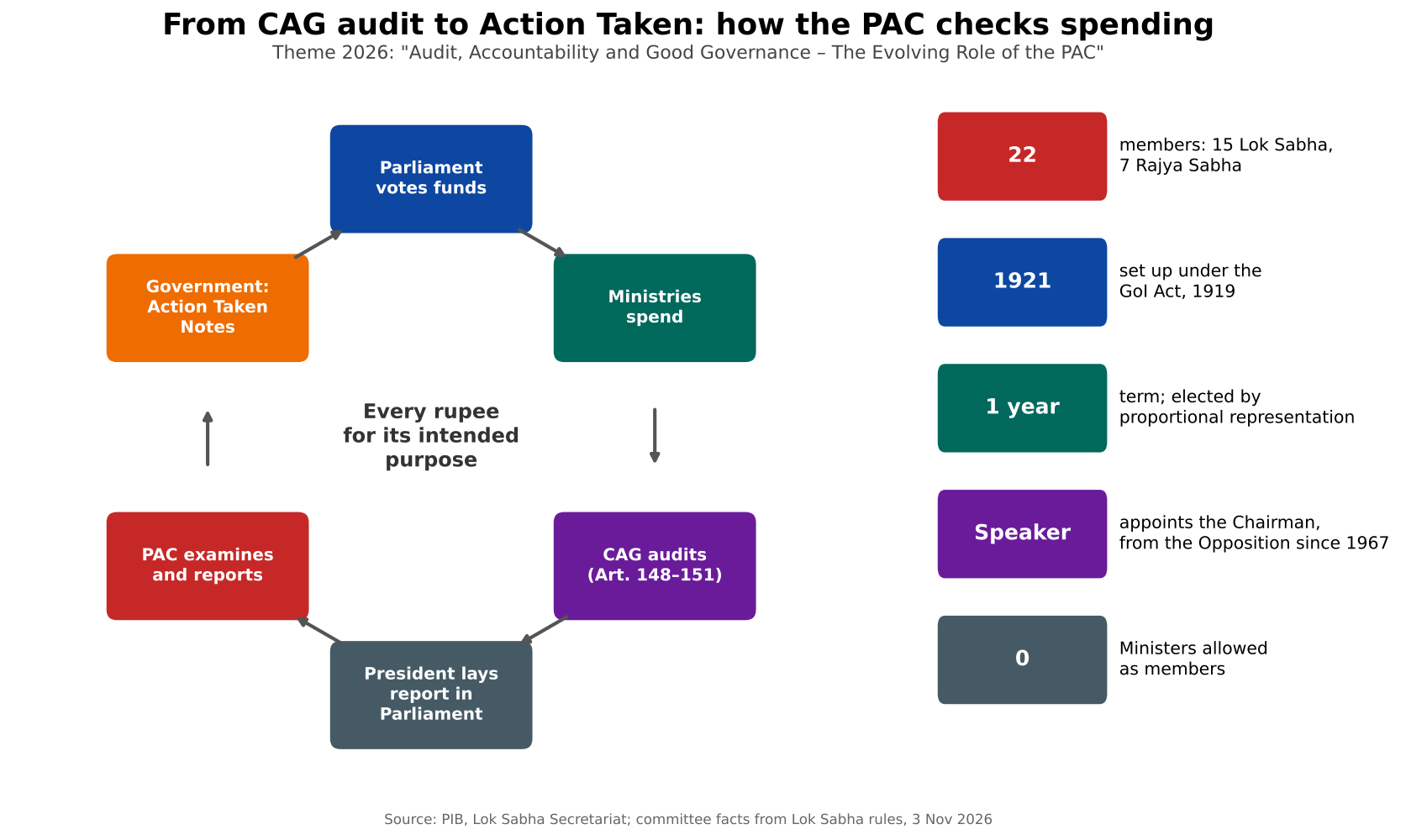
Parliament votes money through the Budget and Appropriation Acts.
Ministries spend the money.
The CAG audits the accounts and sends reports to the President (Article 151), who has them laid before Parliament.
The PAC examines these reports and calls officials to explain lapses.
The PAC reports to the Lok Sabha with recommendations.
The Government replies through Action Taken Notes, which the PAC reviews again.
The three financial committees
Committee
Members
Set up
Main job
Public Accounts Committee
22 (15 Lok Sabha, 7 Rajya Sabha)
1921
Examines CAG reports and appropriation accounts
Estimates Committee
30 (all Lok Sabha)
1950
Suggests economies in estimates
Committee on Public Undertakings
22 (15 Lok Sabha, 7 Rajya Sabha)
1964
Examines CAG reports on public sector undertakings
Key facts about the PAC
It began in 1921 under the Government of India Act, 1919 (Montagu–Chelmsford Reforms). Its centenary was marked in 2021.
Members are elected every year by proportional representation by means of the single transferable vote.
The Speaker appoints the Chairman from among the members. Since 1967, the Chairman has been from the Opposition.
A Minister cannot be a member.
The CAG acts as the PAC's "friend, philosopher and guide".
Limits: its work is largely post-mortem, and its recommendations are advisory. It cannot question policy, only how money was spent.
States have their own PACs, which examine the CAG's State audit reports placed before the State Legislature under Article 151(2).
Likely Prelims angles
Composition and election of the PAC.
Articles 148–151 on the CAG. The CAG is appointed by the President and removed only like a Supreme Court judge.
Differences among the three financial committees.
Quick Revision
The PAC chairpersons' conference was held in Thiruvananthapuram on 3 November 2026.
The PAC has 22 members: 15 from Lok Sabha and 7 from Rajya Sabha.
The Speaker appoints its Chairman, by convention from the Opposition.
It examines CAG reports, and the Government answers through Action Taken Notes.
It was set up in 1921 under the Government of India Act, 1919.
Practice MCQ
Q. With reference to the Public Accounts Committee of Parliament, consider the following statements:
1. All its members are drawn from the Lok Sabha.
2. Its Chairman is appointed by the Speaker of the Lok Sabha.
3. A Minister cannot be elected as its member.
Which of the statements given above is/are correct?
(a) 1 only
(b) 2 and 3 only
(c) 1 and 3 only
(d) 1, 2 and 3
Answer: (b). Seven of its 22 members come from the Rajya Sabha.
Related PYQs
PYQ 1 (UPSC CSE Prelims 2024)
With reference to the Speaker of the Lok Sabha, consider the following statements:
While any resolution for the removal of the Speaker of the Lok Sabha is under consideration
1. He/She shall not preside.
2. He/She shall not have the right to speak.
3. He/She shall not be entitled to vote on the resolution in the first instance.
Which of the statements given above is/are correct?
(a) 1 only
(b) 1 and 2 only
(c) 2 and 3 only
(d) 1, 2 and 3
Answer: (a).
PYQ 2 (UPSC CSE Prelims 2024)
Which of the following statements about the Ethics Committee in the Lok Sabha are correct?
1. Initially it was an ad-hoc Committee.
2. Only a Member of the Lok Sabha can make a complaint relating to unethical conduct of a member of the Lok Sabha.
3. This Committee cannot take up any matter which is sub-judice.



 28
Nov 2026
 28
Nov 2026
 28
Nov 2026














0 comments
Discussion
No comments yet. Be the first.