Constitution Day 2026: Revisiting the Making of the Constitution
Ministry of Parliamentary Affairs announced that Constitution Day (Samvidhan Diwas) will be observed on 26 November 2026
DDecode Civils
· 4 min read
Constitution Day 2026: Revisiting the Making of the Constitution
Why in News
The Ministry of Parliamentary Affairs announced that Constitution Day (Samvidhan Diwas) will be observed on 26 November 2026. The day marks the adoption of the Constitution by the Constituent Assembly on 26 November 1949, and has been observed as Constitution Day since 2015.
News Summary
An online reading of the Preamble is being run on the MyGov portal in 23 languages: the 22 Scheduled Languages and English.
A Constitution Quiz runs on the MyGov and MyBharat portals from 18 to 26 November 2026.
Viksit Bharat Yuva Samvad is being held in 786 districts across all 36 States/UTs from 24 to 26 November.
Ministries, States, schools and universities are holding collective Preamble readings, seminars, quizzes, debates, walks and runs.
The aim is to build constitutional awareness and responsible citizenship, especially among young people.
Prelims Facts & Static Linkages
Making of the Constitution
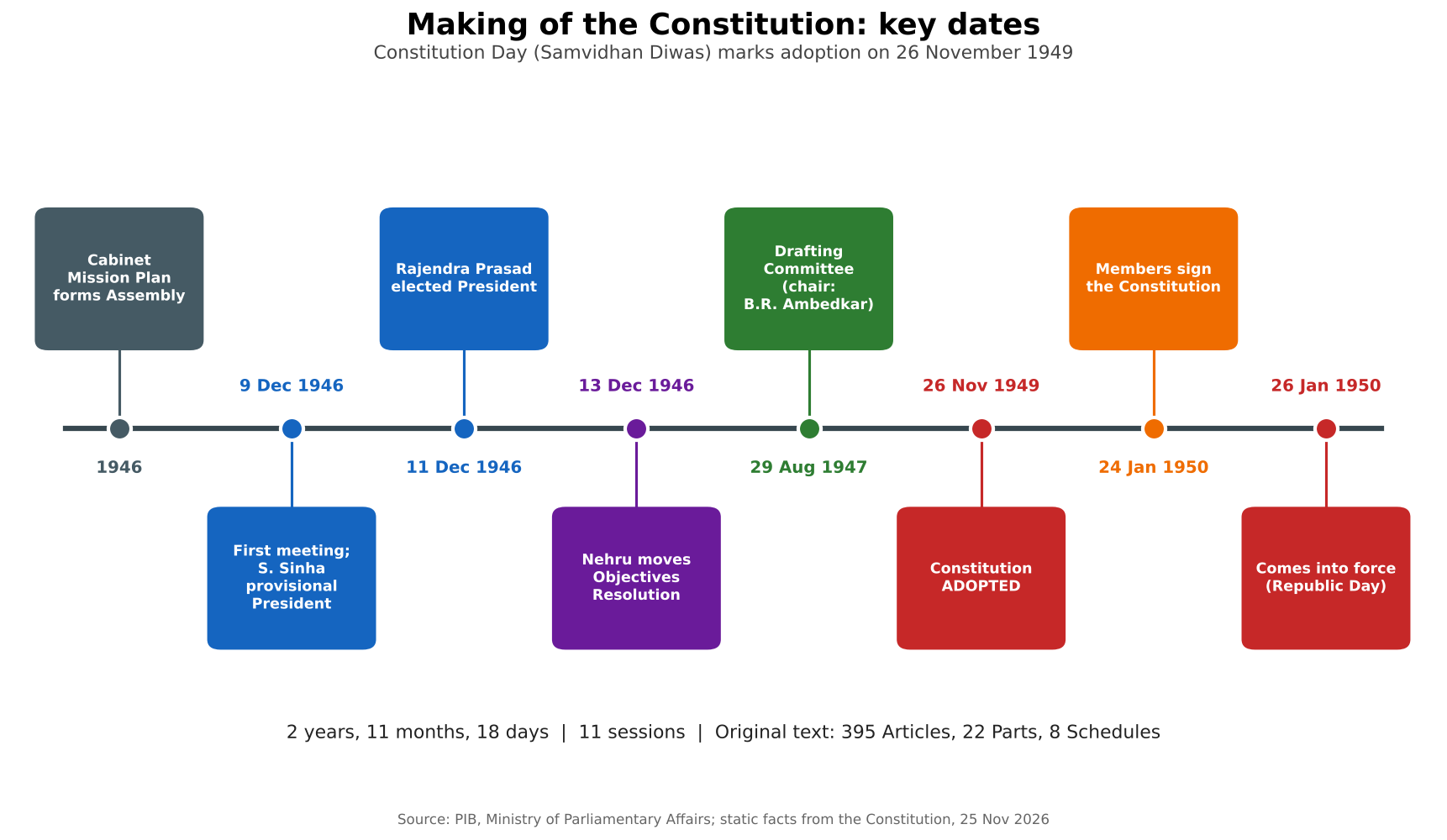
The Constituent Assembly was formed under the Cabinet Mission Plan, 1946. Its members were indirectly elected by the provincial legislative assemblies.
First meeting: 9 December 1946. Dr. Sachchidananda Sinha was the provisional President.
Dr. Rajendra Prasad was elected President on 11 December 1946.
Objectives Resolution: moved by Jawaharlal Nehru on 13 December 1946 and adopted on 22 January 1947. It later became the basis of the Preamble.
Drafting Committee: set up on 29 August 1947 and chaired by Dr. B.R. Ambedkar. B.N. Rau was the Constitutional Advisor.
The Constitution took 2 years, 11 months and 18 days to make, across 11 sessions.
Adopted: 26 November 1949. Signed: 24 January 1950. Came into force:26 January 1950.
Provisions on citizenship, elections, the provisional Parliament and temporary provisions came into force on 26 November 1949 itself (Article 394).
The original Constitution
Feature
Detail
Articles
395
Parts
22
Schedules
8
Calligraphy
Prem Behari Narain Raizada
Artwork
Nandalal Bose and artists of Santiniketan
The Preamble
The Preamble names its own date: "this twenty-sixth day of November, 1949".
"We, the people of India" shows that the people are the source of authority.
The 42nd Amendment (1976) added "Socialist", "Secular" and "Integrity". It is the only amendment to the Preamble so far.
Berubari Union case (1960): the Supreme Court held the Preamble is not part of the Constitution.
Kesavananda Bharati case (1973): reversed this. The Preamble is part of the Constitution and can be amended, but not its basic structure.
LIC of India case (1995): reaffirmed that the Preamble is an integral part.
The Preamble is not justiciable and is neither a source of power nor a limit on the legislature.
Why 26 November
26 November was earlier marked as National Law Day.
In 2015, the 125th birth anniversary of Dr. Ambedkar, the government notified it as Constitution Day.
26 January was chosen as the commencement date because the Purna Swaraj declaration was celebrated on 26 January 1930.
Scheduled Languages
The Eighth Schedule lists 22 languages.
The 92nd Amendment (2003) added Bodo, Dogri, Maithili and Santhali.
Quick Revision
The Constitution was adopted on 26 November 1949 and came into force on 26 January 1950.
Sachchidananda Sinha was the provisional President of the Assembly, and Rajendra Prasad its permanent President.
The Preamble has been amended only once, in 1976.
Kesavananda Bharati held the Preamble is part of the Constitution.
Constitution Day has been observed since 2015.
Practice MCQ
Q. Consider the following statements:
1. The Constitution of India was adopted by the Constituent Assembly on 26 November 1949.
2. The words "Socialist" and "Secular" were added to the Preamble by the 44th Amendment.
3. The provisions relating to citizenship came into force on 26 November 1949.
Which of the statements given above are correct?
(a) 1 and 2 only
(b) 2 and 3 only
(c) 1 and 3 only
(d) 1, 2 and 3
Answer: (c). Both words were added by the 42nd Amendment, 1976.
Related PYQs
PYQ 1 (UPSC CSE Prelims 2024)
Who was the Provisional President of the Constituent Assembly before Dr. Rajendra Prasad took over?
(a) C. Rajagopalachari
(b) Dr. B.R. Ambedkar
(c) T.T. Krishnamachari
(d) Dr. Sachchidananda Sinha
Answer: (d).
PYQ 2 (UPSC CSE Prelims 2020)
The Preamble to the Constitution of India is
(a) a part of the Constitution but has no legal effect
(b) not a part of the Constitution and has no legal effect either
(c) a part of the Constitution and has the same legal effect as any other part
(d) a part of the Constitution but has no legal effect independently of other parts



 25
Nov 2026
 25
Nov 2026
 25
Nov 2026














0 comments
Discussion
No comments yet. Be the first.