CCEA approved a Second Container Terminal at Kamarajar Port Limited (KPL), Tamil Nadu
DDecode Civils
· 3 min read
Kamarajar Port Gets a Second Container Terminal
Why in News
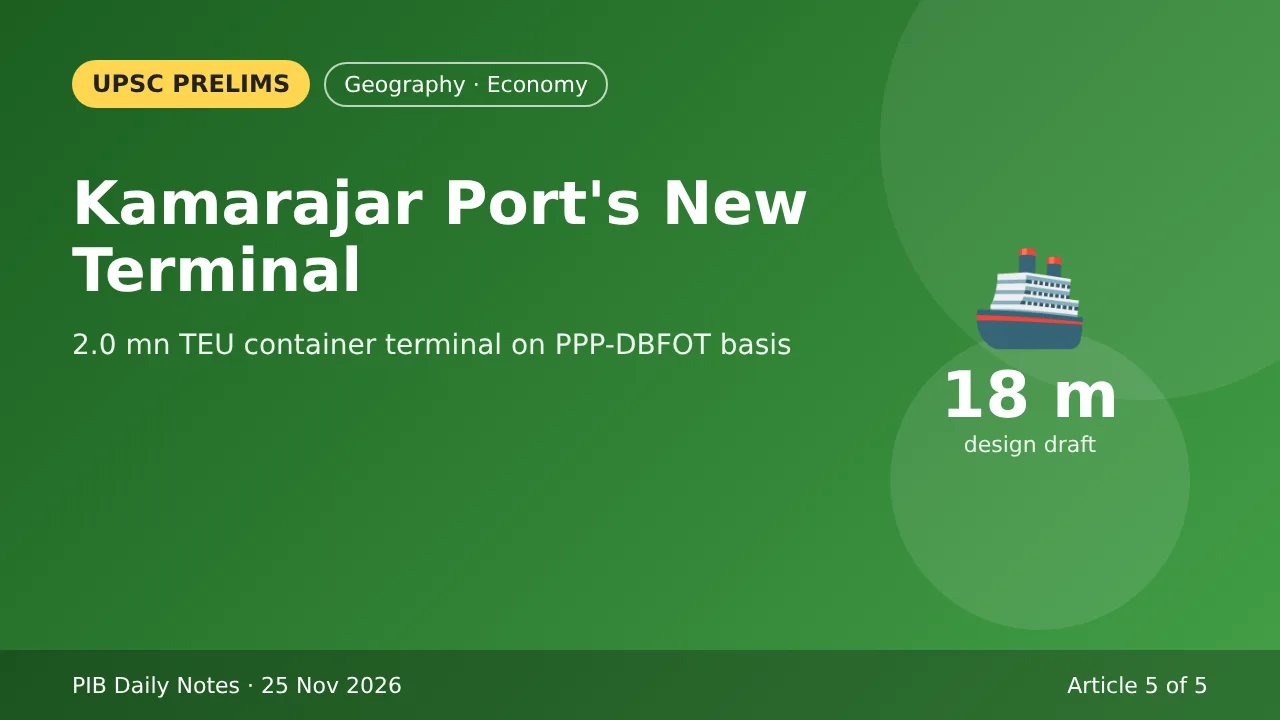
The Cabinet Committee on Economic Affairs (CCEA) approved a Second Container Terminal at Kamarajar Port Limited (KPL), Tamil Nadu. It will be built in Public Private Partnership (PPP) mode on a Design, Build, Finance, Operate and Transfer (DBFOT) basis, at an estimated cost of ₹4,288.26 crore.
News Summary
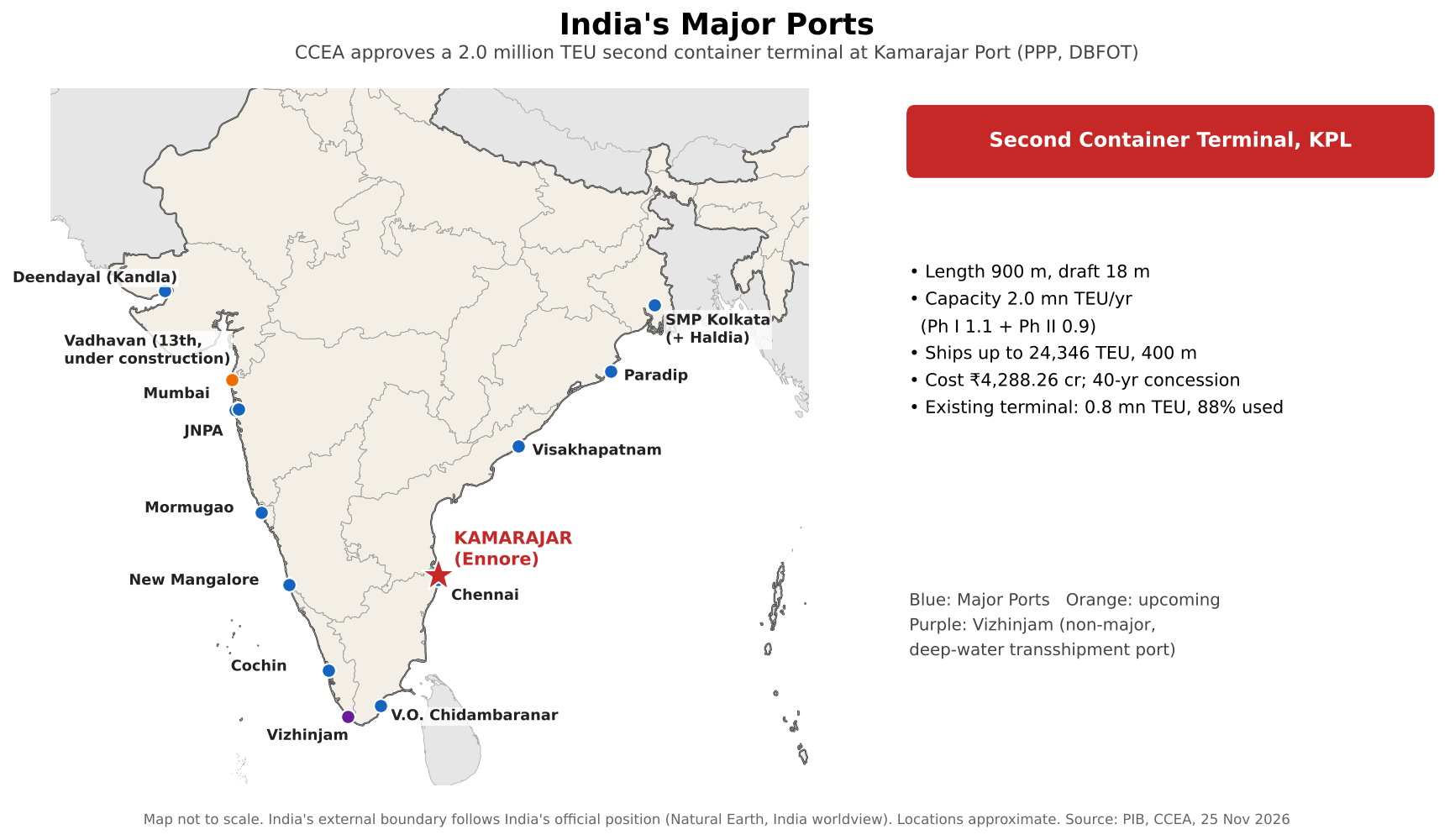
Terminal:900 metres long with an 18-metre design draft. Capacity is 2.0 million TEUs a year.
Two phases:
Phase I: 1.1 million TEUs, ready in 24 months
Phase II: 0.9 million TEUs, ready by the 48th month
Ship size: vessels of up to 24,346 TEUs and 400 m in length, the largest class of container ships.
Concession:40 years, including 48 months of construction. KPL will pay about ₹450 crore for dredging.
There is no cost to the Government of India. The concessionaire raises the money and recovers it through user charges.
The existing terminal is nearly full:
Capacity: 0.8 million TEUs
FY 2025–26 traffic: about 0.7 million TEUs, or 88% utilisation
FY 2025–26 performance:
Cargo: 49.08 million tonnes
Revenue: about ₹1,280 crore
The project follows Maritime India Vision 2030 and Maritime Amrit Kaal Vision 2047.
Prelims Facts & Static Linkages
About Kamarajar Port
It was formerly Ennore Port, about 24 km north of Chennai Port. It was renamed in 2011 after K. Kamaraj, former Chief Minister of Tamil Nadu.
It is India's first corporatised Major Port, registered as a company. It is wholly owned by the Chennai Port Authority.
It handles coal, POL, LNG, LPG, containers and automobiles.
Hinterland: the Chennai–Ennore industrial belt and parts of Karnataka, Andhra Pradesh and Telangana.
India's 12 Major Ports
East coast:
Syama Prasad Mookerjee Port (Kolkata, with Haldia)
Paradip
Visakhapatnam
Kamarajar
Chennai
V.O. Chidambaranar (Thoothukudi)
West coast:
Cochin
New Mangalore
Mormugao
Mumbai
Jawaharlal Nehru Port Authority
Deendayal (Kandla)
Vadhavan (Maharashtra), approved in 2024, is being built as a 13th Major Port.
Why bigger ships matter
Mega container ships need deep drafts (16–18 m or more). Most Indian ports were too shallow, so cargo went to Colombo, Singapore or Jebel Ali for transshipment.
This added feeder costs and delays for Indian exporters.
Deep-draft terminals let mainline vessels call directly, cutting logistics costs.
Key terms
Term
Meaning
TEU
Twenty-foot Equivalent Unit, the standard unit of container capacity
Draft
The depth of water a ship needs to float; deeper drafts allow bigger ships
DBFOT
The private partner designs, builds, finances and operates, then returns the asset
Transshipment
Moving cargo between ships at a hub port; India still relies on Colombo and Singapore
Constitutional and legal linkages
Major ports are in the Union List (Entry 27). Non-major ports come under States through the Concurrent List (Entry 31).
The Major Port Authorities Act, 2021 replaced the Major Port Trusts Act, 1963.
Sagarmala Programme (2015): port-led development.
Vizhinjam (Kerala): India's first deep-water transshipment port.
Quick Revision
The second terminal at Kamarajar is 900 m long, with an 18 m draft and 2.0 million TEUs of capacity.
It is a PPP on a DBFOT basis, with a 40-year concession.
Kamarajar (Ennore) was India's first corporatised Major Port.
India has 12 Major Ports, and Vadhavan will be the 13th.
Major ports are in the Union List.
Vizhinjam is India's first deep-water transshipment port.
Practice MCQ
Q. Consider the following statements:
1. Kamarajar Port, formerly Ennore Port, is located in Andhra Pradesh.
2. Major ports are a subject in the Union List.
3. In a DBFOT project, the private concessionaire arranges the financing.
Which of the statements given above are correct?
(a) 1 and 2 only
(b) 2 and 3 only
(c) 1 and 3 only
(d) 1, 2 and 3
Answer: (b). Kamarajar Port is in Tamil Nadu.
Related PYQs
PYQ 1 (UPSC CSE Prelims 2026)
In what way(s) does the Vizhinjam International Seaport represent a structural shift in India's maritime trade and logistics policy?
1. By functioning exclusively as a domestic cargo hub to reduce reliance on coastal shipping and eliminate the need for foreign collaborations.
2. By focusing primarily on passenger cruise tourism and heritage shipping to increase Kerala's profile as a maritime heritage destination.
3. By leveraging its natural deep draft and strategic location to reduce dependence on foreign trans-shipment ports, enhance revenue retention, and reposition India in regional maritime trade.



 25
Nov 2026
 25
Nov 2026
 25
Nov 2026














0 comments
Discussion
No comments yet. Be the first.