Northeast's First Region-Specific Antivenom for Pit Vipers
Scientists at IASST, Guwahati have developed the first Northeast India-specific antivenom
DDecode Civils
· 3 min read
Northeast's First Region-Specific Antivenom for Pit Vipers
Why in News
Scientists at the Institute of Advanced Study in Science and Technology (IASST), Guwahati have developed the first Northeast India-specific antivenom. It works against two pit vipers that the commercial antivenom does not neutralise well.
News Summary
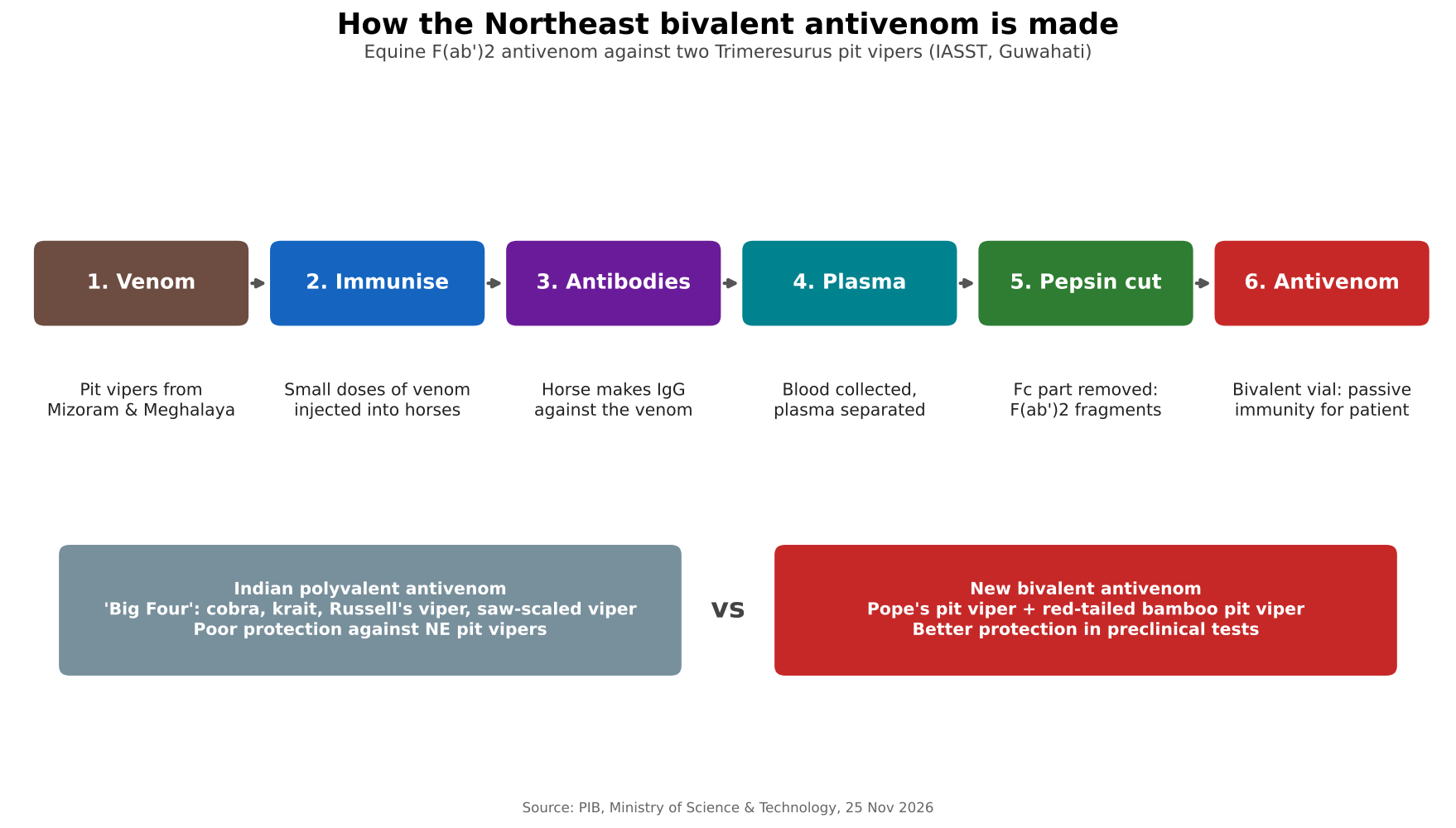
The new antivenom is an equine F(ab')2 bivalent antivenom. It targets the venom of:
Venom was collected from snakes in Mizoram and Meghalaya.
India's commercial polyvalent antivenom targets only the "Big Four". Studies show it works poorly against many Northeast species.
In laboratory and preclinical tests, the new antivenom gave clearly better protection than the Indian polyvalent antivenom. It reduced blood-clotting disruption and local and organ tissue damage.
The team was led by Prof. Ashis K. Mukherjee, Director of IASST. Partners were:
Premium Serums and Vaccines Pvt. Ltd., Pune
Amrita Research Center, Delhi-NCR
Mizoram University
Aaranyak, Guwahati
The study appeared in the International Journal of Biological Macromolecules. Clinical and regulatory trials are still needed before routine use.
Prelims Facts & Static Linkages
The "Big Four" snakes of India
Snake
Venom type
Main effect
Spectacled cobra
Neurotoxic
Paralysis, breathing failure
Common krait
Neurotoxic
Paralysis, often painless bite at night
Russell's viper
Haemotoxic
Bleeding, kidney injury
Saw-scaled viper
Haemotoxic
Bleeding, clotting failure
How antivenom is made
A small, safe dose of venom is injected into horses (equine) over weeks.
The horse's immune system makes antibodies against the venom.
Blood plasma is collected and the antibodies are purified.
Enzyme digestion (pepsin) cuts off the Fc part, leaving F(ab')2 fragments. This lowers the risk of allergic reactions.
The finished vial gives passive immunity: ready-made antibodies that neutralise venom at once.
Key terms
Polyvalent antivenom: works against several species (in India, the Big Four).
Bivalent antivenom: works against two species.
Monovalent antivenom: works against one species.
Pit vipers: vipers with a heat-sensing pit between the eye and nostril that detects warm-blooded prey.
Snakebite as a public health issue
The WHO added snakebite envenoming to its list of Neglected Tropical Diseases in 2017. Its target is to halve snakebite deaths and disabilities by 2030.
India has the highest number of snakebite deaths in the world.
India's National Action Plan for Prevention and Control of Snakebite Envenoming (NAP-SE), launched in 2024, shares the goal of halving deaths by 2030.
Northeast India has high snake diversity, and many of its species fall outside the Big Four.
Why region-specific antivenoms matter
Venom composition varies by species and even by region, so an antivenom raised against one population may fail against another.
Doctors in the Northeast often had to give large doses of polyvalent antivenom with poor results.
Region-specific products can cut deaths, disability and treatment costs.
About IASST
IASST is an autonomous institute of the Department of Science and Technology (DST), located in Guwahati, Assam.
Quick Revision
IASST Guwahati developed the antivenom, and it is under DST.
It is a bivalent, equine F(ab')2 antivenom against two Trimeresurus pit vipers.
The venom came from Mizoram and Meghalaya.
The Big Four are the cobra, krait, Russell's viper and saw-scaled viper.
The WHO listed snakebite as an NTD in 2017.
Antivenom gives passive immunity.
Practice MCQ
Q. With reference to antivenom used in India, consider the following statements:
1. It is produced by immunising horses with snake venom.
2. It provides active immunity by stimulating the patient's body to make its own antibodies.
3. The commercially available polyvalent antivenom targets the "Big Four" snakes.
Which of the statements given above are correct?
(a) 1 and 2 only
(b) 2 and 3 only
(c) 1 and 3 only
(d) 1, 2 and 3
Answer: (c). Antivenom gives passive immunity.
Related PYQs
PYQ 1 (UPSC CSE Prelims 2025)
With reference to monoclonal antibodies, often mentioned in news, consider the following statements:
I. They are man-made proteins.
II. They stimulate immunological function due to their ability to bind to specific antigens.
III. They are used in treating viral infections like that of Nipah virus.



 25
Nov 2026
 25
Nov 2026
 25
Nov 2026














0 comments
Discussion
No comments yet. Be the first.