
NIPU-2026: Six New Urea Plants for Self-Reliance
The government approved 6 new brownfield urea plants under the National Investment Policy for Urea

NIPU-2026: Six New Urea Plants for Self-Reliance
Why in News
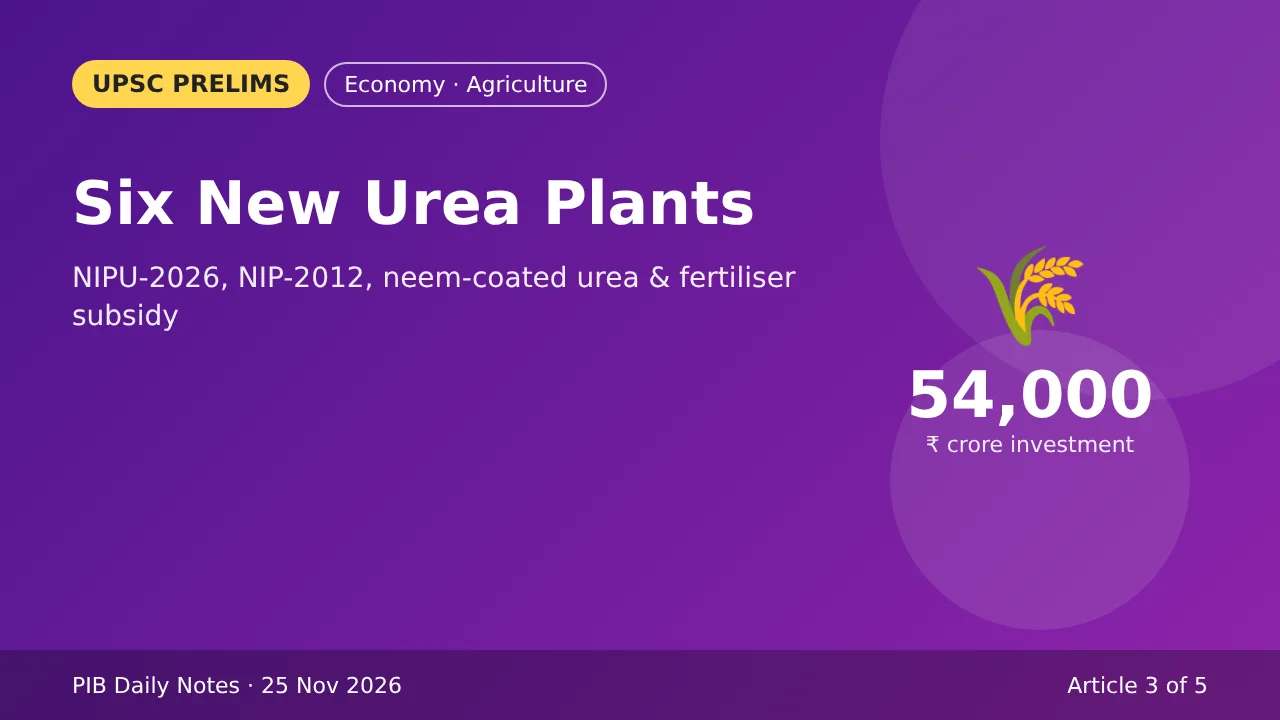
The government approved 6 new brownfield urea plants under the National Investment Policy for Urea (NIPU)-2026. They bring an expected investment of about ₹54,000 crore and aim at self-reliance in urea production.
News Summary
Each plant will have an annual installed capacity of 12.7 lakh metric tonnes (LMT). The six plants are:
MFL-Madras (Chennai, Tamil Nadu), a PSU plant replacing a unit over 60 years old.
NFL Nangal (Punjab), a PSU plant replacing a 50–55 year old unit of 4.73 LMT.
KFL-Shahjahanpur (Uttar Pradesh), a cooperative project of KRIBHCO.
Matix-Panagarh (West Bengal), a private project. It will be the state's second urea plant.
CFCL Gadepan (Kota, Rajasthan), a private project.
IIPL-Jagdishpur (Uttar Pradesh), a private project.
Brownfield projects reuse existing land, utilities and manpower, so they are faster and cheaper to build.
Investor safeguards:
A Return on Equity band of 12–16%
A foreign exchange rate mitigation mechanism
Old plants waste energy. Nangal uses 6.498 Gcal/MT, against an industry average of 5.95 and a New Energy Norm of 5 Gcal/MT.
Prelims Facts & Static Linkages
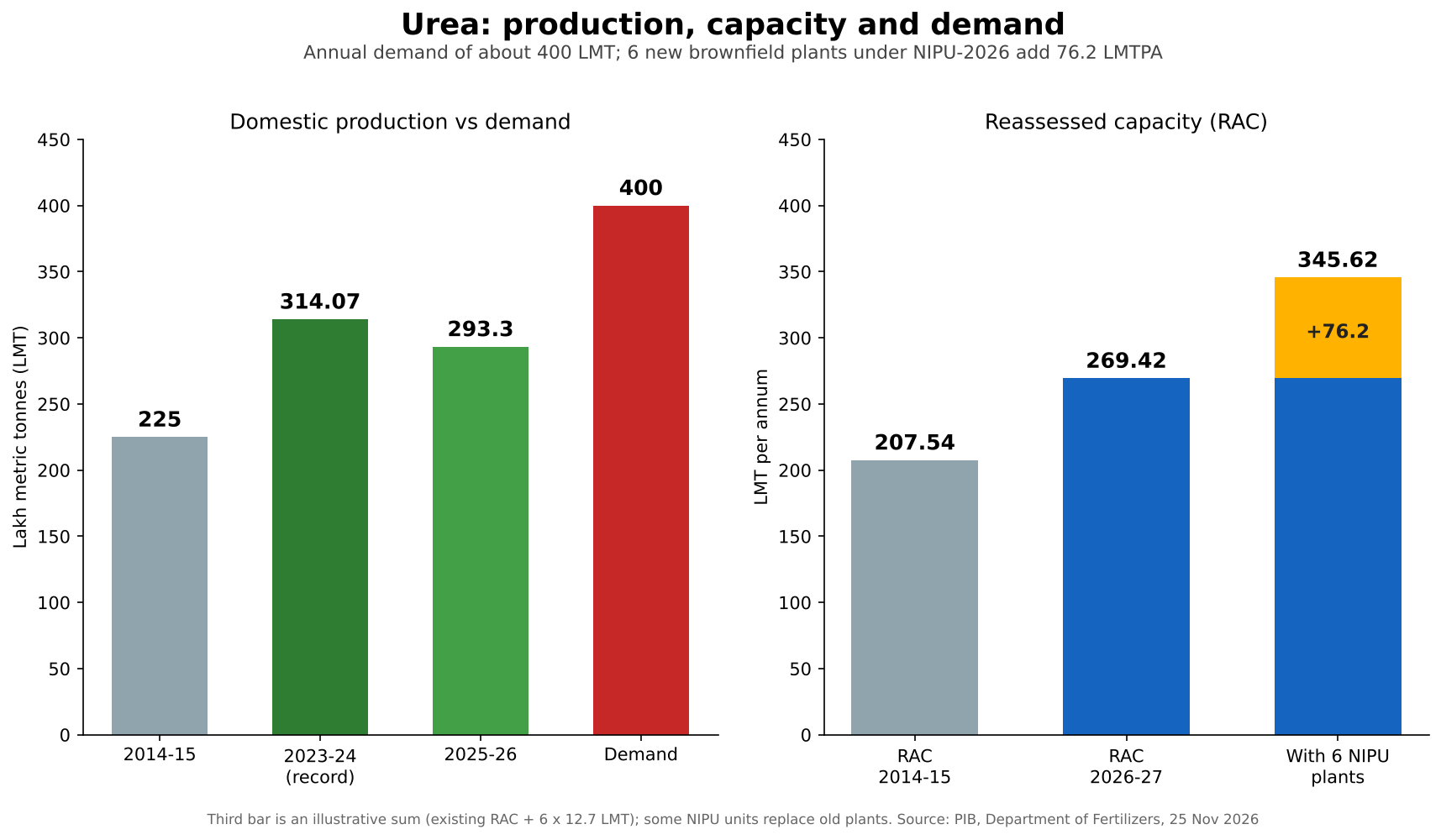
Urea demand and supply
| Indicator | Figure |
|---|---|
| Annual consumption | About 400 LMT |
| Production, 2014–15 | 225 LMT |
| Record production, 2023–24 | 314.07 LMT |
| Production, 2025–26 | 293.30 LMT |
| Reassessed capacity, 2014–15 | 207.54 LMTPA |
| Reassessed capacity, 2026–27 | 269.42 LMTPA |
The gap between demand and output is met by imports, which cost foreign exchange.
New Investment Policy (NIP)-2012
It was notified in January 2013 and amended in 2014.
It led to 6 new units of 12.7 LMTPA each, adding 76.2 LMTPA:
Ramagundam (Telangana), run by RFCL
Gorakhpur (UP), Sindri (Jharkhand) and Barauni (Bihar), run by HURL
Panagarh (West Bengal), run by Matix
Gadepan-III (Rajasthan), run by Chambal
Two more projects are under way:
Talcher (Odisha), India's coal-gasification urea project
Namrup (Assam), run by AVFCCL
How urea is made
Natural gas gives hydrogen, which combines with atmospheric nitrogen to form ammonia (Haber–Bosch process).
Ammonia reacts with carbon dioxide to form urea, which contains about 46% nitrogen.
Coal gasification (Talcher) is an alternative to imported gas.
Why self-reliance matters
India is among the world's largest importers of urea, so global price spikes raise the subsidy bill.
Most plants depend on imported LNG, so gas prices also matter.
Domestic capacity protects farmers from supply shocks during the kharif and rabi sowing seasons.
Urea policy in brief
The MRP of urea is fixed by the government, and the producer gets the difference as a subsidy.
Phosphatic and potassic (P&K) fertilisers fall under the Nutrient Based Subsidy (NBS) scheme (2010), and urea is outside NBS.
100% neem-coated urea has been required since 2015. It reduces diversion to industrial use and slows nitrogen release.
The New Urea Policy, 2015 aimed at higher production and energy efficiency.
Nano urea (liquid) was launched by IFFCO in 2021.
Quick Revision
NIPU-2026 covers 6 brownfield plants, each of 12.7 LMT, with about ₹54,000 crore in investment.
India uses about 400 LMT of urea a year and produced 293.30 LMT in 2025–26.
NIP-2012 added 6 plants and 76.2 LMTPA.
Talcher uses coal gasification.
Urea is outside NBS, and its MRP is fixed.
Ammonia comes from natural gas.
Practice MCQ
Q. With reference to urea in India, consider the following statements:
1. Urea is covered under the Nutrient Based Subsidy scheme.
2. The Talcher fertilizer project uses the coal-gasification route.
3. Neem coating of urea discourages its diversion for industrial use.
Which of the statements given above are correct?
(a) 1 and 2 only
(b) 2 and 3 only
(c) 1 and 3 only
(d) 1, 2 and 3
Answer: (b). NBS covers P&K fertilisers, not urea.
Related PYQs
PYQ 1 (UPSC CSE Prelims 2020)
With reference to chemical fertilizers in India, consider the following statements:
1. At present, the retail price of chemical fertilizers is market-driven and not administered by the Government.
2. Ammonia, which is an input of urea, is produced from natural gas.
3. Sulphur, which is a raw material for phosphoric acid fertilizer, is a by-product of oil refineries.
Select the correct answer using the code given below:
(a) 1 only
(b) 2 and 3 only
(c) 2 only
(d) 1, 2 and 3
Answer: (b).
Join Decode Civils Telegram Group For Free UPSC CSE Guidance From Mudit Jain, Ex-IPS, Ex-IRS
You can reach me at Instagram, LinkedIn, Twitter, Facebook, Youtube and Telegram.
Click Here to Learn More About

Downloads
Most read on Mudit Jain Blogs
- 2026 UPSC CSE Prelims GS Detailed Analysis Analysis
- Shubham Shukla AIR-43, CSE-21 Prelims & Mains Strategy Topper Strategies
- Anjali Shrotriya (AIR-44, CSE-21) Comprehensive Strategy Topper Strategies
- Aastha Singh, AIR-61 CSE-24, Journey & Strategy Topper Strategies
- Muskan Dagar AIR-72 CSE-22 GS 470 Marks & Ethics 141 Marks Topper Strategies
- Apurva Pandey (AIR-39 CSE-17) 175 Marks in Essay Topper Strategies
- Anita AIR-644 CSE-25 220 Marks in Personality Test Topper Strategies
- Booklist & Sources for UPSC Prelims 2027 Prelims
- When & How to Switch from Mains to Prelims? Prelims
- 2026 UPSC CSE Prelims CSAT Detailed Analysis Analysis
Preparing for UPSC?
Talk to us about the right programme for your attempt.
Keep reading
Related articles
 25
Nov 2026
Current Affairs · Decode PIB
Kamarajar Port Gets a Second Container Terminal
CCEA approved a Second Container Terminal at Kamarajar Port Limited (KPL), Tamil Nadu
Decode Civils · 25 Nov 2026
 25
Nov 2026
Current Affairs · Decode PIB
Exercise Suryakiran XX: India–Nepal Army Drill Begins
The 20th edition of the India–Nepal joint military exercise SURYAKIRAN began on 25 November 2026
Decode Civils · 25 Nov 2026
 25
Nov 2026
Current Affairs · Decode PIB
Northeast's First Region-Specific Antivenom for Pit Vipers
Scientists at IASST, Guwahati have developed the first Northeast India-specific antivenom
Decode Civils · 25 Nov 2026
Our programmes
Courses for your attempt

History Module For Prelims 2027
The toughest part of Prelims, simplified by someone who has cleared Prelims 7 out of 7 times.
History Starts 20 Dec 2026
₹2,359 ₹2,949
Learn More: History Module For Prelims 2027
Current Affairs For Prelims 2027 (Plus)
The only current affairs course with direct hits in UPSC Prelims
CA Plus Starts 4 Jan 2027
₹4,129 ₹4,719
Learn More: Current Affairs For Prelims 2027 (Plus)
Current Affairs For Prelims 2027 (Base)
The only current affairs course with direct hits in UPSC Prelims
CA Base Starts 4 Jan 2027
₹3,539 ₹4,129
Learn More: Current Affairs For Prelims 2027 (Base)
PYQ Edge
A PYQ mastery program: use PYQs to build an edge in your Prelims score
PYQ Edge Starts 15 Dec 2026
₹2,359 ₹2,949
Learn More: PYQ Edge
Prelims Excellence Program 2027 (Pro)
Your One Stop Solution For Prelims 2027
Batch 2 Starts 15 Dec 2026
₹20,059 ₹22,419
Learn More: Prelims Excellence Program 2027 (Pro)
Prelims Excellence Program 2027 (Plus)
Your One Stop Solution For Prelims 2027
Batch 2 Starts 15 Dec 2026
₹10,619 ₹11,799
Learn More: Prelims Excellence Program 2027 (Plus)
Prelims Excellence Program 2027 (Base)
Your One Stop Solution For Prelims 2027
Batch 2 Starts 15 Dec 2026
₹7,079 ₹8,259
Learn More: Prelims Excellence Program 2027 (Base)
CSAT Enrichment Batch
Master the art and science of solving CSAT
₹2,359 ₹2,949
Learn More: CSAT Enrichment Batch
CSAT WEEKEND BATCH
Master CSAT for UPSC Prelims 2027 with expert guidance, focused practice, and mock tests.
CSAT WEEKEND BATCH Starts 31 Oct 2026
₹5,899 ₹8,259
Learn More: CSAT WEEKEND BATCH
ANTHROPOLOGY THROUGH PYQ's
Understand what UPSC asks and how to answer it from the Anthro Topper.
₹5,899 ₹8,259
Learn More: ANTHROPOLOGY THROUGH PYQ's
PSIR EXCELLENCE PROGRAM PRO (OFFLINE): Batch-2
An Enrichment Course that can help you add 50+ marks in your PSIR Scores.

PSIR EXCELLENCE PROGRAM PRO (ONLINE): Batch-2
An Enrichment Course that can help you add 50+ marks in your PSIR Scores.


0 comments
Discussion
No comments yet. Be the first.