Constitution Released in All 22 Scheduled Languages
C. P. Radhakrishnan released the updated edition of the Constitution of India in all 22 Scheduled Languages
DDecode Civils
· 3 min read
Constitution Released in All 22 Scheduled Languages
Why in News
On Constitution Day, 26 November 2026, Vice President C. P. Radhakrishnan released the updated edition of the Constitution of India in all 22 Scheduled Languages at Vigyan Bhawan, New Delhi. The programme was organised by the Legislative Department of the Ministry of Law and Justice.
News Summary
This is the first time since the Constitution came into force that an updated edition is available in all 22 languages of the Eighth Schedule.
The aim is to build constitutional literacy and take the Constitution to rural areas, tribal communities and young people in their own languages.
The Union Law Minister recalled Dr. B. R. Ambedkar, Chairman of the Drafting Committee, and the four pillars of justice, liberty, equality and fraternity.
The Legislative Department is also working to make other central laws available in Indian languages.
Prelims Facts & Static Linkages
The Eighth Schedule at a glance
The Eighth Schedule lists the Scheduled Languages. It is linked to Article 344(1) (Official Language Commission) and Article 351 (development of Hindi).
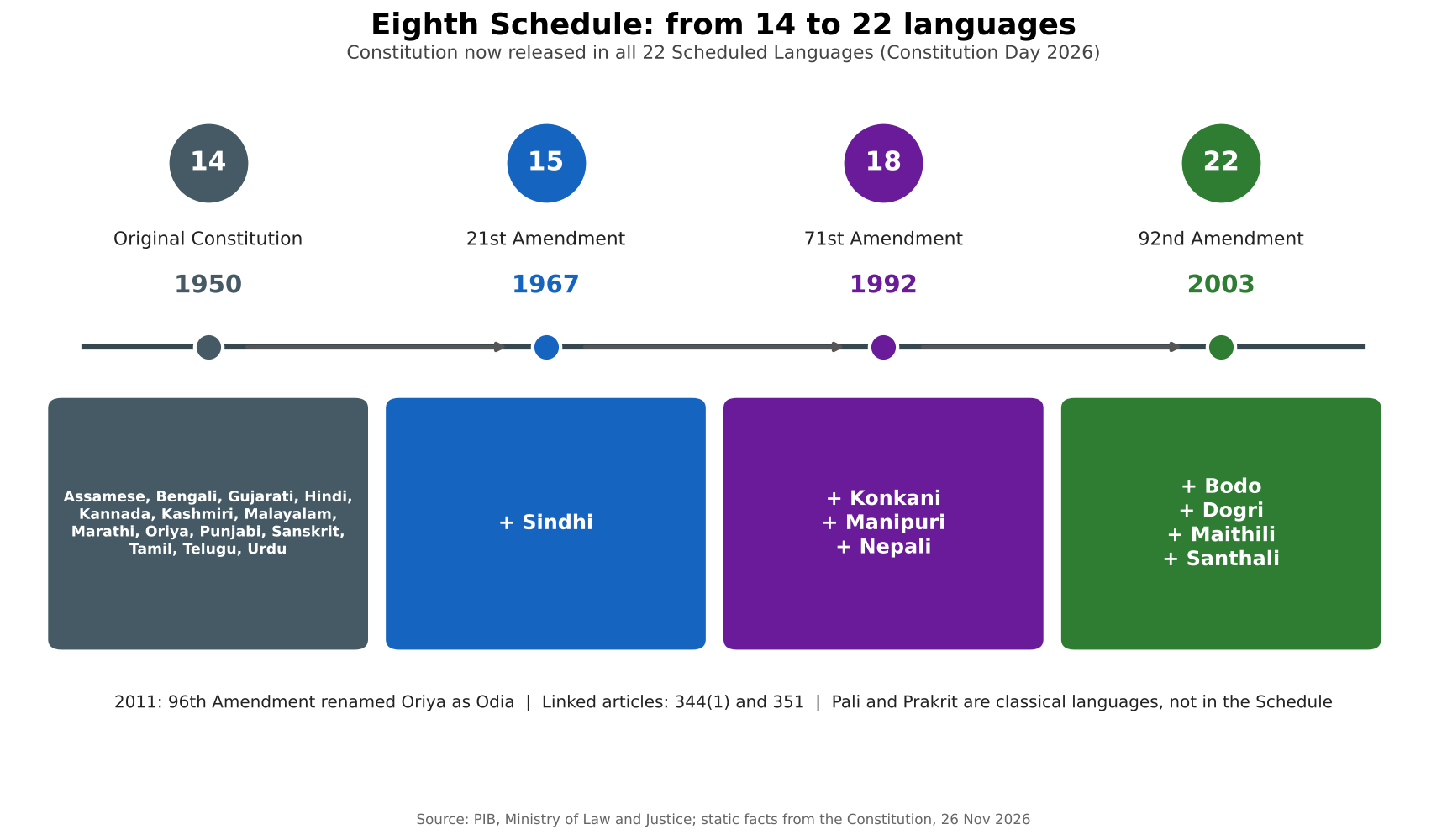
The original Constitution had 14 languages. Today there are 22.
Sindhi was added by the 21st Amendment, 1967.
Konkani, Manipuri and Nepali were added by the 71st Amendment, 1992.
Bodo, Dogri, Maithili and Santhali were added by the 92nd Amendment, 2003.
The 96th Amendment, 2011 changed "Oriya" to "Odia".
The Constitution sets no criteria for including a language. Demands from over 35 languages are pending.
Official language provisions (Part XVII)
Article
Provision
343
Hindi in Devanagari script is the official language of the Union; numerals in international form
344
Official Language Commission and Committee of Parliament
345–347
Official languages of States
348
English for the Supreme Court, High Courts and authoritative texts of Acts
350A
Instruction in the mother tongue at the primary stage
350B
Special Officer for Linguistic Minorities
351
Directive for the development of Hindi
Related facts to revise
Article 29 protects the right of any section of citizens to conserve its distinct language, script or culture.
Article 394A, added by the 58th Amendment, 1987, lets the President publish the authoritative Hindi text of the Constitution.
The Official Languages Act, 1963 allows English to continue alongside Hindi for official Union work.
Classical languages are a separate category. There are 11: Tamil (the first, 2004), Sanskrit, Telugu, Kannada, Malayalam, Odia, and, from 2024, Marathi, Pali, Prakrit, Assamese and Bengali.
Pali and Prakrit are classical languages but are not in the Eighth Schedule.
Members of Parliament may speak in any Scheduled Language, with simultaneous interpretation.
The Eighth Schedule has no bearing on the official language of a State, which each State Legislature chooses under Article 345.
Likely Prelims angles
Matching amendments with the languages they added.
Article numbers of the official language provisions.
The difference between Scheduled and classical languages.
Quick Revision
The updated Constitution is now available in all 22 Scheduled Languages.
The Eighth Schedule began with 14 languages.
Sindhi came in 1967, Konkani, Manipuri and Nepali in 1992, and Bodo, Dogri, Maithili and Santhali in 2003.
Article 343 makes Hindi in Devanagari the official language of the Union.
Article 350A covers mother-tongue instruction, and 350B the Special Officer for Linguistic Minorities.
Article 394A provides for the authoritative Hindi text.
Practice MCQ
Q. Consider the following statements:
1. The original Constitution of India listed 14 languages in the Eighth Schedule.
2. Sindhi was added to the Eighth Schedule by the 92nd Amendment.
3. Pali is included in the Eighth Schedule.
Which of the statements given above is/are correct?
(a) 1 only
(b) 1 and 2 only
(c) 2 and 3 only
(d) 1, 2 and 3
Answer: (a). Sindhi was added by the 21st Amendment (1967), and Pali is a classical language outside the Eighth Schedule.
Related PYQs
PYQ 1 (UPSC CSE Prelims 2024)
The Constitution (71st Amendment) Act, 1992 amends the Eighth Schedule to the Constitution to include which of the following languages?
1. Konkani
2. Manipuri
3. Nepali
4. Maithili
Select the correct answer using the code given below:



 27
Nov 2026
 27
Nov 2026
 27
Nov 2026














0 comments
Discussion
No comments yet. Be the first.