ASI handed over three repatriated bronze idols to the Idol Wing CID, Tamil Nadu
DDecode Civils
· 3 min read
Three Chola and Vijayanagara Bronzes Return Home
Why in News
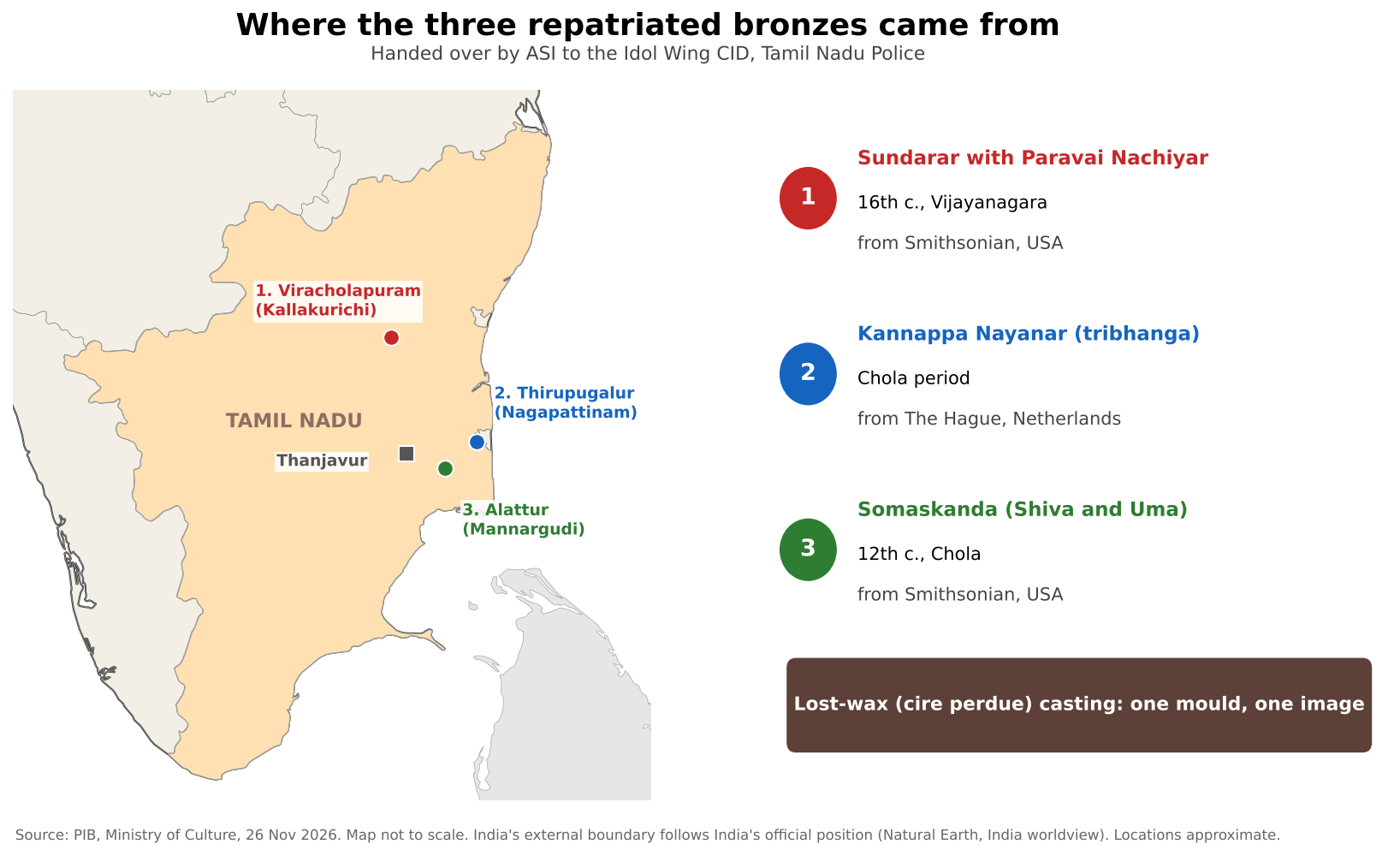
The Archaeological Survey of India (ASI) handed over three repatriated bronze idols to the Idol Wing CID, Tamil Nadu Police, at Dharohar Bhawan, New Delhi. Two came from the Smithsonian Museum, USA, and one from The Hague, Netherlands.
Two idols were identified from temple photographs taken in 1956 and 1959. Such archival photographs are key evidence in restitution claims.
ASI works with national and international agencies to identify and recover stolen heritage.
Prelims Facts & Static Linkages
Chola bronzes: key features
They were made by the lost-wax (cire perdue) process, called madhuchishta vidhana in Sanskrit texts.
A wax model is coated in clay, then heated. The wax melts out and molten metal is poured into the mould. Each mould gives only one image.
The golden age was the 10th–12th centuries. The best-known form is Nataraja, Shiva as the cosmic dancer.
Idols were made as utsava murtis (processional images) and were carried out of the temple during festivals.
Tribhanga is a posture with three bends, at the neck, waist and knee. The Kannappa idol stands in this posture.
Somaskanda shows Shiva with Uma, and usually the child Skanda (Sa-Uma-Skanda). It is a typical Chola-Pallava form.
The Bhakti saints in these idols
The Nayanars were 63 Shaiva saints. The Alvars were 12 Vaishnava saints.
Sundarar (Sundaramurti) is one of the three authors of the Tevaram hymns, with Appar and Sambandar. Paravai Nachiyar was one of his wives.
Kannappa Nayanar was a hunter who, in legend, offered his own eye to Shiva. That explains the hand raised to the eye. He is linked to Srikalahasti.
Nayanar hymns were compiled in the Tirumurai. Sekkizhar's Periya Puranam (12th century) tells the lives of the 63 Nayanars.
Legal framework
The Antiquities and Art Treasures Act, 1972: an antiquity is an object at least 100 years old. Only the government or its agencies may export antiquities.
UNESCO 1970 Convention on preventing illicit import, export and transfer of cultural property.
ASI, under the Ministry of Culture, was set up in 1861 with Alexander Cunningham as its first Director-General.
Likely Prelims angles
The lost-wax process and the features of Chola bronzes.
Nayanars versus Alvars, and the texts linked to them.
The definition of an antiquity under the 1972 Act.
Matching repatriated idols with dynasties and temples.
Thanjavur's Brihadisvara temple, built by Rajaraja I, is part of the UNESCO site Great Living Chola Temples, with Gangaikondacholapuram and Darasuram.
Quick Revision
Three bronzes came back: two from the Smithsonian and one from The Hague.
Two are Chola-period idols, and one is from the Vijayanagara period.
Chola bronzes were made by the lost-wax process.
There were 63 Nayanars and 12 Alvars.
Sundarar co-authored the Tevaram.
An antiquity is at least 100 years old under the 1972 Act.
Practice MCQ
Q. With reference to Chola bronzes, consider the following statements:
1. They were cast by the lost-wax process.
2. A single mould could be reused to cast many identical images.
3. Many of them were processional images carried out during temple festivals.
Which of the statements given above are correct?
(a) 1 and 2 only
(b) 2 and 3 only
(c) 1 and 3 only
(d) 1, 2 and 3
Answer: (c). In the lost-wax process the clay mould is broken, so each image is unique.
Related PYQs
PYQ 1 (UPSC CSE Prelims 2025)
Who among the following led a successful military campaign against the kingdom of Srivijaya, the powerful maritime State, which ruled the Malay Peninsula, Sumatra, Java and the neighbouring islands?
(a) Amoghavarsha (Rashtrakuta)
(b) Prataparudra (Kakatiya)
(c) Rajendra I (Chola)
(d) Vishnuvardhana (Hoysala)
Answer: (c).
PYQ 2 (UPSC CSE Prelims 2025)
The famous female figurine known as 'Dancing Girl', found at Mohenjo-daro, is made of



 27
Nov 2026
 27
Nov 2026
 27
Nov 2026














0 comments
Discussion
No comments yet. Be the first.