Polar Stations Detect Extreme Solar Particle Event
The detectors are at India's Maitri (Antarctica) and Ny-Ålesund (Arctic) research stations.
DDecode Civils
· 4 min read
Polar Stations Detect Extreme Solar Particle Event
Why in News
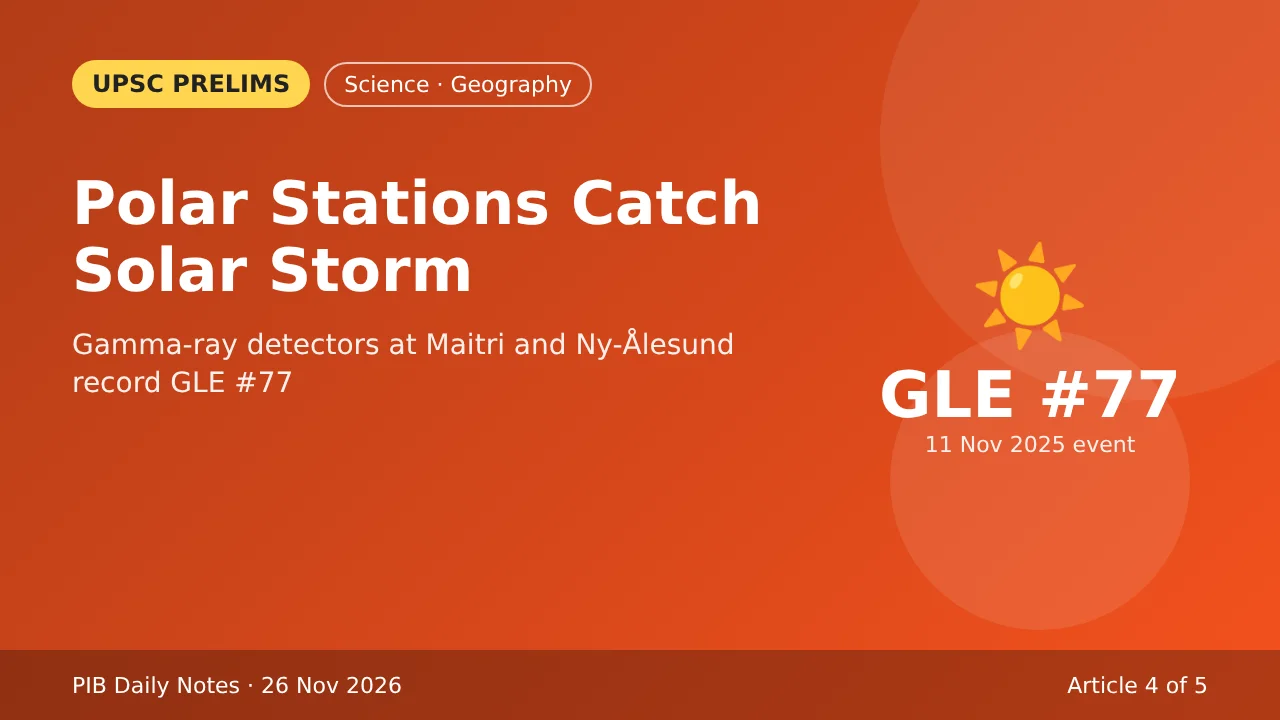
Scientists of the Indian Institute of Geomagnetism (IIG), Mumbai, an autonomous institute of the Department of Science and Technology, detected a rare Ground-Level Enhancement (GLE) for the first time with gamma-ray detectors. The detectors are at India's Maitri (Antarctica) and Ny-Ålesund (Arctic) research stations. The study appeared in The Astrophysical Journal Letters.
News Summary
The event, GLE #77, happened on 11 November 2025. It was linked to an intense X-class solar flare, a fast coronal mass ejection (CME) and a strong solar energetic particle (SEP) event.
The detectors are NaI(Tl) scintillation detectors (sodium iodide doped with thallium).
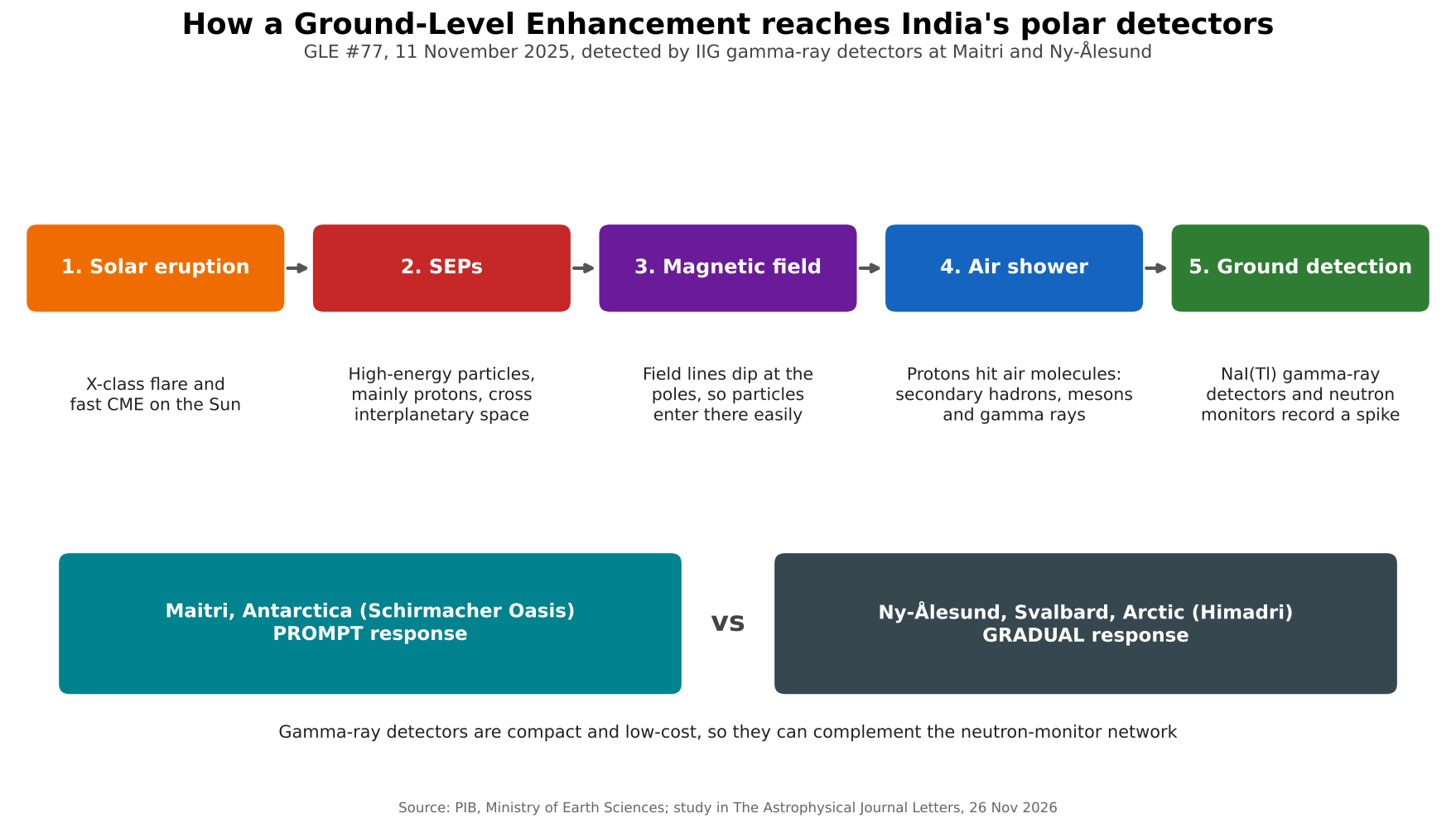
Maitri showed a prompt response, and Ny-Ålesund a more gradual one.
The gamma-ray data matched readings from neutron monitors, the standard instruments for GLEs.
The team ruled out other sources such as terrestrial radioactivity, terrestrial gamma-ray flashes, thunderstorm ground enhancements and gamma-ray bursts.
Gamma-ray detectors are compact and cheap compared to neutron monitors, so a wider network could expand ground coverage.
Prelims Facts & Static Linkages
What is a Ground-Level Enhancement?
A powerful solar eruption accelerates particles, mainly protons, to very high energies.
These particles cross interplanetary space and enter Earth's atmosphere.
They hit air molecules and create a cascade of secondary particles (hadrons, mesons and electromagnetic particles) that reach the ground.
GLEs are the most extreme form of SEP events. Only 77 have been recorded so far.
They are best seen near the poles, where Earth's magnetic field lines dip into the atmosphere, so charged particles enter more easily.
India's polar stations
Station
Location
Year
Dakshin Gangotri
Antarctica (first station, now a supply base)
1983
Maitri
Schirmacher Oasis, Antarctica
1989
Bharati
Larsemann Hills, Antarctica
2012
Himadri
Ny-Ålesund, Svalbard (Norway), Arctic
2008
The National Centre for Polar and Ocean Research (NCPOR), Goa, under the Ministry of Earth Sciences, runs India's polar programme.
India has been an observer in the Arctic Council since 2013. It released its Arctic Policy in 2022 and passed the Indian Antarctic Act, 2022.
Space weather basics
Solar flares are sudden bursts of radiation. By strength, they are classed A, B, C, M and X, with X the strongest.
CMEs are huge clouds of magnetised plasma thrown out from the Sun's corona.
Space weather can disrupt satellites, GPS, HF radio and power grids, and it raises radiation risk for astronauts and polar flights.
Aditya-L1, India's solar mission at the L1 Lagrange point, studies these events from space.
Likely Prelims angles
The meaning of GLE, SEP, solar flare and CME.
Matching India's polar stations with their locations.
Why polar sites see more cosmic and solar particles.
Svalbard is governed by the Svalbard Treaty, 1920, to which India is a party. This is why India can run Himadri there.
The Indian Institute of Geomagnetism grew out of the Colaba Observatory in Mumbai, set up in 1841.
Quick Revision
IIG Mumbai detected GLE #77 (11 November 2025) with gamma-ray detectors.
The detectors are at Maitri (Antarctica) and Ny-Ålesund (Arctic).
GLEs are the most extreme solar energetic particle events.
Neutron monitors are the standard GLE instruments.
X-class flares are the strongest.
Himadri is India's Arctic station, set up in 2008.
Practice MCQ
Q. Consider the following statements:
1. Ground-Level Enhancements are caused mainly by high-energy protons from the Sun.
2. Polar regions are better suited to detect such events because of Earth's magnetic field geometry.
3. Maitri is India's research station in the Arctic.
Which of the statements given above are correct?
(a) 1 and 2 only
(b) 2 and 3 only
(c) 1 and 3 only
(d) 1, 2 and 3
Answer: (a). Maitri is in Antarctica. Himadri is in the Arctic.
Related PYQs
PYQ 1 (UPSC CSE Prelims 2025)
Consider the following statements:
Statement I: Scientific studies suggest that a shift is taking place in the Earth's rotation and axis.
Statement II: Solar flares and associated coronal mass ejections bombarded the Earth's outermost atmosphere with tremendous amount of energy.
Statement III: As the Earth's polar ice melts, the water tends to move towards the equator.
Which one of the following is correct in respect of the above statements?
(a) Both Statement II and Statement III are correct and both of them explain Statement I
(b) Both Statement II and Statement III are correct but only one of them explains Statement I
(c) Only one of the Statements II and III is correct and that explains Statement I
(d) Neither Statement II nor Statement III is correct



 27
Nov 2026
 27
Nov 2026
 27
Nov 2026














0 comments
Discussion
No comments yet. Be the first.