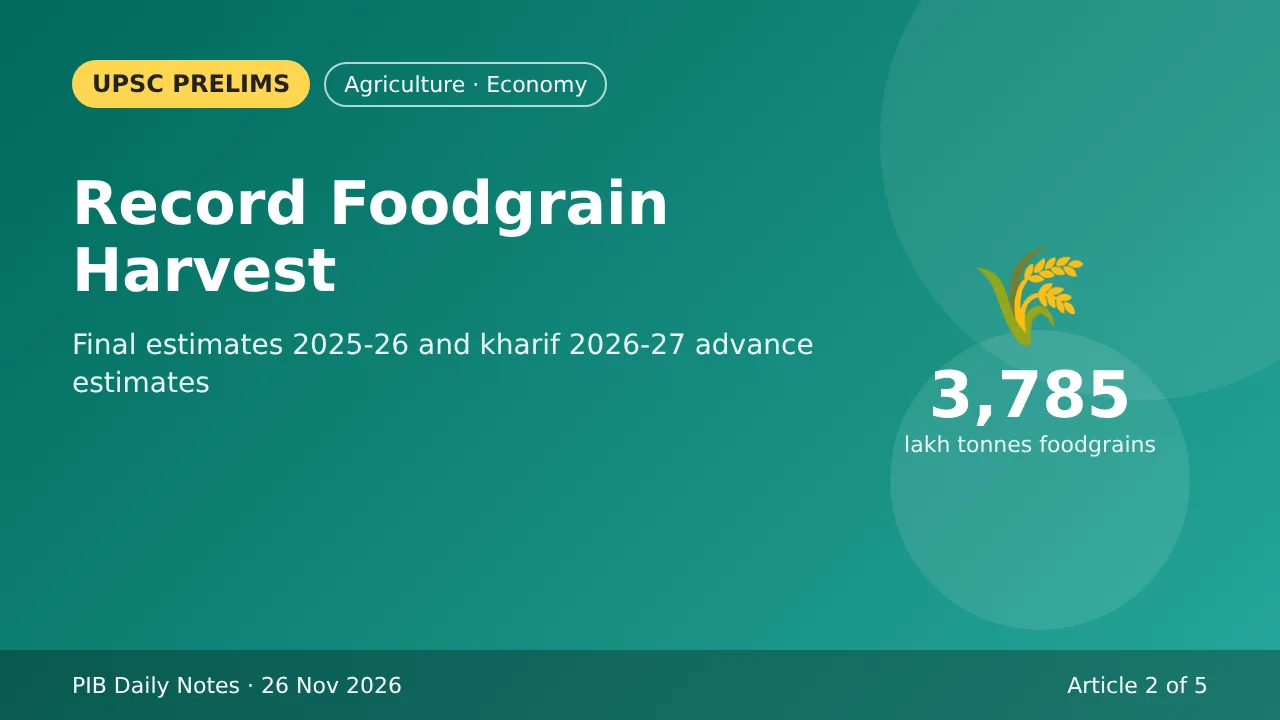
Foodgrain output hit a record 3,785.38 lakh tonnes (LT) in 2025-26.
DDecode Civils
· 4 min read
Record Foodgrain Output of 3,785 Lakh Tonnes
Why in News
The Union Agriculture Minister released the final production estimates for 2025-26 and the first advance estimates for kharif 2026-27. Foodgrain output hit a record 3,785.38 lakh tonnes (LT) in 2025-26.
News Summary
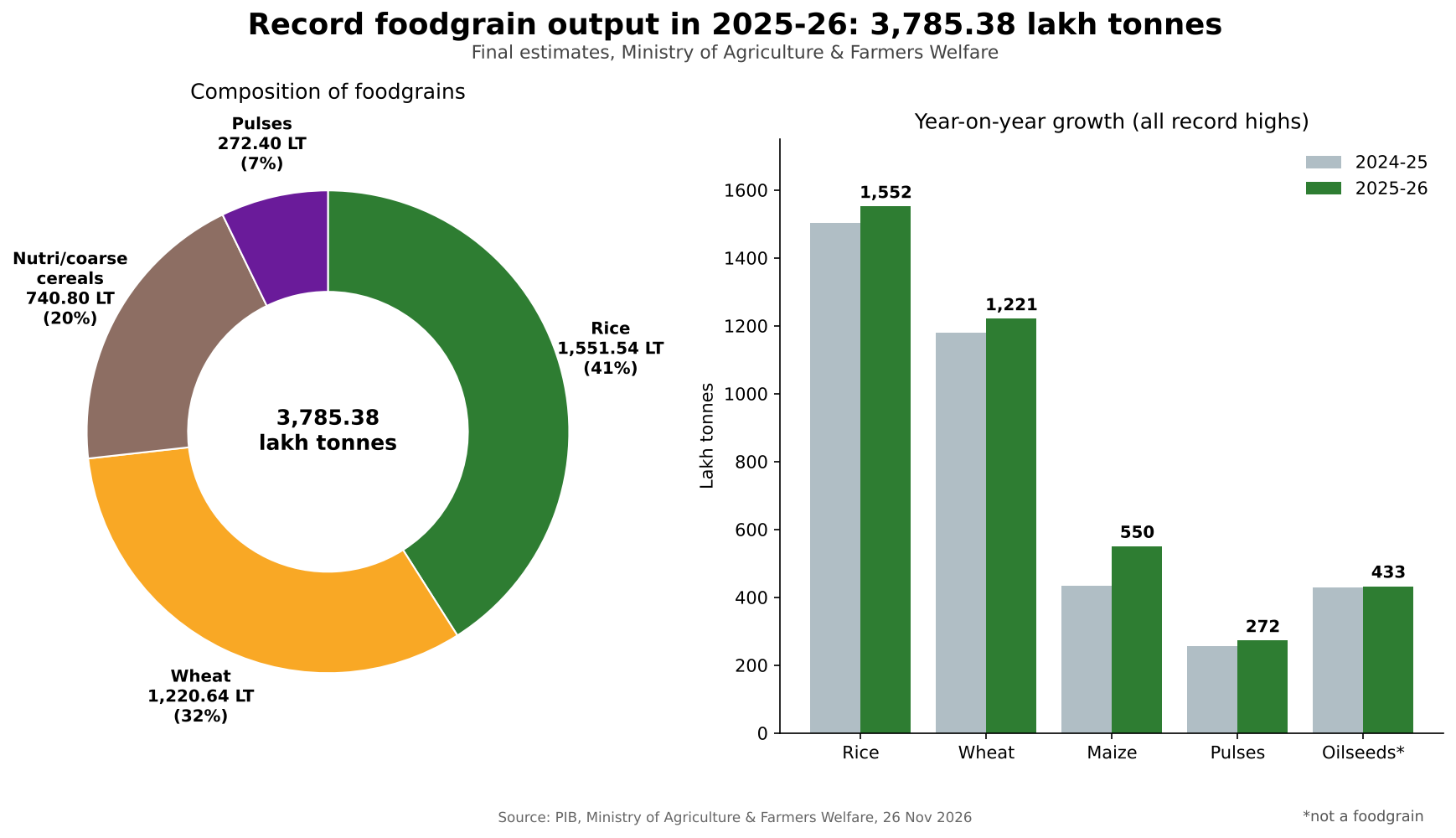
Foodgrain output in 2025-26 rose by 208.06 LT over 3,577.32 LT in 2024-25.
Rice: a record 1,551.54 LT. Wheat: a record 1,220.64 LT.
Maize jumped from 434.09 LT to 550.25 LT.
Pulses reached 272.40 LT, with record moong (43.96 LT). Oilseeds reached a record 432.55 LT, with record groundnut (131.71 LT) and rapeseed-mustard (137.66 LT).
Kharif 2026-27 foodgrains are estimated at 1,671.43 LT, which is 97.67 LT above the five-year average. This came despite El Niño, a delayed June monsoon and rainfall 35–40% below normal.
Rice exports rose by 5%. With surplus rice and wheat, the focus has shifted to pulses and oilseeds.
Prelims Facts & Static Linkages
India's global rank (as per the release)
Rank
Crops
First
Rice, pulses, jute, millets, spices
Second (after China)
Wheat, cotton, groundnut, fruits, vegetables
Second (after Brazil)
Sugarcane
Composition of 2025-26 foodgrains
Rice: 1,551.54 LT, the largest share at about 41%.
Wheat: 1,220.64 LT.
Nutri/coarse cereals: 740.80 LT, of which Shri Anna (millets) are 172.09 LT.
Pulses: 272.40 LT, led by gram (125.13 LT).
Foodgrains = cereals + pulses. Oilseeds are not foodgrains.
How crop estimates are made
Estimates are released by the Directorate of Economics and Statistics (DES), Department of Agriculture and Farmers Welfare.
First advance estimates are revised in the second and final estimates once yields from crop-cutting experiments (CCEs) come in at harvest.
Inputs include State reports, remote sensing, the weekly Crop Weather Watch Group (CWWG), the Digital Crop Survey and the Digital General Crop Estimation Survey.
Concepts to revise
Kharif crops are sown with the south-west monsoon (June–July) and harvested in September–October.
El Niño is the abnormal warming of the central and eastern equatorial Pacific. It is usually linked to a weaker Indian monsoon.
Cotton is counted in bales of 170 kg, and jute and mesta in bales of 180 kg.
Shri Anna is the government's name for millets. 2023 was the International Year of Millets, proposed by India.
India still imports edible oils and some pulses. The National Pulses Mission and National Oilseeds Mission aim at self-reliance.
Why the shift to pulses and oilseeds
India meets a large part of its edible oil demand through imports, mainly palm, soybean and sunflower oil. This drains foreign exchange and exposes consumers to global price swings.
Pulses are the main protein source for most Indians, and imports of tur, urad and lentils have continued.
Pulses fix atmospheric nitrogen through root nodules, so they improve soil health and cut fertiliser needs.
Rice and wheat use far more groundwater, especially in Punjab and Haryana. Crop diversification eases this pressure.
Large central stocks of rice and wheat with the Food Corporation of India give room to shift the focus.
Likely Prelims angles
Which crops count as foodgrains.
India's global rank in different crops.
Who releases crop estimates and how.
Quick Revision
Foodgrains reached a record 3,785.38 LT in 2025-26.
Rice was 1,551.54 LT, wheat 1,220.64 LT and maize 550.25 LT.
Oilseeds reached a record 432.55 LT, and pulses 272.40 LT.
Kharif 2026-27 foodgrains are estimated at 1,671.43 LT despite El Niño.
India ranks first in rice, pulses, jute, millets and spices.
Final estimates use crop-cutting experiments.
Practice MCQ
Q. With reference to agricultural production in India, consider the following statements:
1. Oilseeds are included in the total foodgrain production.
2. Final crop production estimates use yield data from crop-cutting experiments.
3. A bale of cotton weighs 170 kg.
Which of the statements given above are correct?
(a) 1 and 2 only
(b) 2 and 3 only
(c) 1 and 3 only
(d) 1, 2 and 3
Answer: (b). Foodgrains are cereals and pulses only.
Related PYQs
PYQ 1 (UPSC CSE Prelims 2024)
Consider the following statements:
1. India is a member of the International Grains Council.
2. A country needs to be a member of the International Grains Council for exporting or importing rice and wheat.
Which of the statements given above is/are correct?
(a) 1 only
(b) 2 only
(c) Both 1 and 2
(d) Neither 1 nor 2
Answer: (a).
PYQ 2 (UPSC CSE Prelims 2026)
Which among the following is/are the objective(s) of the Rainfed Area Development (RAD) initiative under the National Mission for Sustainable Agriculture (NMSA)?
1. Encouraging monoculture in rainfed areas
2. Increasing rice cultivation in irrigated regions
3. Enhancing productivity and minimising climatic risks through Integrated Farming Systems (IFS)
Select the answer using the code given below:
(a) 1 only
(b) 1 and 2
(c) 2 and 3
(d) 3 only
Answer: (d).
PYQ 3 (UPSC CSE Prelims 2020)
Which of the following factors/policies were affecting the price of rice in India in the recent past?
1. Minimum Support Price
2. Government's trading
3. Government's stockpiling
4. Consumer subsidies
Select the correct answer using the code given below:



 27
Nov 2026
 27
Nov 2026
 27
Nov 2026














0 comments
Discussion
No comments yet. Be the first.