Debris-Free Space by 2030: India's First Active Debris Removal Facility
On 5 November 2026, Union Minister Dr. Jitendra Singh virtually inaugurated Base 1, the facility of the Hyderabad startup Cosmoserve Space
DDecode Civils
· 3 min read
Debris-Free Space by 2030: India's First Active Debris Removal Facility
Why in News
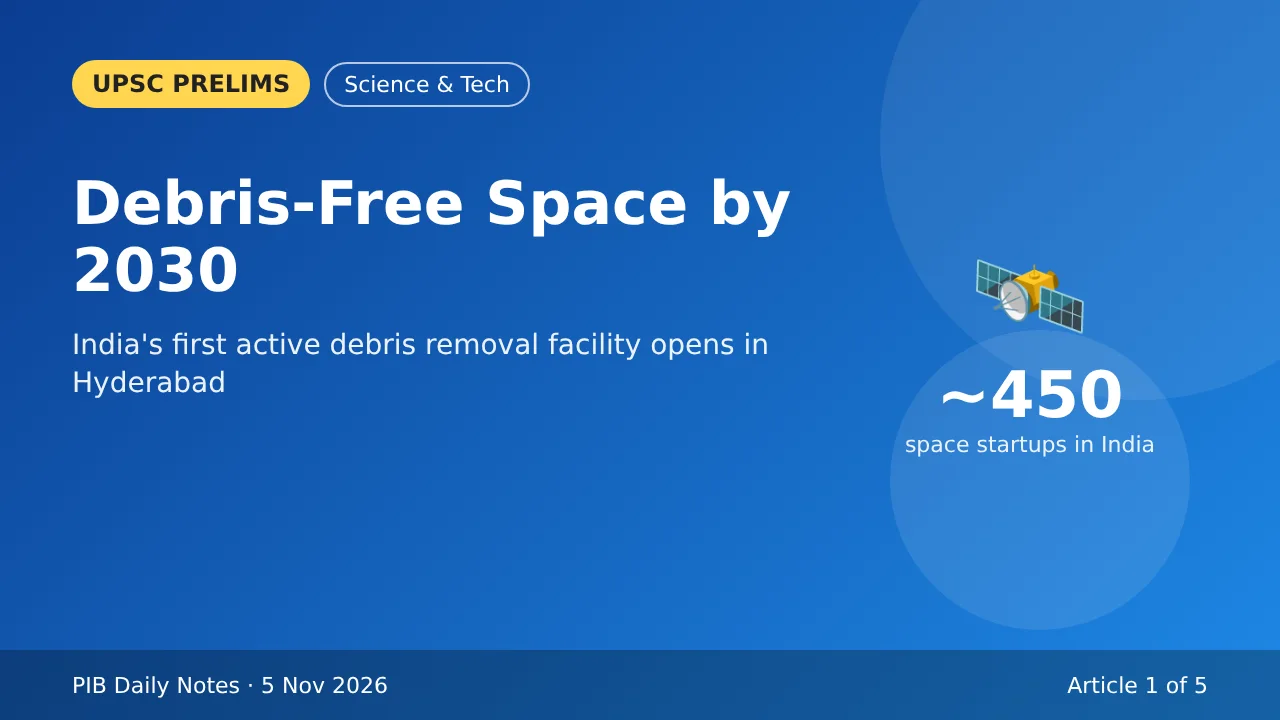
On 5 November 2026, Union Minister Dr. Jitendra Singh virtually inaugurated Base 1, the facility of the Hyderabad startup Cosmoserve Space for Active Debris Removal (ADR) and in-orbit servicing. He announced a national vision of debris-free space by 2030.
News Summary
Base 1 covers about 14,800 sq ft at Gachibowli, Hyderabad. Space robots are designed, built, tested under space conditions and flown from its mission control.
It houses orbital rendezvous and capture labs, space robotics labs, microgravity simulation platforms and satellite integration clean rooms.
Mission EMBRACE tested soft robotic petals in space in July 2026, within a year of the company's formation.
Partners include Pixel (satellite systems), Dhruv Aerospace Netherlands (propulsion) and Skyroot Aerospace (launch).
India's space economy is nearly USD 9 billion and is projected to reach USD 40–45 billion in the coming decade. Space startups have grown from single digits to nearly 450.
The Minister credited the reforms that created NewSpace India Limited (NSIL) and IN-SPACe.
Prelims Facts & Static Linkages
What is space debris and why it matters
Space debris means non-functional human-made objects in orbit: dead satellites, spent rocket stages, and fragments from collisions or explosions.
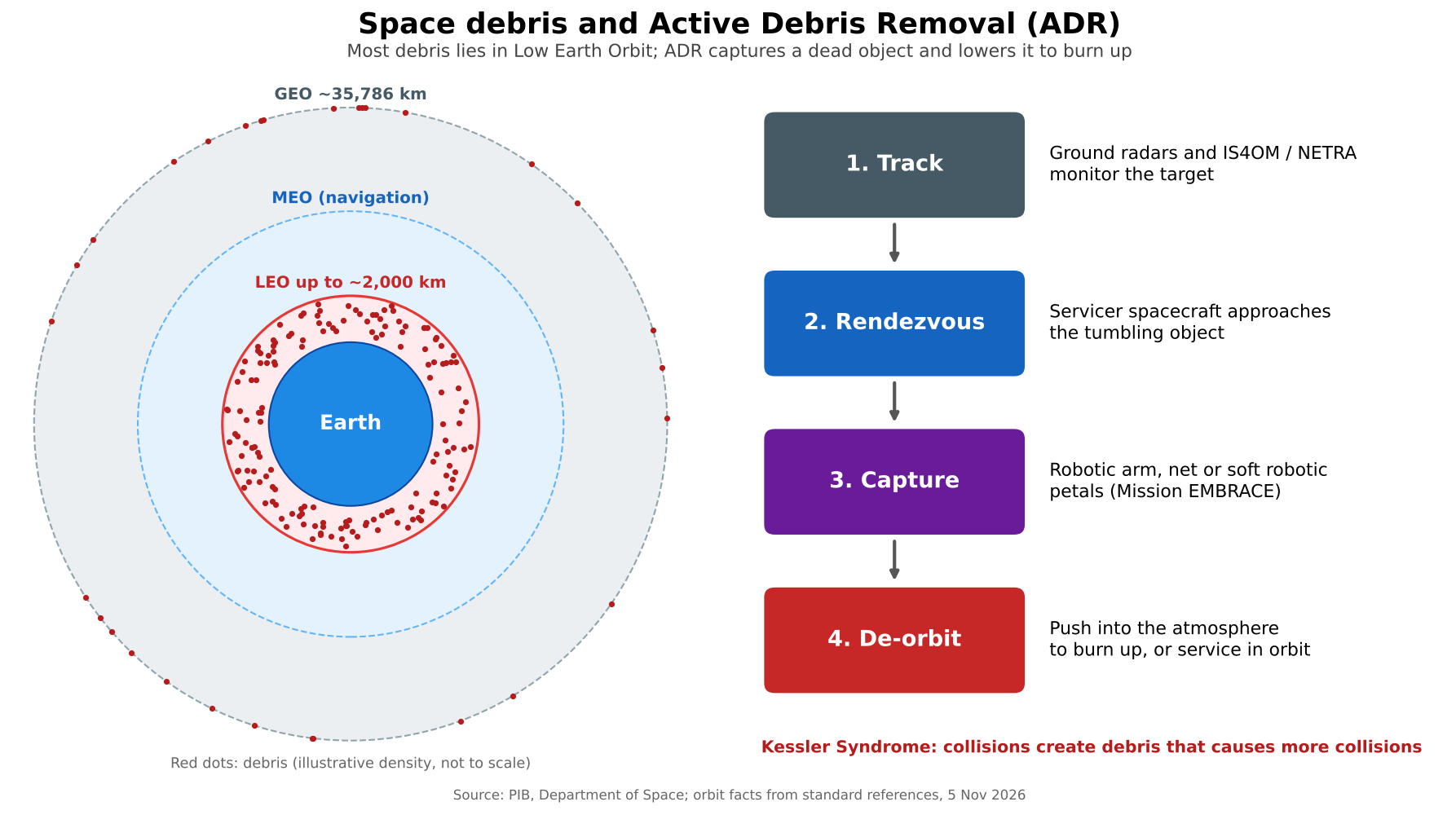
Most of it sits in Low Earth Orbit (LEO), up to about 2,000 km, the orbit used by most Earth-observation and broadband satellites.
Debris travels at about 7–8 km per second, so even a centimetre-sized fragment can disable a satellite.
Kessler Syndrome: a chain reaction in which collisions create more debris, which causes more collisions, until some orbits become unusable.
Active Debris Removal means capturing a dead object (with nets, harpoons, robotic arms or soft grippers) and pushing it down to burn up in the atmosphere.
India's space sustainability efforts
Initiative
What it does
Debris Free Space Missions (DFSM)
ISRO's goal that all Indian space actors leave no debris by 2030
IS4OM, Bengaluru
ISRO System for Safe and Sustainable Space Operations Management; tracks collision risks
Project NETRA
Network for space object Tracking and Analysis, an early-warning system for debris
POEM
PSLV Orbital Experimental Module; reuses the spent PS4 stage as a platform
SpaDeX
ISRO's space docking experiment; docking and rendezvous are the base for in-orbit servicing
International framework
Outer Space Treaty, 1967: states are responsible for national space activities, including private ones.
Liability Convention, 1972: the launching state is liable for damage caused by its space objects.
IADC (Inter-Agency Space Debris Coordination Committee): ISRO is a member. It issues debris mitigation guidelines.
UN COPUOS adopted the Space Debris Mitigation Guidelines in 2007.
India's space reform architecture
NSIL (2019): the commercial arm of the Department of Space.
IN-SPACe (2020): a single-window autonomous agency that authorises and promotes private space activity.
Indian Space Policy, 2023: lets private firms take part across the full value chain.
Quick Revision
Cosmoserve Space's Base 1 in Hyderabad is for active debris removal and in-orbit servicing.
Mission EMBRACE tested soft robotic petals in space in July 2026.
India's target is debris-free space by 2030.
Space economy is about USD 9 billion, aiming for USD 40–45 billion.
Kessler Syndrome describes cascading collisions in orbit.
The Liability Convention (1972) makes the launching state liable for damage.
Practice MCQ
Q. With reference to space debris, consider the following statements:
1. Kessler Syndrome refers to a cascade of collisions that multiplies debris in orbit.
2. Under the Liability Convention, 1972, a private launch company alone is liable for damage caused by its satellite.
3. Most tracked space debris is found in Geostationary Orbit.
Which of the statements given above is/are correct?
(a) 1 only
(b) 1 and 2 only
(c) 2 and 3 only
(d) 1, 2 and 3
Answer: (a). Liability rests with the launching state, and most debris is in Low Earth Orbit.
Related PYQs
PYQ 1 (UPSC CSE Prelims 2026)
Consider the following statements with regard to involvement of private entities in India's space programme:
1. The Indian National Space Promotion and Authorisation Centre (IN-SPACe) is an autonomous agency formed to facilitate participation of private entities.
2. Agnikul Cosmos launched the world's first flight using 3D-printed rocket engine.
3. Skyroot Aerospace has developed liquid fuel for GSLV.
Which of the statements given above is/are correct?



 28
Nov 2026
 28
Nov 2026
 28
Nov 2026














0 comments
Discussion
No comments yet. Be the first.