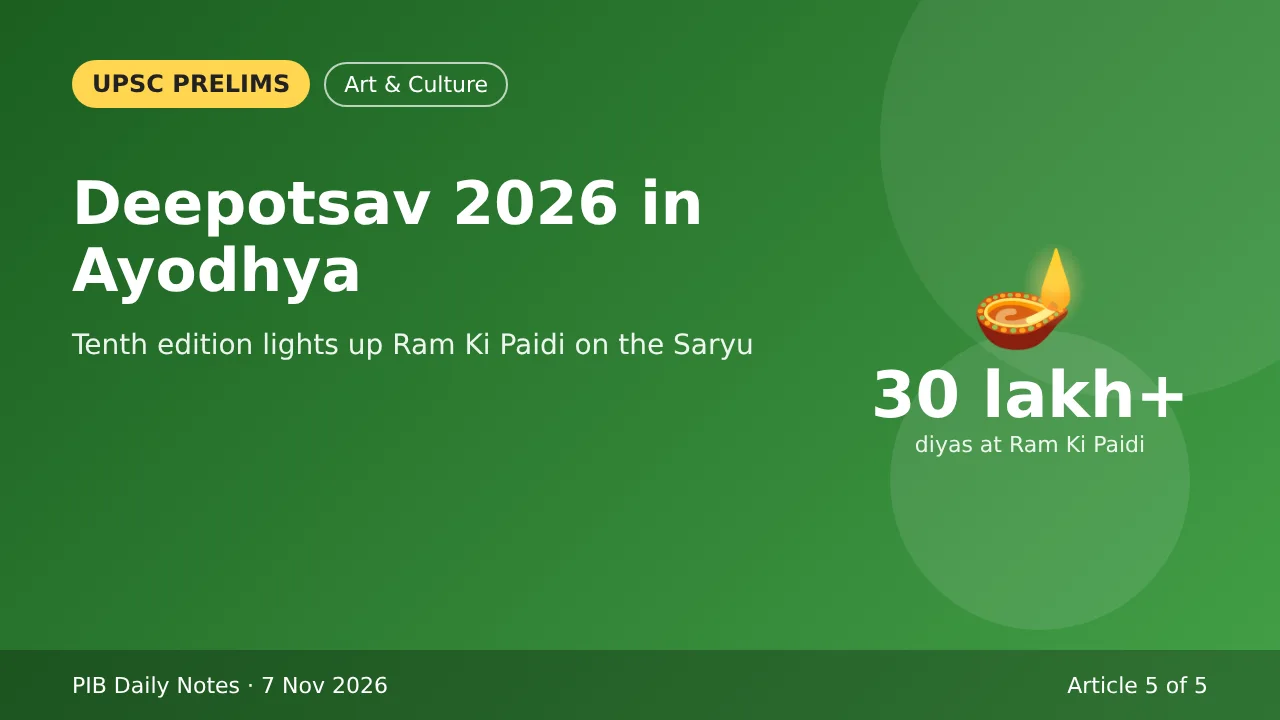
Deepotsav 2026 in Ayodhya: Tenth Edition on the Saryu
Deepavali was inscribed on UNESCO's Representative List of the Intangible Cultural Heritage (ICH) of Humanity in December 2025
DDecode Civils
· 3 min read
Deepotsav 2026 in Ayodhya: Tenth Edition on the Saryu
Why in News
Vice-President C. P. Radhakrishnan inaugurated the tenth Deepotsav at Ram Ki Paidi, Ayodhya, Uttar Pradesh, on 7 November 2026. He watched the ghats lit with millions of diyas and took part in the Saryu Aarti at Naya Ghat.
News Summary
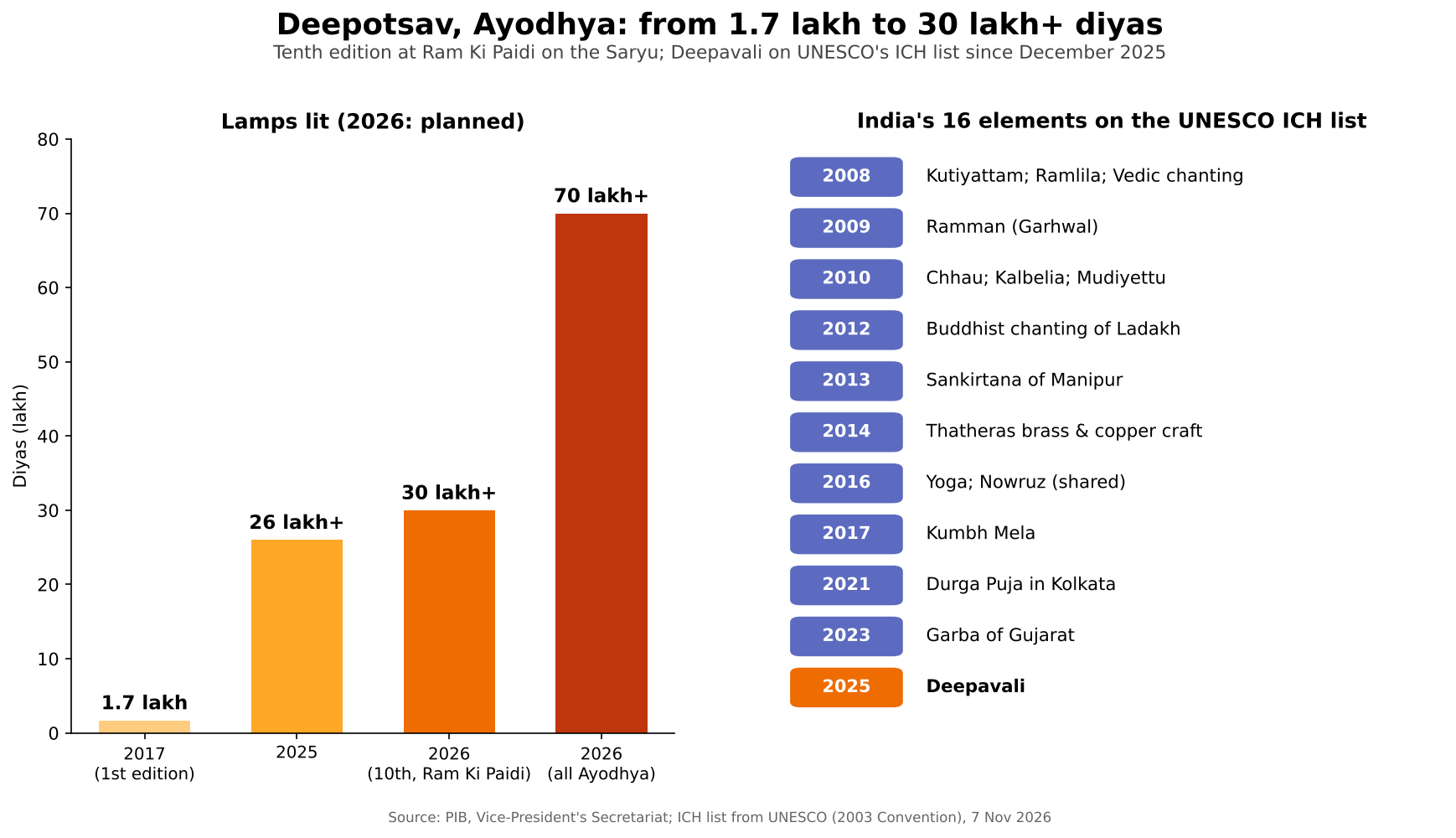
Growth of the festival: about 1.7 lakh lamps in the first edition (2017), over 26 lakh in 2025, and a plan for over 30 lakh at Ram Ki Paidi and 70 lakh across Ayodhya in 2026.
More than 2,100 indigenous drones showed scenes from the Ramayana, and about 1,000 artists performed.
The Vice-President praised the festival's boost to local livelihoods: potters, rural women, artisans, homestays, guides and transport.
He called Ayodhya an example of "Vikas Bhi, Virasat Bhi" (development with heritage), citing new roads, ghats and rail and air links.
He also prayed at the Shri Ram Janmabhoomi Temple and joined the aarti at Ram Katha Park.
He called Deepotsav a celebration of Jan Bhagidari (people's participation).
Prelims Facts & Static Linkages
Deepavali on UNESCO's list
Deepavali was inscribed on UNESCO's Representative List of the Intangible Cultural Heritage (ICH) of Humanity in December 2025.
The decision came at the 20th session of the Intergovernmental Committee, held at the Red Fort, New Delhi, the first time India hosted it.
It became India's 16th element on the list.
The list was created under the 2003 UNESCO Convention for the Safeguarding of the Intangible Cultural Heritage. India's nodal body for nominations is the Sangeet Natak Akademi under the Ministry of Culture.
A country can usually submit one national nomination every two years. UNESCO also keeps a separate Urgent Safeguarding List for elements at risk of disappearing.
India's recent ICH inscriptions
Year
Element
2016
Yoga; Nowruz (shared)
2017
Kumbh Mela
2021
Durga Puja in Kolkata
2023
Garba of Gujarat
2025
Deepavali
Ayodhya: static linkages
Ayodhya lies on the Saryu (Sarayu) river, the name used for the lower Ghaghara in this stretch. The Ghaghara is a left-bank tributary of the Ganga.
In the Mahajanapada period (6th century BCE), Ayodhya (also called Saketa) was a major city of Kosala, whose capital was Shravasti.
Ayodhya is a key stop on the Ramayana Circuit under the Swadesh Darshan scheme. Its new airport is named Maharishi Valmiki International Airport.
Ram Ki Paidi is a chain of ghats along the Saryu, used for the main lamp display.
Mahajanapadas and their rivers
Mahajanapada
River / region
Kosala
Saryu (Ayodhya, Shravasti)
Asmaka
Godavari (only Mahajanapada south of the Vindhyas)
Avanti
Kshipra and Narmada (Ujjain, Mahishmati)
Magadha
Ganga and Son (Rajagriha, later Pataliputra)
Kamboja
North-west, beyond the Indus
Quick Revision
Deepotsav began in Ayodhya in 2017 with about 1.7 lakh lamps.
The 2026 edition was the tenth, inaugurated by the Vice-President.
Deepavali was added to UNESCO's ICH list in December 2025 as India's 16th element.
The 20th ICH Committee session was held at the Red Fort, New Delhi.
Ayodhya stands on the Saryu; it belonged to the Kosala Mahajanapada.
Garba (2023) was India's previous inscription.
Practice MCQ
Q. With reference to UNESCO's Intangible Cultural Heritage list, consider the following statements:
1. Deepavali was inscribed at a session of the Intergovernmental Committee held in New Delhi.
2. The list was created under the 1972 World Heritage Convention.
3. Durga Puja in Kolkata was inscribed before Garba of Gujarat.
Which of the statements given above are correct?
(a) 1 and 2 only
(b) 1 and 3 only
(c) 2 and 3 only
(d) 1, 2 and 3
Answer: (b). The ICH list comes from the 2003 Convention; the 1972 Convention covers World Heritage Sites.
Related PYQs
PYQ 1 (UPSC CSE Prelims 2024)
Which one of the following was the latest inclusion in the Intangible Cultural Heritage List of UNESCO?
(a) Chhau dance
(b) Durga puja
(c) Garba dance
(d) Kumbh mela
Answer: (c).
PYQ 2 (UPSC CSE Prelims 2025)
With reference to ancient India (600–322 BC), consider the following pairs:
Territorial region : River flowing in the region
I. Asmaka : Godavari
II. Kamboja : Vipas
III. Avanti : Mahanadi
IV. Kosala : Sarayu
How many of the pairs given above are correctly matched?



 28
Nov 2026
 28
Nov 2026
 28
Nov 2026














0 comments
Discussion
No comments yet. Be the first.