E20 Petrol Meets Standards: OMCs Respond to Karnataka's Claims
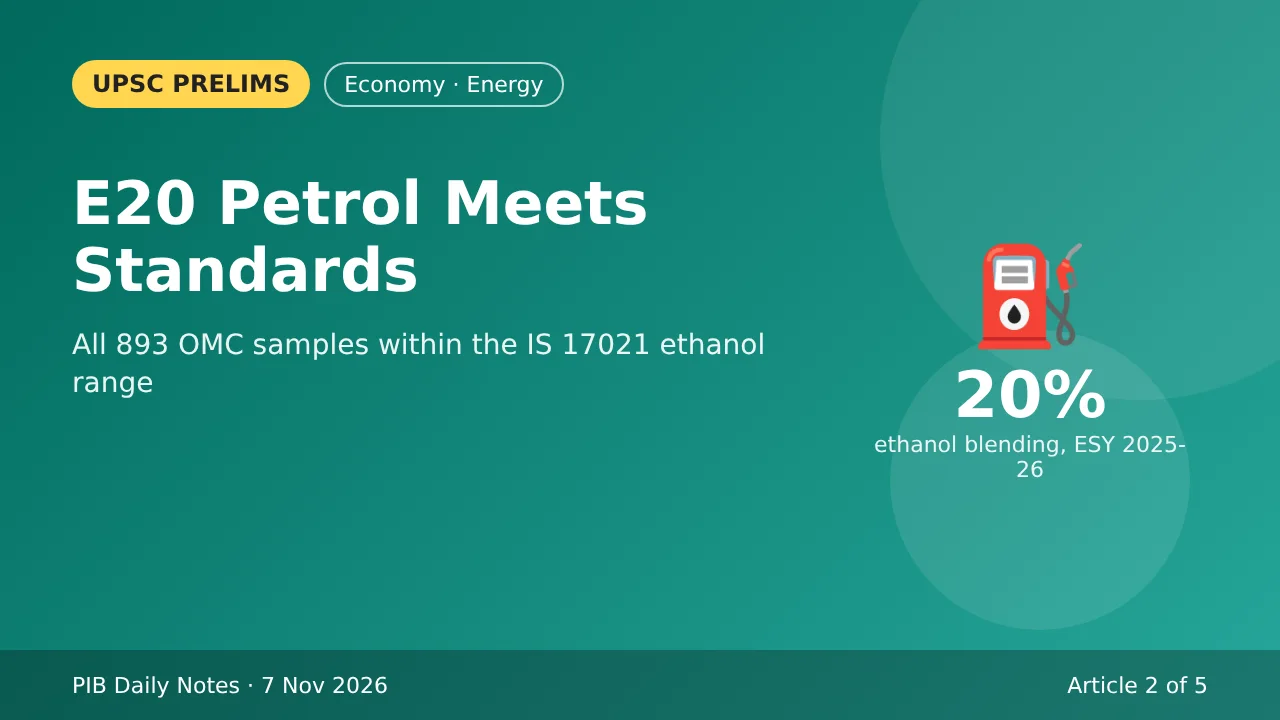
The Ministry of Petroleum and Natural Gas said on 7 November 2026 that E20 petrol sold by the public sector Oil Marketing Companies (OMCs) meets IS 17021
DDecode Civils
· 4 min read
E20 Petrol Meets Standards: OMCs Respond to Karnataka's Claims
Why in News
The Ministry of Petroleum and Natural Gas said on 7 November 2026 that E20 petrol sold by the public sector Oil Marketing Companies (OMCs) meets IS 17021, the Bureau of Indian Standards (BIS) specification. This followed a Karnataka Government claim that some outlets sold petrol with 26–31% ethanol.
News Summary
IOCL, BPCL and HPCL said the claims were not based on the prescribed sampling and testing procedure.
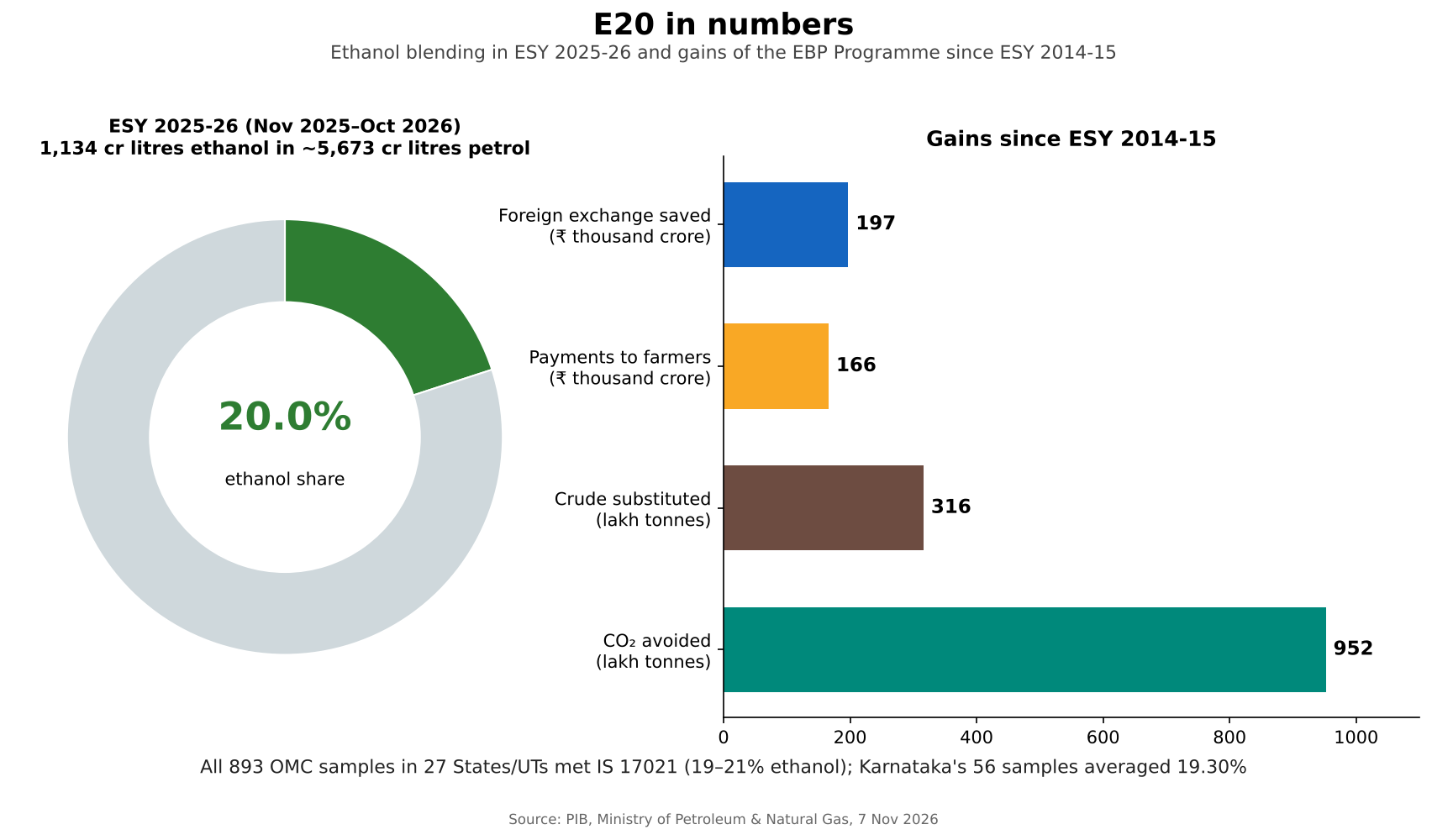
893 E20 samples from 27 States and UTs were all within the prescribed 19–21% ethanol range. All 56 Karnataka samples were between 19% and 20% (average 19.30%).
Testing was done by the OMC/Centre for High Technology (CHT) Quality Coordination Cell.
The OMCs noted that the State's samples showed lower density (0.742–0.749 g/cc) than normal E20 (0.752–0.760 g/cc). Since ethanol is denser than petrol, more ethanol should raise density, not lower it.
Karnataka's estimate of a ₹1.01 lakh crore consumer loss assumed a blanket 10% mileage loss. Studies with ARAI and SIAM show 1–2% loss in E20-calibrated vehicles and 3–6% in others.
ESY 2025-26 (ending 31 October 2026): OMCs blended 1,134 crore litres of ethanol into about 5,673 crore litres of petrol, close to the 20% target.
Prelims Facts & Static Linkages
Gains of the Ethanol Blended Petrol (EBP) Programme since ESY 2014-15
Foreign exchange saved: over ₹1.97 lakh crore.
Crude oil substituted: about 316 lakh tonnes.
CO₂ emissions avoided: about 952 lakh tonnes.
Payments to farmers: over ₹1.66 lakh crore.
Policy milestones
Year
Milestone
2001
Pilot ethanol blending projects
2003
EBP Programme launched (5% blending in select States)
2018
National Policy on Biofuels; 20% target set for 2030
2021
NITI Aayog roadmap for E20 by 2025
2022
Policy amended; E20 target advanced to ESY 2025-26
2025
E20 achieved nationally
Regulatory framework
Motor Spirit and High Speed Diesel (Regulation of Supply, Distribution and Prevention of Malpractices) Order, 2005, issued under the Essential Commodities Act, 1955, sets the sampling procedure: six one-litre samples, shared between the dealer, the oil company and a notified laboratory.
Marketing Discipline Guidelines (MDG) 2024 govern retail outlets.
IS 17021:2018 prescribes ethanol testing by FTIR spectroscopy, water extraction or gas chromatography.
The Ethanol Supply Year (ESY) runs from 1 November to 31 October.
Key concepts
Feedstocks: sugarcane juice, B-heavy and C-heavy molasses, damaged food grains, maize and surplus rice.
1G biofuels come from food crops. 2G come from crop residue and other lignocellulosic biomass, supported by PM JI-VAN Yojana (2019). 3G use algae.
Flex-fuel vehicles can run on high ethanol blends such as E85 or E100.
Concerns: lower energy content (mileage loss), water use by sugarcane, and food-versus-fuel trade-offs.
Quick Revision
E20 means 20% ethanol and 80% petrol, specified in BIS standard IS 17021.
All 893 samples tested across 27 States and UTs met the 19–21% range.
Ethanol is denser than petrol.
ESY runs from November to October.
National Policy on Biofuels 2018 was amended in 2022 to advance E20 to 2025-26.
The EBP Programme has saved over ₹1.97 lakh crore of foreign exchange since 2014-15.
Practice MCQ
Q. With reference to ethanol blending in India, consider the following statements:
1. The specification for E20 fuel is issued by the Bureau of Indian Standards.
2. The Ethanol Supply Year runs from April to March.
3. The sampling procedure for petrol at retail outlets is prescribed under an order issued under the Essential Commodities Act, 1955.
Which of the statements given above are correct?
(a) 1 and 2 only
(b) 2 and 3 only
(c) 1 and 3 only
(d) 1, 2 and 3
Answer: (c). The Ethanol Supply Year runs from November to October.
Related PYQs
PYQ 1 (UPSC CSE Prelims 2025)
Consider the following statements:
Statement I: Of the two major ethanol producers in the world, i.e., Brazil and the United States of America, the former produces more ethanol than the latter.
Statement II: Unlike in the United States of America where corn is the principal feedstock for ethanol production, sugarcane is the principal feedstock for ethanol production in Brazil.
Which one of the following is correct in respect of the above statements?
(a) Both Statement I and Statement II are correct and Statement II explains Statement I
(b) Both Statement I and Statement II are correct but Statement II does not explain Statement I
(c) Statement I is correct but Statement II is not correct
(d) Statement I is not correct but Statement II is correct
Answer: (d).
PYQ 2 (UPSC CSE Prelims 2020)
According to India's National Policy on Biofuels, which of the following can be used as raw materials for the production of biofuels?
1. Cassava
2. Damaged wheat grains
3. Groundnut seeds
4. Horse gram
5. Rotten potatoes
6. Sugar beet
Select the correct answer using the code given below:



 28
Nov 2026
 28
Nov 2026
 28
Nov 2026














0 comments
Discussion
No comments yet. Be the first.