On 4 November 2026, the Union Cabinet approved the continuation of the Centrally Sponsored Scheme (CSS) for Fast Track Special Courts (FTSCs)
DDecode Civils
· 4 min read
Fast Track Special Courts Extended to 2031
Why in News
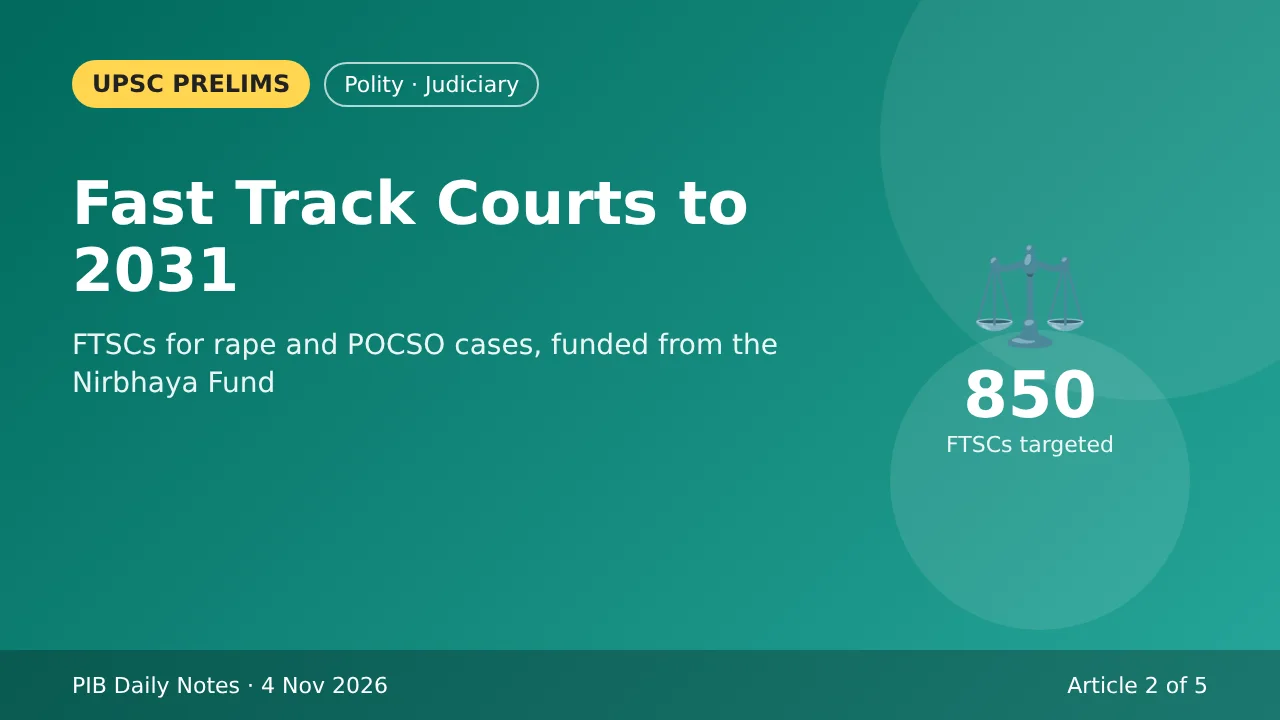
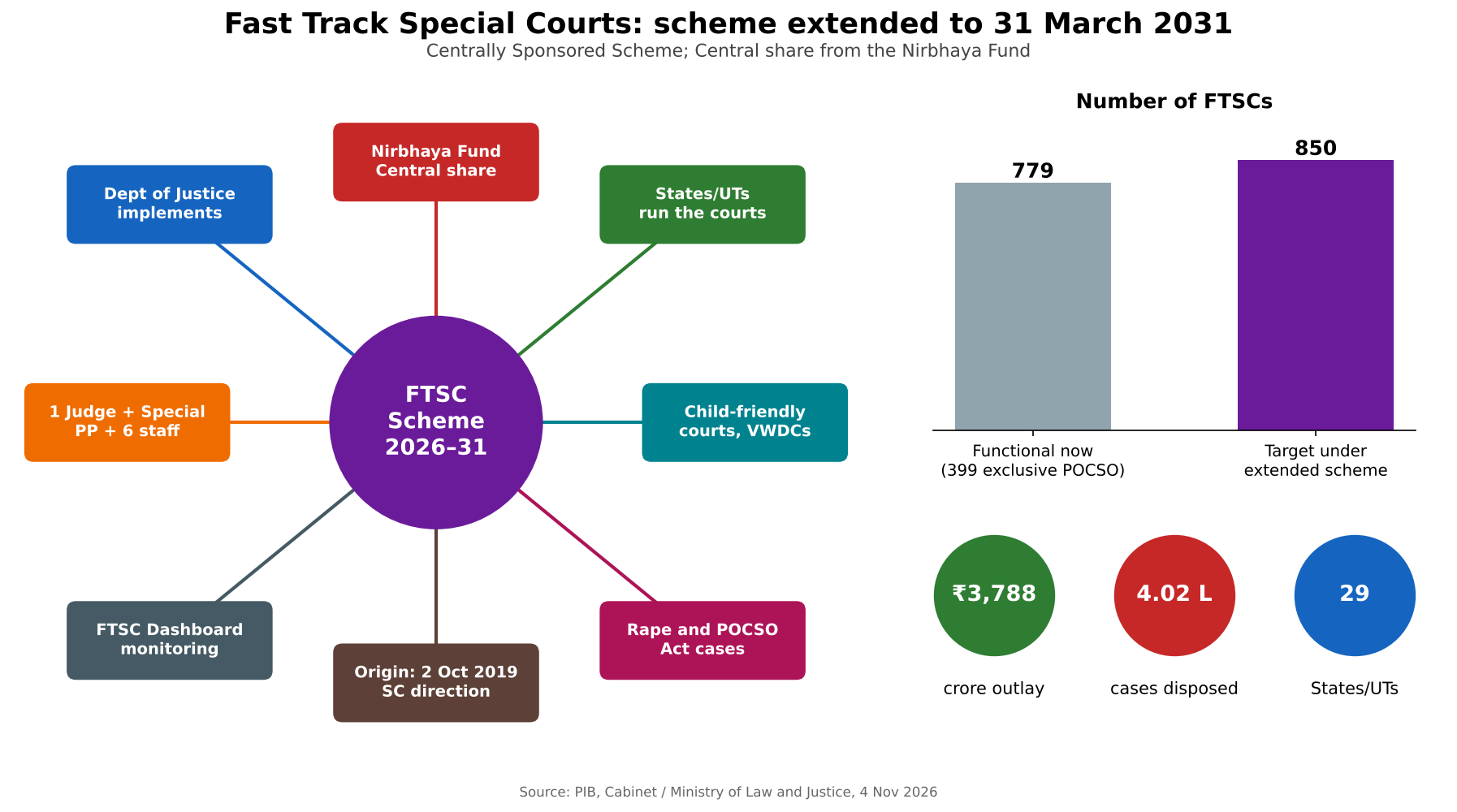
On 4 November 2026, the Union Cabinet approved the continuation of the Centrally Sponsored Scheme (CSS) for Fast Track Special Courts (FTSCs), including exclusive POCSO Courts, for five more years, from 1 April 2026 to 31 March 2031.
News Summary
Outlay:₹3,788.04 crore, with a Central share of ₹2,353.15 crore and a State/UT share of ₹1,434.89 crore.
Funding source: the Central share comes from the Nirbhaya Fund.
Expansion: from the current 779 FTSCs (including 399 exclusive POCSO Courts) to 850. New courts will go to districts chosen on the basis of pending rape and POCSO cases.
Staffing: each court gets one Judicial Officer, a dedicated Special Public Prosecutor and six support staff.
Track record:4,02,457 cases disposed of since the scheme began, with 29 States/UTs taking part.
Victim-centric features:Vulnerable Witness Deposition Centres (VWDCs) and child-friendly court spaces.
Monitoring: the Department of Justice (Ministry of Law and Justice) tracks courts through the FTSC Dashboard and reviews with High Courts.
Prelims Facts & Static Linkages
Origin of the scheme
Criminal Law (Amendment) Act, 2018: passed after the Kathua and Unnao cases. It allowed the death penalty for rape of a girl below 12 and set time limits for investigation and trial.
Supreme Court direction (25 July 2019): in a suo motu writ, the Court directed exclusive POCSO courts in districts with more than 100 pending POCSO cases.
Launch: the scheme began on 2 October 2019 for one year and was later extended up to 31 March 2026.
Today's law: the Bharatiya Nyaya Sanhita, 2023 now covers rape (in place of the IPC), and the Bharatiya Nagarik Suraksha Sanhita, 2023 covers procedure.
POCSO Act, 2012 essentials
Feature
Provision
Child
Any person below 18 years
Gender
Gender-neutral for victims
Courts
Special Courts in each district (Section 28)
Time limit
Trial to be completed within one year as far as possible
2019 amendment
Death penalty for aggravated penetrative sexual assault
Nodal ministry
Ministry of Women and Child Development
Key concepts to revise
Centrally Sponsored Scheme: run by States with shared funding, unlike a Central Sector Scheme, which the Centre funds fully. The usual sharing is 60:40, or 90:10 for North-Eastern and Himalayan States.
Nirbhaya Fund (2013): a non-lapsable corpus for women's safety, administered by the Department of Economic Affairs. The Ministry of Women and Child Development is the nodal ministry for appraisal.
Subordinate courts: covered by Articles 233–237. District judges are appointed by the Governor in consultation with the High Court.
Article 39A: a Directive Principle on equal justice and free legal aid.
Fast-track courts first came with Eleventh Finance Commission grants in 2000.
Likely Prelims angles
CSS vs Central Sector schemes and their funding.
POCSO Act features, such as the age of a child and gender neutrality.
Constitutional articles on the subordinate judiciary.
Quick Revision
FTSC scheme extended to 31 March 2031 with ₹3,788.04 crore.
The Central share comes from the Nirbhaya Fund.
Courts will rise from 779 to 850; 399 are exclusive POCSO Courts.
Over 4 lakh cases have been disposed of since 2019.
The Department of Justice runs the scheme.
It began on 2 October 2019, following a Supreme Court direction.
Practice MCQ
Q. With reference to the scheme for Fast Track Special Courts (FTSCs), consider the following statements:
1. It is a Central Sector Scheme fully funded by the Union Government.
2. The Central share of the scheme is met from the Nirbhaya Fund.
3. The scheme is implemented by the Ministry of Women and Child Development.
Which of the statements given above is/are correct?
(a) 1 and 2 only
(b) 2 only
(c) 2 and 3 only
(d) 1, 2 and 3
Answer: (b). It is a Centrally Sponsored Scheme run by the Department of Justice.
Related PYQs
PYQ 1 (UPSC CSE Prelims 2024)
A Writ of Prohibition is an order issued by the Supreme Court or High Courts to:
(a) a government officer prohibiting him from taking a particular action.
(b) the Parliament/Legislative Assembly to pass a law on Prohibition.
(c) the lower court prohibiting continuation of proceedings in a case.
(d) the Government prohibiting it from following an unconstitutional policy.
Answer: (c).
PYQ 2 (UPSC CSE Prelims 2025)
Consider the following pairs:
Provision in the Constitution of India
Stated under
I. Separation of Judiciary from the Executive in the public services of the State
The Directive Principles of the State Policy
II. Valuing and preserving the rich heritage of our composite culture
The Fundamental Duties
III. Prohibition of employment of children below the age of 14 years in factories
The Fundamental Rights
How many of the above pairs are correctly matched?



 28
Nov 2026
 28
Nov 2026
 28
Nov 2026














0 comments
Discussion
No comments yet. Be the first.