Geothermal Energy: India Taps the Heat Beneath Puga Valley
A PIB backgrounder, released as the Bharat Renewable Energy Summit & Expo 2026 opened at Bharat Mandapam (2–5 November)
DDecode Civils
· 3 min read
Geothermal Energy: India Taps the Heat Beneath Puga Valley
Why in News
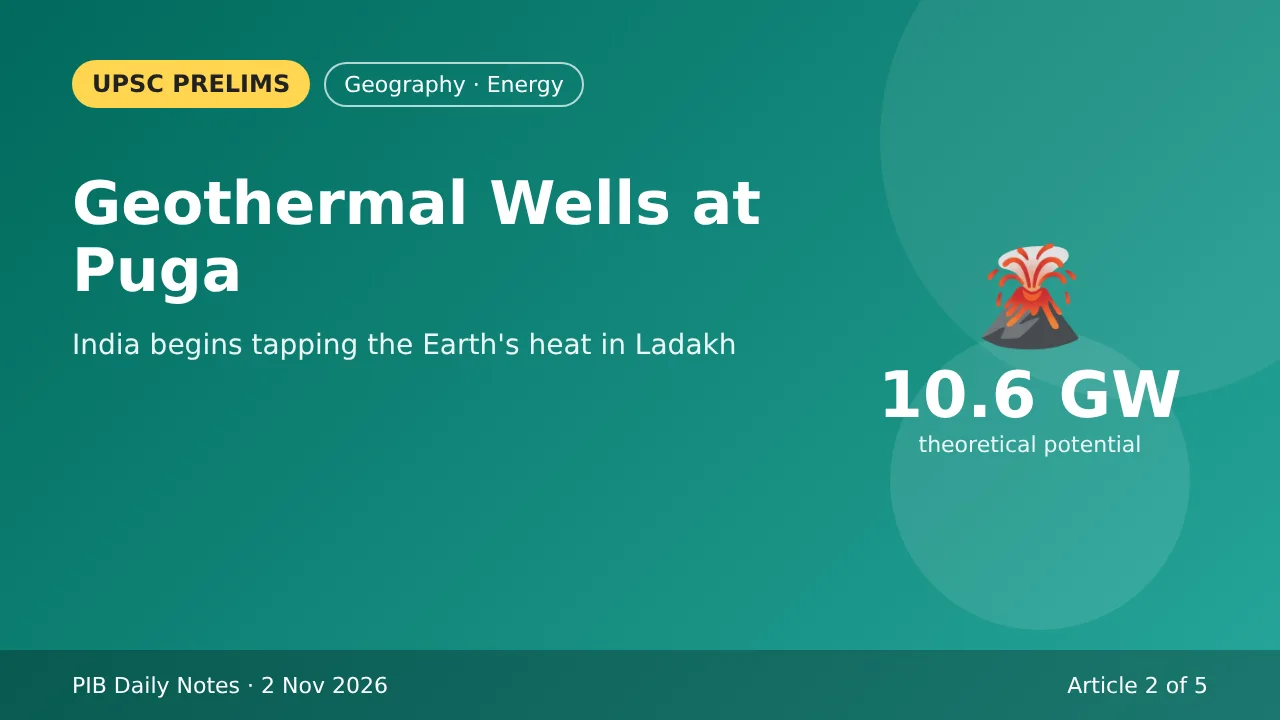
A PIB backgrounder, released as the Bharat Renewable Energy Summit & Expo 2026 opened at Bharat Mandapam (2–5 November), set out India's geothermal plans. It follows the National Policy on Geothermal Energy (September 2025) and the commissioning of India's first two geothermal wells at Puga Valley, Ladakh, in July 2026.
News Summary
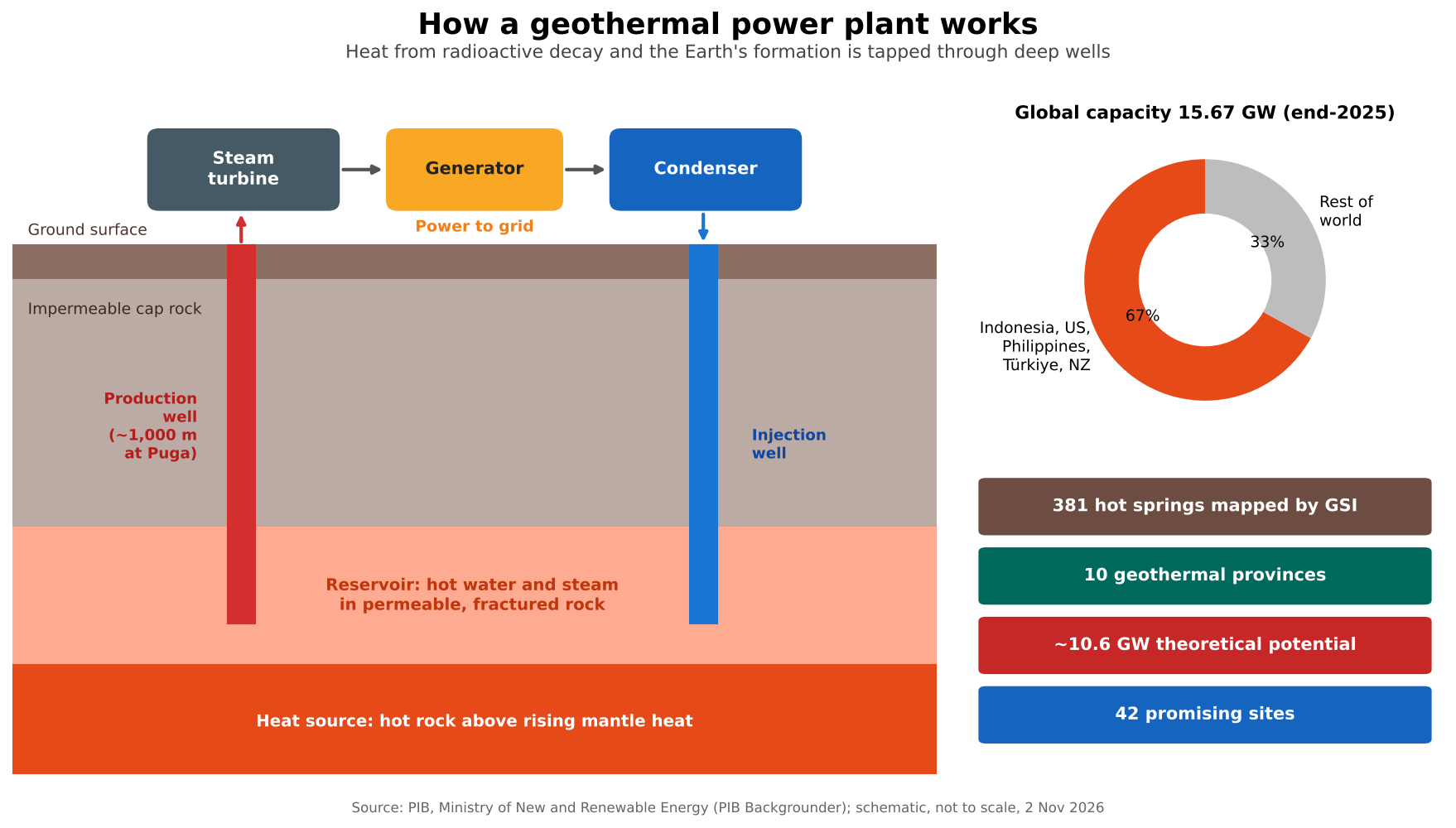
ONGC Energy Centre drilled the two wells, each about 1,000 metres deep, at over 14,000 feet. They will evaluate the reservoir for India's first 1 MW demonstration geothermal power plant.
The Geological Survey of India (GSI) has mapped 381 hot springs and 10 geothermal provinces. The theoretical potential is about 10.6 GW, and 42 sites look promising.
The Ministry of New and Renewable Energy (MNRE) is the nodal ministry. It sanctioned five R&D projects in July–August 2025.
Pilots include repurposing unproductive oil wells at Ankleshwar, a solar–geothermal hybrid at Gandhinagar (50–90 kW), site studies at Tawang and geothermal cooling at Hyderabad.
Global installed capacity was 15.67 GW at the end of 2025. Indonesia, the US, the Philippines, Türkiye and New Zealand hold about 67% of it.
India cooperates on geothermal with Australia, Iceland and Saudi Arabia.
Prelims Facts & Static Linkages
How geothermal power works
Heat source: radioactive decay of uranium, thorium and potassium, plus heat left over from the Earth's formation.
Reservoir: mantle convection drives tectonics. Faults let heat rise, trapping hot water and steam in permeable rock.
Extraction: production wells bring the fluid up, and steam turns a turbine and generator.
Reinjection: the cooled water goes back into the reservoir, keeping it productive.
Direct use: district heating, greenhouses, aquaculture and Ground Source Heat Pumps (GSHPs).
Inside the Earth (as given in the release)
Layer
State
Key fact
Crust
Solid
5–8 km under oceans, 24–56 km under continents
Mantle
Semi-solid, hot rock
About 2,900 km thick, the largest layer
Outer core
Liquid iron and nickel
About 2,400 km thick
Inner core
Solid iron and nickel
Core temperature 5,000–6,000 °C
India's 10 geothermal provinces
Himalayan (Puga and Chumathang in Ladakh, Manikaran in Himachal Pradesh), Naga-Lusai and Andaman and Nicobar Islands.
Son-Narmada-Tapi (SONATA), which includes Tattapani in Chhattisgarh, the West Coast and the Cambay Graben in Gujarat.
Aravalli, Mahanadi, Godavari and the South Indian Cratonic region.
Why geothermal matters
It is round-the-clock baseload power, unlike solar and wind.
It has a small land footprint and low emissions.
Challenges: high drilling cost, exploration risk and most sites being in remote Himalayan terrain.
Enhanced Geothermal Systems (EGS) create reservoirs in hot dry rock and widen the resource.
Energy security: it is an indigenous resource that cuts reliance on imported fossil fuels on the way to Net Zero by 2070.
Quick Revision
The National Policy on Geothermal Energy was notified in September 2025, with MNRE as the nodal ministry.
India's first two geothermal wells are at Puga Valley, Ladakh, drilled by ONGC Energy Centre.
GSI: 381 hot springs, 10 provinces, about 10.6 GW potential.
Geothermal energy comes from radioactive decay and primordial heat.
Indonesia and the US lead global capacity.
Practice MCQ
Q. With reference to geothermal energy in India, consider the following statements:
1. The Ministry of Earth Sciences is the nodal ministry for the National Policy on Geothermal Energy.
2. India's first geothermal wells were commissioned in Puga Valley, Ladakh.
3. Unproductive oil and gas wells can be repurposed for geothermal use.
Which of the statements given above is/are correct?
(a) 1 and 2 only
(b) 2 and 3 only
(c) 1 and 3 only
(d) 1, 2 and 3
Answer: (b). The Ministry of New and Renewable Energy is the nodal ministry.
Related PYQs
PYQ 1 (UPSC CSE Prelims 2023)
Consider the following statements:
1. In a seismograph, P waves are recorded earlier than S waves.
2. In P waves, the individual particles vibrate to and fro in the direction of wave propagation whereas in S waves, the particles vibrate up and down at right angles to the direction of wave propagation.
Which of the statements given above is/are correct?



 28
Nov 2026
 28
Nov 2026
 28
Nov 2026














0 comments
Discussion
No comments yet. Be the first.