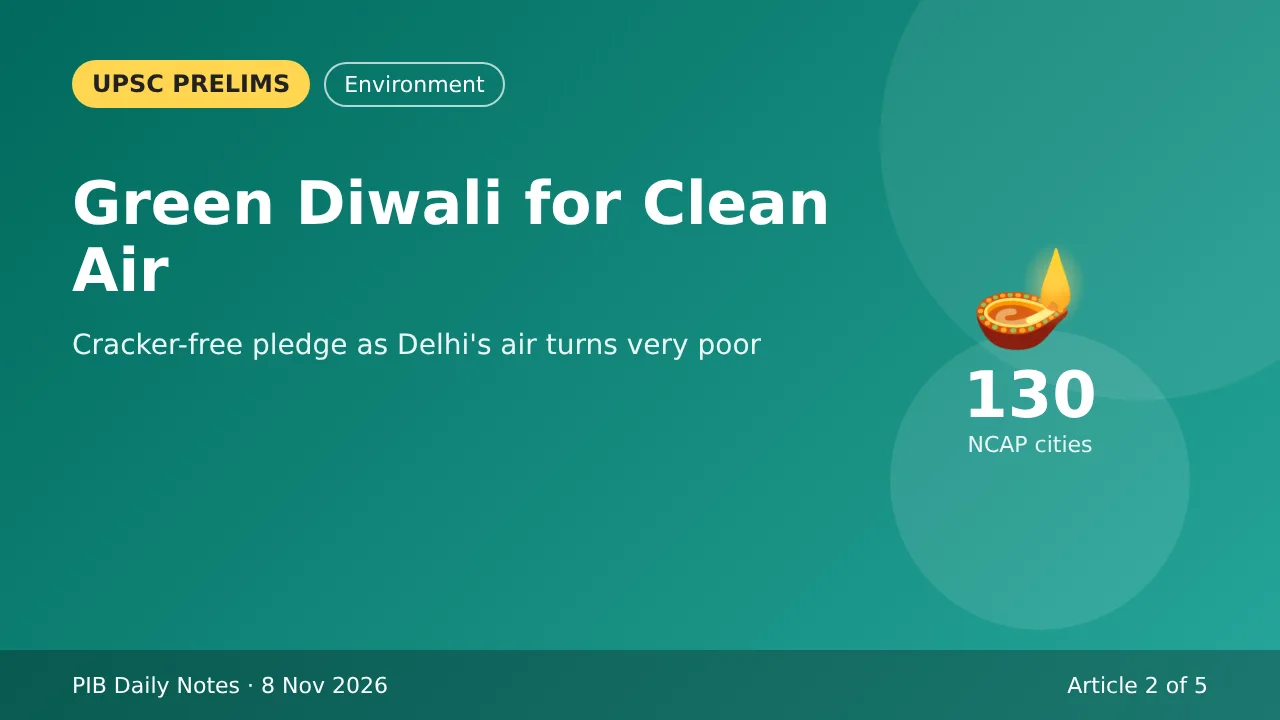
Green Diwali Campaign 2026 and Delhi's Air Quality
WWF-India's EIACP Programme Centre, supported by the Ministry of Environment, Forest and Climate Change (MoEFCC), urged Delhi-NCR
DDecode Civils
· 4 min read
Green Diwali Campaign 2026 and Delhi's Air Quality
Why in News
WWF-India's EIACP Programme Centre, supported by the Ministry of Environment, Forest and Climate Change (MoEFCC), urged Delhi-NCR residents to celebrate a cracker-free Green Diwali and take the Green Diwali Pledge. Delhi's air was already 'Very Poor', with forecasts warning of 'Severe' levels.
News Summary
The Green Diwali Campaign 2026 ran from 20 October to 8 November 2026 under Mission LiFE (Lifestyle for Environment).
It focused on the 130 cities covered by the National Clean Air Programme (NCAP) in 24 States and UTs.
The Central Pollution Control Board (CPCB) rated Delhi's air 'Very Poor'. The Air Quality Early Warning System forecast 'Severe' air on festival days.
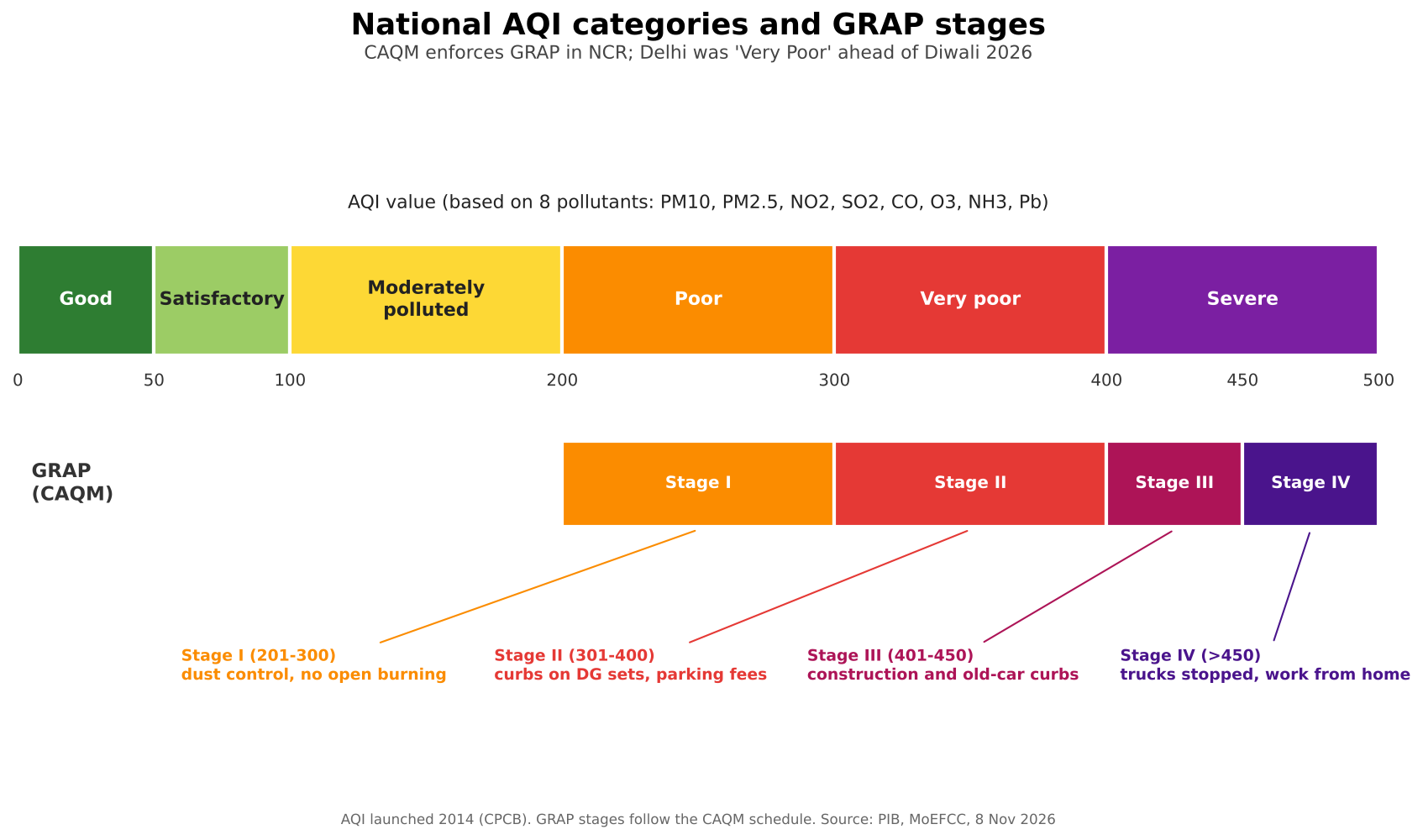
The Commission for Air Quality Management (CAQM) is enforcing the Graded Response Action Plan (GRAP) across NCR.
Suggested steps include earthen diyas, no firecrackers, natural rangoli colours, no single-use plastic, waste segregation, public or shared transport, and checking the AQI on the CPCB's SAMEER app.
Citizens were also asked to take WWF-India's Carbon Footprint Survey.
Prelims Facts & Static Linkages
Why Delhi's air worsens around Diwali
Stubble burning in Punjab and Haryana peaks in late October and November.
Temperature inversion: cold air near the ground traps pollutants under a warmer layer.
Low wind speed and a low mixing height stop pollutants from dispersing.
Local sources: vehicles, construction dust, industry and waste burning.
Firecrackers add a sudden spike of PM2.5, metals and noise on one or two nights.
Geography: Delhi sits in the land-locked Indo-Gangetic Plain, so winter north-westerly winds bring smoke in and little blows it out.
National Air Quality Index (launched 2014)
AQI range
Category
0–50
Good
51–100
Satisfactory
101–200
Moderately polluted
201–300
Poor
301–400
Very poor
401–500
Severe
The AQI uses eight pollutants: PM10, PM2.5, NO₂, SO₂, CO, O₃, NH₃ and lead (Pb).
GRAP stages
Stage I (Poor, 201–300): dust control, ban on open burning, checks on polluting vehicles.
Stage II (Very Poor, 301–400): curbs on diesel generator sets and higher parking fees.
Stage III (Severe, 401–450): curbs on construction and on older BS-III petrol and BS-IV diesel cars.
Stage IV (Severe+, above 450): entry of most trucks stopped and more work from home.
Institutions and programmes
CAQM: a statutory body under the CAQM in NCR and Adjoining Areas Act, 2021. It replaced the EPCA.
CPCB: a statutory body set up under the Water Act, 1974, also working under the Air Act, 1981.
NCAP (2019): aims to cut particulate levels by up to 40% by 2025–26, against a 2017–18 base. Cities are ranked under Swachh Vayu Sarvekshan.
Green crackers: developed by CSIR-NEERI, in three types (SWAS, SAFAL and STAR), with lower emissions.
EIACP: the Environmental Information, Awareness, Capacity Building and Livelihood Programme, the renamed ENVIS scheme of MoEFCC.
Mission LiFE: announced by India at COP26 (Glasgow, 2021) and launched in 2022. It promotes mindful use of resources instead of wasteful consumption.
Air Quality Early Warning System: run by the Indian Institute of Tropical Meteorology (IITM), Pune, under the Ministry of Earth Sciences.
Quick Revision
The Green Diwali Campaign ran from 20 October to 8 November 2026 under Mission LiFE.
NCAP covers 130 cities.
CAQM enforces GRAP in NCR.
GRAP has four stages, from 'Poor' to 'Severe+'.
The AQI has six categories and uses eight pollutants.
Green crackers were developed by CSIR-NEERI.
Practice MCQ
Q. Consider the following statements:
1. The Commission for Air Quality Management in NCR and Adjoining Areas is a statutory body.
2. The National Air Quality Index uses six pollutants.
3. Stage IV of the Graded Response Action Plan applies when the AQI crosses 450.
Which of the statements given above is/are correct?
(a) 1 only
(b) 1 and 3 only
(c) 2 and 3 only
(d) 1, 2 and 3
Answer: (b). The AQI uses eight pollutants.
Related PYQs
PYQ 1 (UPSC CSE Prelims 2022)
In the context of WHO Air Quality Guidelines, consider the following statements:
1. The 24-hour mean of PM2.5 should not exceed 15 µg/m³ and annual mean of PM2.5 should not exceed 5 µg/m³.
2. In a year, the highest levels of ozone pollution occur during the periods of inclement weather.
3. PM10 can penetrate the lung barrier and enter the bloodstream.
4. Excessive ozone in the air can trigger asthma.
Which of the statements given above are correct?
(a) 1, 3 and 4
(b) 1 and 4 only
(c) 2, 3 and 4
(d) 1 and 2 only
Answer: (b).
PYQ 2 (UPSC CSE Prelims 2025)
Artificial way of causing rainfall to reduce air pollution makes use of



 28
Nov 2026
 28
Nov 2026
 28
Nov 2026














0 comments
Discussion
No comments yet. Be the first.