
How to Make a Daily Study Timetable for UPSC Beginners?
A well-structured UPSC daily study timetable helps aspirants maintain consistency, complete the syllabus and develop effective revision habits. However, the objective is not to study for 12–14 hours daily but to make every study session productive.

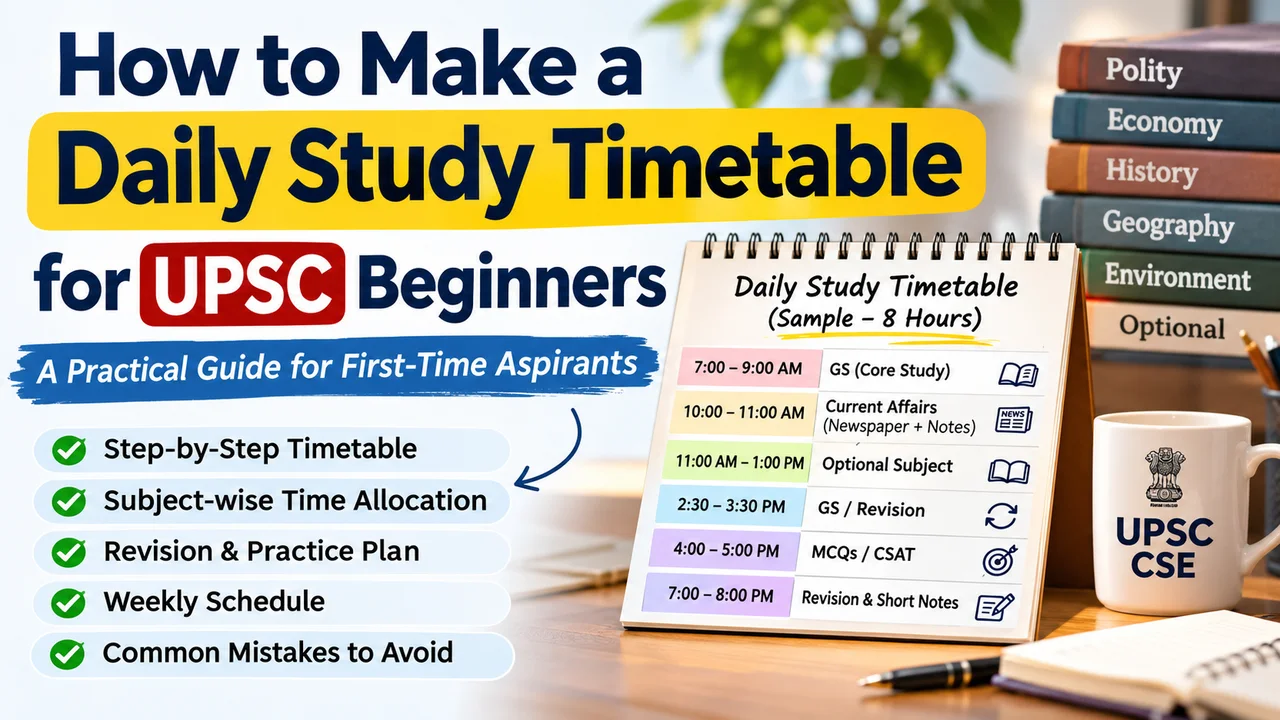
How to Make a Daily Study Timetable for UPSC Beginners: A Practical Guide for First-Time Aspirants
Preparing for UPSC Civil Services Examination for the first time can feel overwhelming. With an extensive syllabus covering General Studies, Current Affairs, Optional Subjects, CSAT and Essay, beginners often struggle to decide what to study and when.
A well-structured UPSC daily study timetable helps aspirants maintain consistency, complete the syllabus and develop effective revision habits. However, the objective is not to study for 12–14 hours daily but to make every study session productive.
1. Understand the UPSC Syllabus Before Creating a Timetable
Before scheduling study hours, understand the examination requirements.
Download the official UPSC Prelims and Mains syllabus.
Analyse previous years' questions (PYQs).
Identify important subjects and their relative difficulty.
Select limited, reliable study resources.
Set realistic daily and weekly targets.
Topper's Strategy: Aditi Varshney (AIR 57, UPSC CSE 2022), who cleared UPSC in her first attempt, recommends understanding the syllabus, building NCERT fundamentals and avoiding excessive study resources.
2. Ideal Daily UPSC Study Timetable for Beginners
First-time aspirants preparing full-time can initially target 6 hours of focused study, gradually increasing towards 8 hours as their concentration improves.
Sample 8-Hour Daily Study Timetable
| Time | Activity |
|---|---|
| 6:30–7:00 AM | Wake up, exercise and freshen up |
| 7:00–9:00 AM | General Studies: NCERTs and standard books |
| 9:00–10:00 AM | Breakfast and break |
| 10:00–11:00 AM | Newspaper reading and current affairs |
| 11:00 AM–1:00 PM | Optional subject preparation |
| 1:00–2:30 PM | Lunch and rest |
| 2:30–3:30 PM | Second GS subject or revision |
| 3:30–4:00 PM | Break |
| 4:00–5:00 PM | MCQs, PYQs or CSAT practice |
| 5:00–7:00 PM | Personal time, exercise and dinner |
| 7:00–8:00 PM | Revision and short-note preparation |
Total focused study time: 8 hours. The schedule is illustrative and should be adjusted according to individual circumstances.
Decode Civils Free-for-all Initiatives & Study Material: This is a free-for-all course and provides exam-oriented strategies, analysis and resources for UPSC CSE 2027 & 2028 Aspirants. Click Here to Enroll for Free to Access the Same.
For easy access, the free-for-all material is segregated into 3 folders:
- Prelims: Booklist, 13 Types of MCQs, CSAT High Focus Areas, Polity High Focus Areas.
- Mains: Micro Topic Breakdown, Topic wise PYQ Segregation, Solved PYQs, PDFs of Mudit Sir's Books.
- Current Affairs: May-August Prelims + Mains Notes.
Strategies and Notes can be downloaded for free from relevant folder!
Click Here to Learn More About Decode Civils' UPSC Prelims 2027 Courses
3. Divide Preparation Between GS, Optional and Current Affairs
A balanced timetable should allocate sufficient attention to every major examination component.
General Studies: 3 hours daily for conceptual understanding.
Optional Subject: 2 hours for systematic syllabus coverage.
Current Affairs: 1 hour for newspaper reading and relevant notes.
Practice: 1 hour for PYQs, MCQs or CSAT.
Revision: 1 hour to consolidate previously studied topics.
Topper's Strategy: Prajnanandan Giri (AIR 24, UPSC CSE 2023) followed monthly, weekly and daily targets instead of a rigid hourly timetable. He regularly evaluated his progress and modified targets accordingly.
4. Make Revision a Daily Habit
Reading new material without revision leads to poor retention. Allocate a dedicated revision slot rather than postponing revision until the examination approaches.
Follow this practical revision cycle:
Daily: Revise important concepts studied that day.
Weekly: Revisit topics completed during the previous six days.
Monthly: Consolidate short notes and attempt sectional tests.
Aditi Varshney also emphasises repeated revision and concise notes over collecting multiple resources.
5. Include Answer Writing and CSAT Practice
Beginners should first develop conceptual clarity before attempting intensive Mains answer writing.
Once sufficient topics have been covered:
Start with one Mains answer on alternate days.
Practise 15–20 topic-wise MCQs regularly.
Reserve dedicated sessions for CSAT comprehension, reasoning and numeracy.
Increase timed practice gradually as the examination approaches.
Avoid neglecting CSAT simply because it is qualifying.
6. Create a Weekly Study Plan
Daily schedules become more effective when supported by weekly evaluation.
| Day | Priority |
|---|---|
| Monday–Friday | GS, Optional, Current Affairs and daily revision |
| Saturday | PYQs, sectional tests and error analysis |
| Sunday | Weekly revision, backlog clearance and rest |
Keep one flexible session for unexpected interruptions or unfinished topics.
7. Avoid Common Timetable Mistakes
First-time aspirants should avoid:
Copying a topper's timetable without considering personal circumstances.
Changing resources or schedules frequently.
Spending excessive time on newspapers and note-making.
Ignoring sleep, physical activity and breaks.
Measuring progress only through hours studied.
Conclusion: Follow a Sustainable Timetable
The best UPSC timetable is not necessarily the longest or most demanding. It is one that can be followed consistently for months.
Begin with achievable targets, strengthen fundamentals, incorporate regular practice and evaluate progress every week. As preparation advances, adjust the timetable towards Prelims revision, mock tests and Mains answer writing.
Remember: Consistency, revision and measurable syllabus coverage matter more than simply counting study hours.
Decode Civils Free-for-all Initiatives & Study Material: This is a free-for-all course and provides exam-oriented strategies, analysis and resources for UPSC CSE 2027 & 2028 Aspirants. Click Here to Enroll for Free to Access the Same.
For easy access, the free-for-all material is segregated into 3 folders:
- Prelims: Booklist, 13 Types of MCQs, CSAT High Focus Areas, Polity High Focus Areas.
- Mains: Micro Topic Breakdown, Topic wise PYQ Segregation, Solved PYQs, PDFs of Mudit Sir's Books.
- Current Affairs: May-August Prelims + Mains Notes.
Strategies and Notes can be downloaded for free from relevant folder!
Click Here to Learn More About Decode Civils' UPSC Prelims 2027 Courses
Downloads
Most read on Mudit Jain Blogs
- 2026 UPSC CSE Prelims GS Detailed Analysis Analysis
- Booklist & Sources for UPSC Prelims 2027 Prelims
- UPSC Prelims - Types of Questions Asked 2013 Onwards Analysis
- 2026 UPSC CSE Prelims CSAT Detailed Analysis Analysis
- 2013-2025 UPSC Mains GS-2 PYQs Analysis Analysis
- K.N.Chandana Jahnavi (CSE-23 AIR-50) Comprehensive and Sociology Strategy Topper Strategies
- 2013-2025 UPSC Mains GS-1 PYQs Analysis Analysis
- Prajnanandan Giri (CSE-23 AIR-24) Journey, Geography & Comprehensive Strategy Topper Strategies
- Aditi Varshney (AIR-57 CSE-22) Comprehensive Strategy Topper Strategies
- Jatin Jain (AIR-91 CSE-22) Sociology + Comprehensive Strategy Topper Strategies
Preparing for UPSC?
Talk to us about the right programme for your attempt.
Keep reading
Related articles
 19
Nov 2026
Foundation · Prelims
How to Use UPSC PYQs Effectively?
Sourabh Arbole Sir, who has cleared all six of his UPSC Prelims attempts, advocates a deeper approach. His methodology focuses on understanding how UPSC
Decode Civils · 19 Nov 2026
 19
Nov 2026
Foundation · Prelims
Newspaper and Current Affairs Strategy for UPSC Beginners: Mudit Jain (Ex-IPS, Ex-IRS)
Mudit Jain (Ex-IPS, Ex-IRS), who cleared UPSC CSE three times with AIR 222, 207 and 173, emphasises comprehensive coverage, linking Current Affairs with static subjects, systematic revision and question-based practice.
Decode Civils · 19 Nov 2026
 18
Nov 2026
Foundation · Prelims
Can I Crack UPSC in 1 Year? 12-Month Study Plan Based on Toppers' Strategies
Yes, cracking UPSC Civil Services Examination in one year is possible, even for a beginner. However, success requires disciplined preparation, limited study resources, regular revision and consistent practice for both Prelims and Mains.
Decode Civils · 18 Nov 2026
Our programmes
Courses for your attempt

History Module For Prelims 2027
The toughest part of Prelims, simplified by someone who has cleared Prelims 7 out of 7 times.
History Starts 20 Dec 2026
₹2,359 ₹2,949
Learn More: History Module For Prelims 2027
Current Affairs For Prelims 2027 (Plus)
The only current affairs course with direct hits in UPSC Prelims
CA Plus Starts 4 Jan 2027
₹4,129 ₹4,719
Learn More: Current Affairs For Prelims 2027 (Plus)
Current Affairs For Prelims 2027 (Base)
The only current affairs course with direct hits in UPSC Prelims
CA Base Starts 4 Jan 2027
₹3,539 ₹4,129
Learn More: Current Affairs For Prelims 2027 (Base)
PYQ Edge
A PYQ mastery program: use PYQs to build an edge in your Prelims score
PYQ Edge Starts 15 Dec 2026
₹2,359 ₹2,949
Learn More: PYQ Edge
Prelims Excellence Program 2027 (Pro)
Your One Stop Solution For Prelims 2027
PEP Pro Starts 20 Nov 2026
₹20,059 ₹22,419
Learn More: Prelims Excellence Program 2027 (Pro)
Prelims Excellence Program 2027 (Plus)
Your One Stop Solution For Prelims 2027
PEP Plus Starts 20 Nov 2026
₹11,799 10618.82
Learn More: Prelims Excellence Program 2027 (Plus)
Prelims Excellence Program 2027 (Base)
Your One Stop Solution For Prelims 2027
PEP Base Starts 20 Nov 2026
₹7,079 ₹8,259
Learn More: Prelims Excellence Program 2027 (Base)
CSAT Enrichment Batch
Master the art and science of solving CSAT
₹2,359 ₹2,949
Learn More: CSAT Enrichment Batch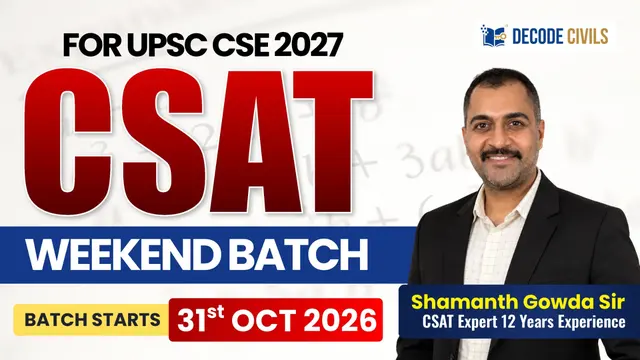
CSAT WEEKEND BATCH
Master CSAT for UPSC Prelims 2027 with expert guidance, focused practice, and mock tests.
CSAT WEEKEND BATCH Starts 31 Oct 2026
₹5,899 ₹8,259
Learn More: CSAT WEEKEND BATCH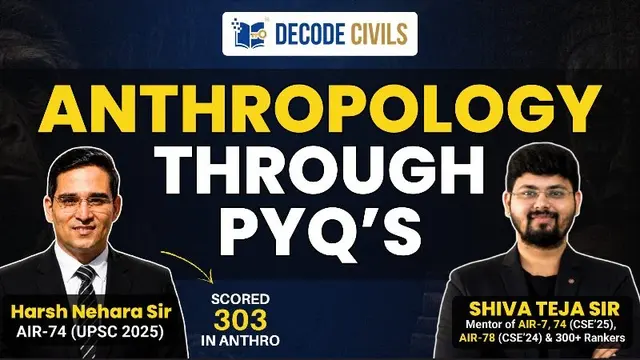
ANTHROPOLOGY THROUGH PYQ's
Understand what UPSC asks and how to answer it from the Anthro Topper.
₹5,899 ₹8,259
Learn More: ANTHROPOLOGY THROUGH PYQ's
PSIR EXCELLENCE PROGRAM PRO (OFFLINE): Batch-2
An Enrichment Course that can help you add 50+ marks in your PSIR Scores.

PSIR EXCELLENCE PROGRAM PRO (ONLINE): Batch-2
An Enrichment Course that can help you add 50+ marks in your PSIR Scores.


0 comments
Discussion
No comments yet. Be the first.