
How to Use UPSC PYQs Effectively?
Sourabh Arbole Sir, who has cleared all six of his UPSC Prelims attempts, advocates a deeper approach. His methodology focuses on understanding how UPSC


How to Use UPSC PYQs Effectively: Sourabh Arbole Sir's Strategy for Prelims
Previous Year Questions (PYQs) are among the most important resources for UPSC Civil Services Examination preparation. However, many aspirants make the mistake of solving questions, checking answers and immediately moving to the next paper.
Sourabh Arbole Sir, who has cleared all six of his UPSC Prelims attempts, advocates a deeper approach. His methodology focuses on understanding how UPSC frames questions, identifying recurring themes and developing the ability to solve unfamiliar questions through reasoning.
Here is how beginners can apply his PYQ strategy effectively.
1. Understand Why UPSC PYQs Matter
PYQs reveal what UPSC actually expects from aspirants.
They help identify:
Frequently tested concepts and recurring themes.
The examiner's approach to framing statements.
The relationship between static subjects and current affairs.
Common traps in multiple-choice questions.
The depth of conceptual understanding required.
Instead of treating PYQs merely as practice tests, use them to understand the examination itself.
2. Follow the Four-Level PYQ Analysis Method
Sourabh Arbole Sir's PYQ Edge framework emphasises analysing each question at four levels.
Level 1: Question and Answer
Identify the correct answer and understand the reasoning behind it.
Level 2: High-Yield Themes
Determine the broader syllabus topic and whether similar concepts have appeared previously.
Level 3: Examiner's Mindset
Examine why UPSC framed the question in a particular way and what conceptual confusion it tests.
Level 4: Individual Statements
Analyse every statement and option, including incorrect ones, to develop wider conceptual knowledge.
This transforms a single question into an opportunity to learn several related concepts.

3. Develop Logical Elimination Skills
UPSC Prelims frequently presents situations where candidates cannot recall every fact.
Therefore, preparation must include the ability to eliminate incorrect alternatives.
Practise identifying:
Factually incorrect statements.
Misleading qualifications and exaggerated claims.
Incorrect combinations of otherwise familiar concepts.
Contradictions between options and established principles.
However, elimination must be based on defensible reasoning, not arbitrary shortcuts.
The objective is to reduce uncertainty while maintaining accuracy under negative marking.
4. Identify Frequently Repeated Themes
UPSC may not repeat identical questions, but important concepts can appear in different forms.
For example, questions concerning constitutional institutions may examine their composition, appointment procedures, powers or independence.
Create a subject-wise PYQ notebook covering:
Recurring topics.
Important conceptual distinctions.
Commonly confused facts.
Areas requiring additional revision.
Allocate greater attention to frequently tested themes without completely ignoring the remaining syllabus.
Decode Civils Free-for-all Initiatives & Study Material: This is a free-for-all course and provides exam-oriented strategies, analysis and resources for UPSC CSE 2027 & 2028 Aspirants. Click Here to Enroll for Free to Access the Same.
For easy access, the free-for-all material is segregated into 3 folders:
- Prelims: Booklist, 13 Types of MCQs, CSAT High Focus Areas, Polity High Focus Areas.
- Mains: Micro Topic Breakdown, Topic wise PYQ Segregation, Solved PYQs, PDFs of Mudit Sir's Books.
- Current Affairs: May-August Prelims + Mains Notes.
Strategies and Notes can be downloaded for free from relevant folder!
Click Here to Learn More About Decode Civils' UPSC Prelims 2027 Courses
5. Go Beyond the Correct Answer
One distinctive element of Sourabh Sir's approach is working backwards from PYQ options.
For example, if a question asks about a national park, do not stop after identifying its location.
Explore related areas such as:
Important species and habitats.
Relevant geographical features.
Protected-area classifications.
Associated environmental legislation.
This approach expands conceptual coverage without requiring multiple unrelated study sources.
However, avoid excessive research into peripheral facts.
6. Solve PYQs Topic-Wise and Year-Wise
Beginners can combine two complementary methods.
During syllabus preparation:
Solve topic-wise PYQs immediately after completing a chapter.
Identify conceptual gaps.
Revisit the relevant textbook or notes.
During Prelims revision:
Attempt complete previous-year papers.
Follow the actual examination time limit.
Record incorrect answers and uncertain guesses.
Analyse performance before attempting another paper.
Sourabh Sir's PYQ Edge programme uses year-wise analysis to develop an understanding of evolving question patterns.
7. Follow a Practical Weekly PYQ Schedule
| Day | Activity |
|---|---|
| Monday–Tuesday | 20–30 topic-wise PYQs daily |
| Wednesday | Analyse statements and options |
| Thursday | Revise recurring concepts |
| Friday | Practise elimination techniques |
| Saturday | Attempt a mixed PYQ test |
| Sunday | Review mistakes and update notes |
This is a suggested beginner-friendly application of the strategy.
8. Avoid Common PYQ Preparation Mistakes
Aspirants should avoid:
Memorising answers without understanding concepts.
Ignoring incorrect options.
Solving PYQs only during the final preparation phase.
Treating recurring topics as guaranteed future questions.
Neglecting CSAT PYQs.
Focusing on the number of questions solved rather than learning outcomes.
Conclusion: Learn to Think Like the Examiner
The real value of UPSC PYQs lies in understanding the logic behind questions.
Sourabh Arbole Sir's approach encourages aspirants to move beyond answer memorisation towards deeper conceptual analysis, elimination skills and recurring-theme identification.
Do not simply solve PYQs. Decode the question, understand every option, identify the underlying concept and revise it repeatedly.
This makes PYQs an integral part of preparation rather than merely a final-stage assessment tool.
References
Downloads
Most read on Mudit Jain Blogs
- 2026 UPSC CSE Prelims GS Detailed Analysis Analysis
- Booklist & Sources for UPSC Prelims 2027 Prelims
- UPSC Prelims - Types of Questions Asked 2013 Onwards Analysis
- 2026 UPSC CSE Prelims CSAT Detailed Analysis Analysis
- 2013-2025 UPSC Mains GS-2 PYQs Analysis Analysis
- K.N.Chandana Jahnavi (CSE-23 AIR-50) Comprehensive and Sociology Strategy Topper Strategies
- 2013-2025 UPSC Mains GS-1 PYQs Analysis Analysis
- Prajnanandan Giri (CSE-23 AIR-24) Journey, Geography & Comprehensive Strategy Topper Strategies
- Aditi Varshney (AIR-57 CSE-22) Comprehensive Strategy Topper Strategies
- Jatin Jain (AIR-91 CSE-22) Sociology + Comprehensive Strategy Topper Strategies
Preparing for UPSC?
Talk to us about the right programme for your attempt.
Keep reading
Related articles
 19
Nov 2026
Foundation · Prelims
Newspaper and Current Affairs Strategy for UPSC Beginners: Mudit Jain (Ex-IPS, Ex-IRS)
Mudit Jain (Ex-IPS, Ex-IRS), who cleared UPSC CSE three times with AIR 222, 207 and 173, emphasises comprehensive coverage, linking Current Affairs with static subjects, systematic revision and question-based practice.
Decode Civils · 19 Nov 2026
 18
Nov 2026
Foundation · Prelims
How to Make a Daily Study Timetable for UPSC Beginners?
A well-structured UPSC daily study timetable helps aspirants maintain consistency, complete the syllabus and develop effective revision habits. However, the objective is not to study for 12–14 hours daily but to make every study session productive.
Decode Civils · 18 Nov 2026
 18
Nov 2026
Foundation · Prelims
Can I Crack UPSC in 1 Year? 12-Month Study Plan Based on Toppers' Strategies
Yes, cracking UPSC Civil Services Examination in one year is possible, even for a beginner. However, success requires disciplined preparation, limited study resources, regular revision and consistent practice for both Prelims and Mains.
Decode Civils · 18 Nov 2026
Our programmes
Courses for your attempt

History Module For Prelims 2027
The toughest part of Prelims, simplified by someone who has cleared Prelims 7 out of 7 times.
History Starts 20 Dec 2026
₹2,359 ₹2,949
Learn More: History Module For Prelims 2027
Current Affairs For Prelims 2027 (Plus)
The only current affairs course with direct hits in UPSC Prelims
CA Plus Starts 4 Jan 2027
₹4,129 ₹4,719
Learn More: Current Affairs For Prelims 2027 (Plus)
Current Affairs For Prelims 2027 (Base)
The only current affairs course with direct hits in UPSC Prelims
CA Base Starts 4 Jan 2027
₹3,539 ₹4,129
Learn More: Current Affairs For Prelims 2027 (Base)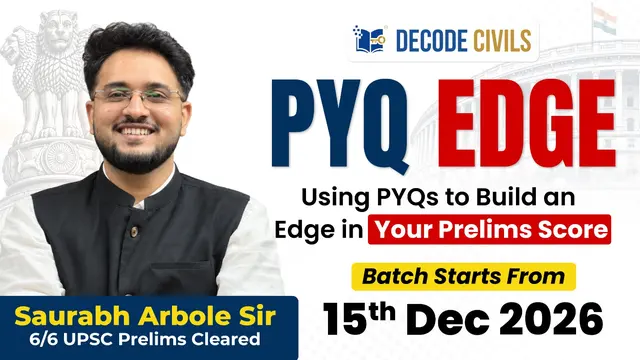
PYQ Edge
A PYQ mastery program: use PYQs to build an edge in your Prelims score
PYQ Edge Starts 15 Dec 2026
₹2,359 ₹2,949
Learn More: PYQ Edge
Prelims Excellence Program 2027 (Pro)
Your One Stop Solution For Prelims 2027
PEP Pro Starts 20 Nov 2026
₹20,059 ₹22,419
Learn More: Prelims Excellence Program 2027 (Pro)
Prelims Excellence Program 2027 (Plus)
Your One Stop Solution For Prelims 2027
PEP Plus Starts 20 Nov 2026
₹11,799 10618.82
Learn More: Prelims Excellence Program 2027 (Plus)
Prelims Excellence Program 2027 (Base)
Your One Stop Solution For Prelims 2027
PEP Base Starts 20 Nov 2026
₹7,079 ₹8,259
Learn More: Prelims Excellence Program 2027 (Base)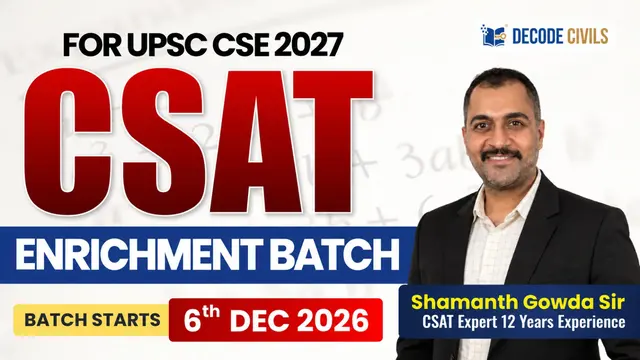
CSAT Enrichment Batch
Master the art and science of solving CSAT
₹2,359 ₹2,949
Learn More: CSAT Enrichment Batch
CSAT WEEKEND BATCH
Master CSAT for UPSC Prelims 2027 with expert guidance, focused practice, and mock tests.
CSAT WEEKEND BATCH Starts 31 Oct 2026
₹5,899 ₹8,259
Learn More: CSAT WEEKEND BATCH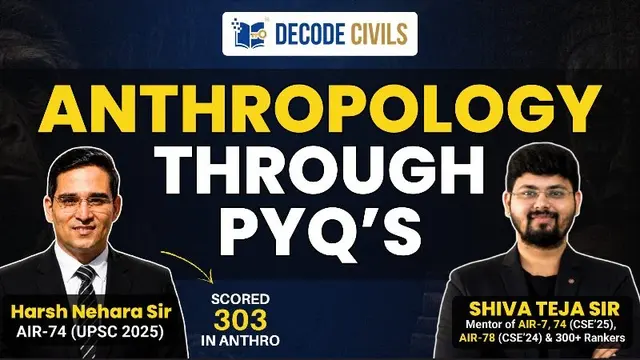
ANTHROPOLOGY THROUGH PYQ's
Understand what UPSC asks and how to answer it from the Anthro Topper.
₹5,899 ₹8,259
Learn More: ANTHROPOLOGY THROUGH PYQ's
PSIR EXCELLENCE PROGRAM PRO (OFFLINE): Batch-2
An Enrichment Course that can help you add 50+ marks in your PSIR Scores.

PSIR EXCELLENCE PROGRAM PRO (ONLINE): Batch-2
An Enrichment Course that can help you add 50+ marks in your PSIR Scores.


0 comments
Discussion
No comments yet. Be the first.