
Newspaper and Current Affairs Strategy for UPSC Beginners: Mudit Jain (Ex-IPS, Ex-IRS)
Mudit Jain (Ex-IPS, Ex-IRS), who cleared UPSC CSE three times with AIR 222, 207 and 173, emphasises comprehensive coverage, linking Current Affairs with static subjects, systematic revision and question-based practice.


Newspaper and Current Affairs Strategy for UPSC Beginners: Mudit Jain (Ex-IPS, Ex-IRS)
Current Affairs is an essential component of UPSC Civil Services Examination preparation. However, first-time aspirants often struggle with newspaper selection, identifying relevant news, making notes and revising information effectively.
Mudit Jain (Ex-IPS, Ex-IRS), who cleared UPSC CSE three times with AIR 222, 207 and 173, emphasises comprehensive coverage, linking Current Affairs with static subjects, systematic revision and question-based practice.
1. Which Newspaper Should UPSC Beginners Read?
Mudit Jain's Current Affairs approach draws upon four important sources:
The Hindu: National issues, editorials, governance, polity and international relations.
The Indian Express: Explained articles, policy developments, economy and science.
PIB: Government schemes, initiatives, reports and official announcements.
PIB PRISM: Additional government information useful for examination-oriented preparation.
Beginners should start with one newspaper, either The Hindu or The Indian Express, rather than attempting to read both completely.
Use PIB and other official sources selectively for important developments.
Reference: Current Affairs Sources and Revision Strategy
2. How to Read Newspapers for UPSC
Newspaper reading should be guided by the UPSC syllabus, not by the number of articles published daily.
Prioritise:
Polity: Constitutional developments, laws and judicial decisions.
Governance: Government policies, education, healthcare and welfare.
Economy: Inflation, banking, employment and fiscal policies.
International Relations: India's bilateral and multilateral relationships.
Environment: Climate change, biodiversity and conservation.
Science and Technology: Space, biotechnology and emerging technologies.
Avoid spending excessive time on political statements, routine crime, celebrity news and events without meaningful syllabus relevance.
Beginner's tip: Initially spend 60–75 minutes reading the newspaper. Gradually develop the ability to identify examination-relevant information.
3. Connect Current Affairs With Static Subjects
A central feature of Mudit Jain's strategy is integrating Current Affairs with static knowledge.
For example, when reading about a Supreme Court judgment:
Identify the constitutional provisions involved.
Understand the relevant fundamental rights or institutional powers.
Examine the judgment's implications.
Connect the issue with previous UPSC questions.
Similarly, a news report about monsoon variability should encourage revision of Indian climatology.
Mudit Jain's approach: Current Affairs questions should be understood alongside the static concepts underlying them, rather than treated as isolated facts.
Decode Civils Free-for-all Initiatives & Study Material: This is a free-for-all course and provides exam-oriented strategies, analysis and resources for UPSC CSE 2027 & 2028 Aspirants. Click Here to Enroll for Free to Access the Same.
For easy access, the free-for-all material is segregated into 3 folders:
- Prelims: Booklist, 13 Types of MCQs, CSAT High Focus Areas, Polity High Focus Areas.
- Mains: Micro Topic Breakdown, Topic wise PYQ Segregation, Solved PYQs, PDFs of Mudit Sir's Books.
- Current Affairs: May-August Prelims + Mains Notes.
Strategies and Notes can be downloaded for free from relevant folder!
Click Here to Learn More About Decode Civils' UPSC Prelims 2027 Courses
4. Make Short, Subject-Wise Current Affairs Notes
Beginners often make the mistake of copying entire newspaper articles into notebooks.
Instead, organise notes according to the UPSC syllabus.
For every important issue, record:
Why the topic is in the news.
Important background information.
Relevant constitutional, economic or scientific concepts.
Important data, reports or institutional findings.
Implications for Prelims and Mains.
For example, notes on a government scheme should cover its objective, implementing ministry, beneficiaries and important features.
Avoid maintaining multiple overlapping sets of notes.
5. Follow a Daily Current Affairs Timetable
A practical beginner-friendly schedule is:
| Activity | Daily Time |
|---|---|
| Newspaper reading | 45 minutes |
| Important editorials and background | 15 minutes |
| Subject-wise notes | 20 minutes |
| MCQs and PYQs | 20 minutes |
| Revision | 20 minutes |
| Total | 2 hours |
6. Revise Current Affairs Subject-Wise
Mudit Jain's structured Current Affairs programme groups developments across nine broad subject areas, including Polity, Governance, International Relations, Economy, Environment, Science and Technology, Geography, History and Security.
Beginners can apply a similar system:
Daily: Revise the previous day's important developments.
Weekly: Consolidate subject-wise notes and solve MCQs.
Monthly: Revise major topics through compilations and sectional tests.
Before Prelims: Focus on repeated revision, PYQs and mock-test analysis.
Use one reliable compilation to fill gaps rather than collecting several magazines.
7. Test Your Current Affairs Preparation
Reading and remembering information are different skills.
Mudit Jain's examination-oriented approach incorporates regular quizzes, monthly tests and analysis of incorrect answers.
Beginners should practise 10–15 Current Affairs MCQs daily and gradually introduce Mains questions.
Maintain an error notebook covering factual mistakes, conceptual weaknesses and incorrect assumptions.
Conclusion: Read Less Randomly, Revise More Effectively
A successful UPSC Current Affairs strategy requires more than reading newspapers every morning.
First-time aspirants should develop a syllabus-based reading habit, connect news with static subjects, prepare concise notes and practise questions regularly.
The objective is not to remember every headline but to understand issues that UPSC can test through conceptual and analytical questions.
Read selectively, understand deeply, revise consistently and test regularly.
Reference Videos and Resources
Decode Civils Free-for-all Initiatives & Study Material: This is a free-for-all course and provides exam-oriented strategies, analysis and resources for UPSC CSE 2027 & 2028 Aspirants. Click Here to Enroll for Free to Access the Same.
For easy access, the free-for-all material is segregated into 3 folders:
- Prelims: Booklist, 13 Types of MCQs, CSAT High Focus Areas, Polity High Focus Areas.
- Mains: Micro Topic Breakdown, Topic wise PYQ Segregation, Solved PYQs, PDFs of Mudit Sir's Books.
- Current Affairs: May-August Prelims + Mains Notes.
Strategies and Notes can be downloaded for free from relevant folder!
Click Here to Learn More About Decode Civils' UPSC Prelims 2027 Courses
Downloads
Most read on Mudit Jain Blogs
- 2026 UPSC CSE Prelims GS Detailed Analysis Analysis
- Booklist & Sources for UPSC Prelims 2027 Prelims
- UPSC Prelims - Types of Questions Asked 2013 Onwards Analysis
- 2026 UPSC CSE Prelims CSAT Detailed Analysis Analysis
- 2013-2025 UPSC Mains GS-2 PYQs Analysis Analysis
- K.N.Chandana Jahnavi (CSE-23 AIR-50) Comprehensive and Sociology Strategy Topper Strategies
- 2013-2025 UPSC Mains GS-1 PYQs Analysis Analysis
- Prajnanandan Giri (CSE-23 AIR-24) Journey, Geography & Comprehensive Strategy Topper Strategies
- Aditi Varshney (AIR-57 CSE-22) Comprehensive Strategy Topper Strategies
- Jatin Jain (AIR-91 CSE-22) Sociology + Comprehensive Strategy Topper Strategies
Preparing for UPSC?
Talk to us about the right programme for your attempt.
Keep reading
Related articles
 19
Nov 2026
Foundation · Prelims
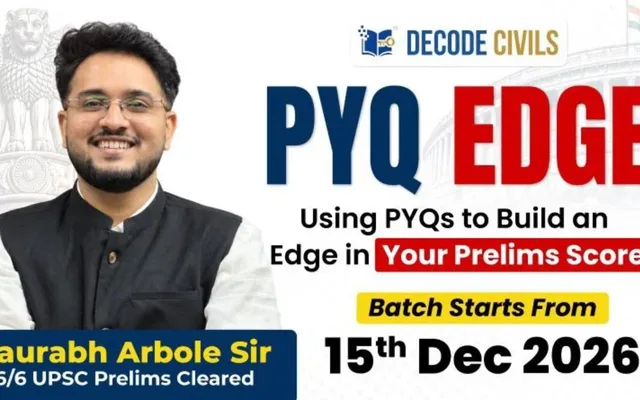
How to Use UPSC PYQs Effectively?
Sourabh Arbole Sir, who has cleared all six of his UPSC Prelims attempts, advocates a deeper approach. His methodology focuses on understanding how UPSC
Decode Civils · 19 Nov 2026
 18
Nov 2026
Foundation · Prelims
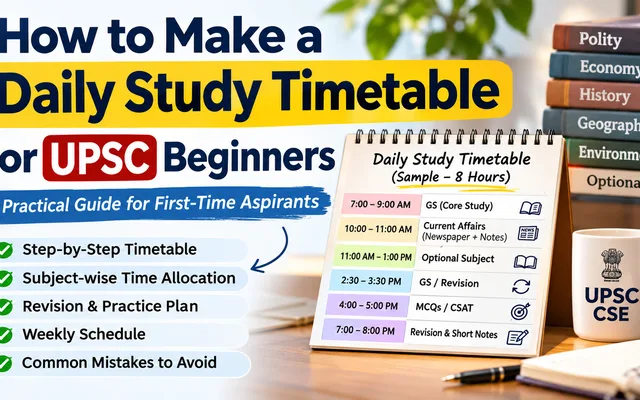
How to Make a Daily Study Timetable for UPSC Beginners?
A well-structured UPSC daily study timetable helps aspirants maintain consistency, complete the syllabus and develop effective revision habits. However, the objective is not to study for 12–14 hours daily but to make every study session productive.
Decode Civils · 18 Nov 2026
 18
Nov 2026
Foundation · Prelims
Can I Crack UPSC in 1 Year? 12-Month Study Plan Based on Toppers' Strategies
Yes, cracking UPSC Civil Services Examination in one year is possible, even for a beginner. However, success requires disciplined preparation, limited study resources, regular revision and consistent practice for both Prelims and Mains.
Decode Civils · 18 Nov 2026
Our programmes
Courses for your attempt

History Module For Prelims 2027
The toughest part of Prelims, simplified by someone who has cleared Prelims 7 out of 7 times.
History Starts 20 Dec 2026
₹2,359 ₹2,949
Learn More: History Module For Prelims 2027
Current Affairs For Prelims 2027 (Plus)
The only current affairs course with direct hits in UPSC Prelims
CA Plus Starts 4 Jan 2027
₹4,129 ₹4,719
Learn More: Current Affairs For Prelims 2027 (Plus)
Current Affairs For Prelims 2027 (Base)
The only current affairs course with direct hits in UPSC Prelims
CA Base Starts 4 Jan 2027
₹3,539 ₹4,129
Learn More: Current Affairs For Prelims 2027 (Base)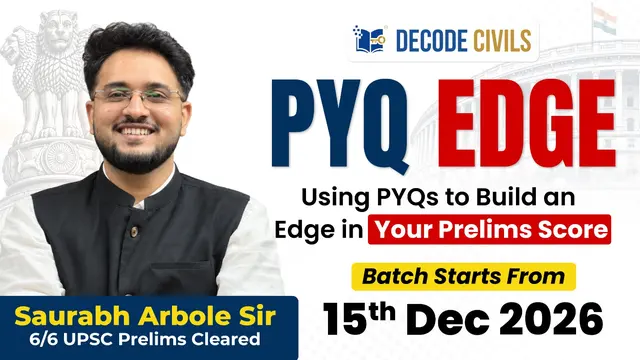
PYQ Edge
A PYQ mastery program: use PYQs to build an edge in your Prelims score
PYQ Edge Starts 15 Dec 2026
₹2,359 ₹2,949
Learn More: PYQ Edge
Prelims Excellence Program 2027 (Pro)
Your One Stop Solution For Prelims 2027
PEP Pro Starts 20 Nov 2026
₹20,059 ₹22,419
Learn More: Prelims Excellence Program 2027 (Pro)
Prelims Excellence Program 2027 (Plus)
Your One Stop Solution For Prelims 2027
PEP Plus Starts 20 Nov 2026
₹11,799 10618.82
Learn More: Prelims Excellence Program 2027 (Plus)
Prelims Excellence Program 2027 (Base)
Your One Stop Solution For Prelims 2027
PEP Base Starts 20 Nov 2026
₹7,079 ₹8,259
Learn More: Prelims Excellence Program 2027 (Base)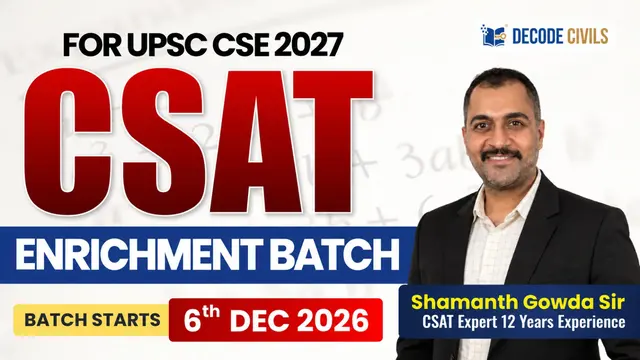
CSAT Enrichment Batch
Master the art and science of solving CSAT
₹2,359 ₹2,949
Learn More: CSAT Enrichment Batch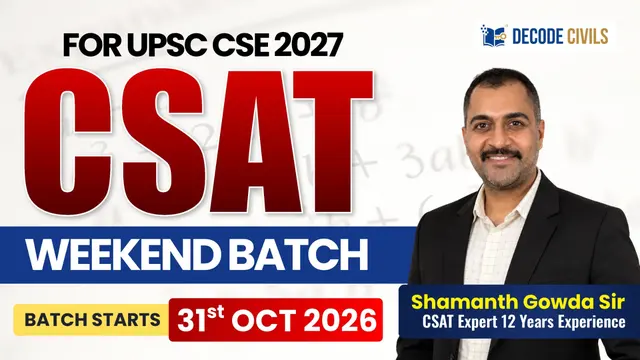
CSAT WEEKEND BATCH
Master CSAT for UPSC Prelims 2027 with expert guidance, focused practice, and mock tests.
CSAT WEEKEND BATCH Starts 31 Oct 2026
₹5,899 ₹8,259
Learn More: CSAT WEEKEND BATCH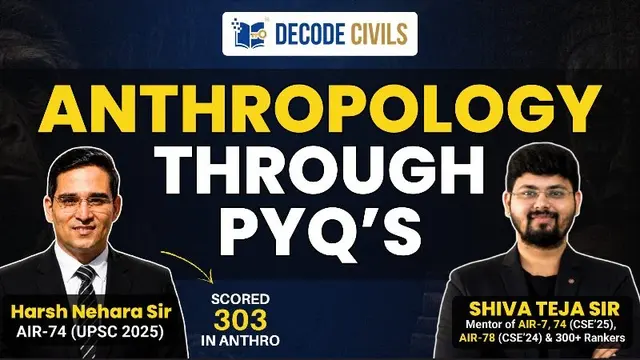
ANTHROPOLOGY THROUGH PYQ's
Understand what UPSC asks and how to answer it from the Anthro Topper.
₹5,899 ₹8,259
Learn More: ANTHROPOLOGY THROUGH PYQ's
PSIR EXCELLENCE PROGRAM PRO (OFFLINE): Batch-2
An Enrichment Course that can help you add 50+ marks in your PSIR Scores.

PSIR EXCELLENCE PROGRAM PRO (ONLINE): Batch-2
An Enrichment Course that can help you add 50+ marks in your PSIR Scores.


0 comments
Discussion
No comments yet. Be the first.