I-OECM Guidelines 2026: Counting Conservation Beyond Protected Areas
Union Environment Minister Bhupender Yadav released the Guidelines for the Designation of India's Other Effective Area-Based Conservation Measures (I-OECMs)
DDecode Civils
· 4 min read
I-OECM Guidelines 2026: Counting Conservation Beyond Protected Areas
Why in News
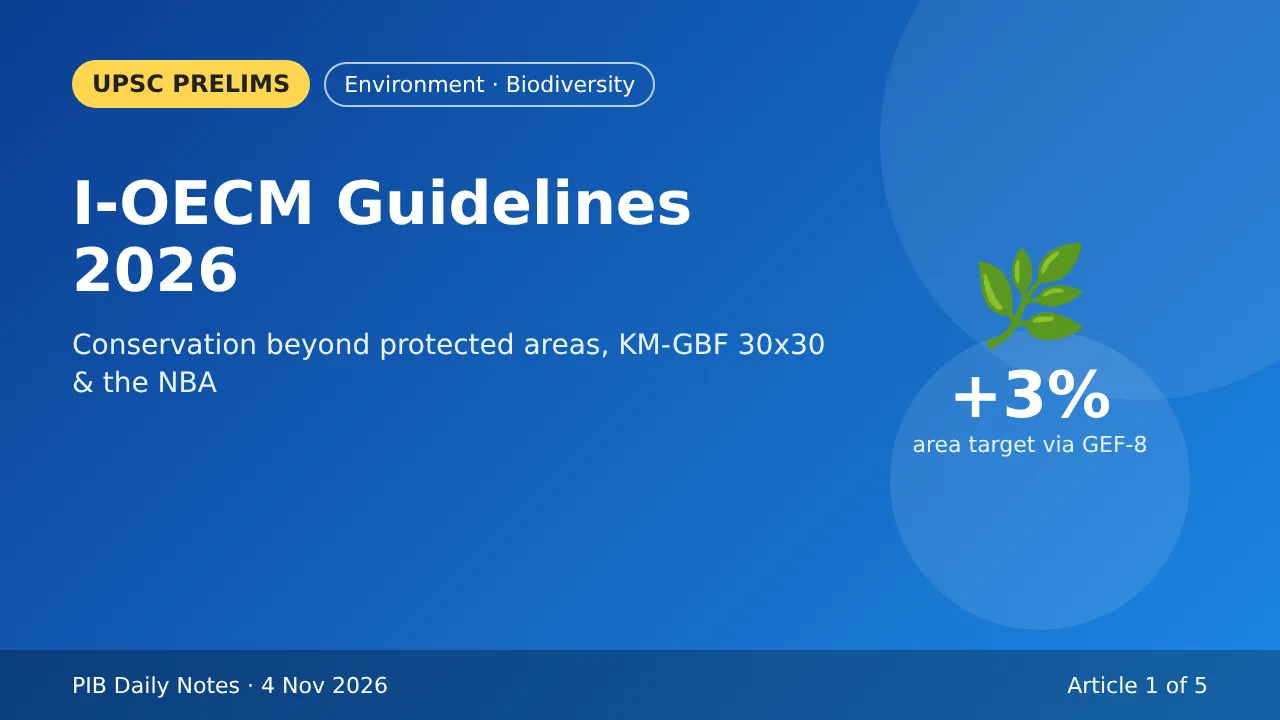
Union Environment Minister Bhupender Yadav released the Guidelines for the Designation of India's Other Effective Area-Based Conservation Measures (I-OECMs), 2026 on 3 November 2026, at a side event of CBD COP-17 in Yerevan, Armenia. The guidelines were prepared by MoEFCC with the National Biodiversity Authority (NBA).
News Summary
The guidelines give a framework to recognise and report areas outside legally protected and conserved areas that deliver long-term, in-situ conservation of biodiversity.
They support Target 3 (30x30) of the Kunming-Montreal Global Biodiversity Framework (KM-GBF) and National Biodiversity Target 3 of India's updated NBSAP (2024–2030).
They cover terrestrial, inland water, and coastal and marine ecosystems. Examples include biodiversity parks, sacred groves, community-managed irrigation tanks, seagrass and seaweed beds, and fisheries seasonal ban areas.
Recognition does not make an area a protected area and does not change its ownership, legal status or existing activities.
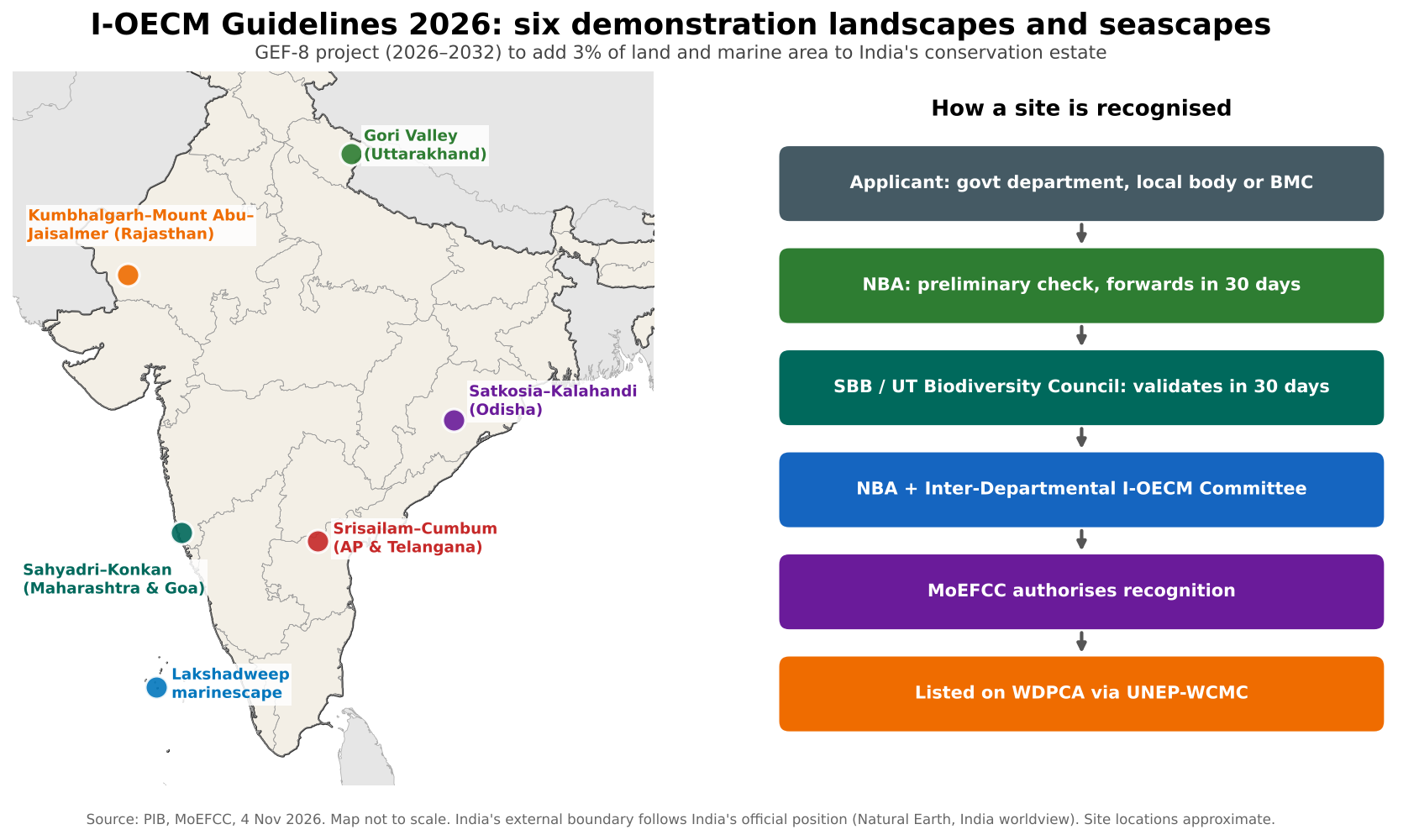
A GEF-8 project (USD 60.79 million, 2026–2032, with UNDP support) will apply the guidelines in six demonstration landscapes and seascapes. It aims to add 3% of India's land and marine area to the conservation estate, above the existing 27%.
Prelims Facts & Static Linkages
How an I-OECM is recognised
Four mandatory criteria: the area is not a legally protected area; it is governed by the Centre, a State or a recognised local body such as a Panchayat or a Biodiversity Management Committee (BMC); it has defined boundaries and does not overlap any site in the World Database on Protected Areas (WDPA); and recognition does not alter its existing regime.
Who applies: government departments, local bodies and BMCs apply to the NBA.
Validation: the NBA forwards the application within 30 days to the State Biodiversity Board (SBB) or UT Biodiversity Council, which sends its recommendation within 30 days.
Decision: the NBA, with an Inter-Departmental I-OECM Committee, decides; MoEFCC authorises recognition.
Monitoring: indicators are assessed at least once every five years.
Global listing: recognised sites go on the World Database on Protected and Conserved Areas, kept by UNEP-WCMC.
Protected areas vs OECMs
Feature
Protected Area
OECM
Main aim
Conservation is the primary objective
Conservation can be a by-product of other goals
Legal basis in India
Wildlife (Protection) Act, 1972
Recognition under the I-OECM Guidelines, 2026
Examples
National parks, sanctuaries, conservation and community reserves
Sacred groves, irrigation tanks, seagrass beds, fishing ban zones
Change in status
Notified area with restrictions
No change in ownership or legal status
Key concepts to revise
CBD: opened at the Rio Earth Summit (1992), in force from 1993, secretariat in Montreal. Protocols: Cartagena (biosafety) and Nagoya (access and benefit sharing).
OECM definition: adopted at CBD COP-14 (2018, Sharm el-Sheikh).
KM-GBF: adopted at COP-15 (December 2022), with 4 goals for 2050 and 23 targets for 2030. Target 3 aims to conserve 30% of land and 30% of inland water, coastal and marine areas by 2030.
Biological Diversity Act, 2002: sets up a three-tier structure. The NBA (Chennai) works at national level, SBBs at State level and BMCs at local-body level, which also prepare People's Biodiversity Registers.
Quick Revision
I-OECM Guidelines, 2026 were released at CBD COP-17 in Yerevan.
OECMs are conserved areas outside the protected area network.
They support KM-GBF Target 3 (30x30) and NBSAP 2024–2030.
A GEF-8 project covers six demonstration sites, including the Lakshadweep marinescape.
Practice MCQ
Q. With reference to Other Effective Area-Based Conservation Measures (OECMs) in India, consider the following statements:
1. Recognition of an area as an OECM converts it into a protected area under the Wildlife (Protection) Act, 1972.
2. Biodiversity Management Committees can apply for recognition of an area as an OECM.
3. Recognised OECMs are reported to a global database maintained by UNEP-WCMC.
Which of the statements given above is/are correct?
(a) 1 only
(b) 2 and 3 only
(c) 1 and 3 only
(d) 1, 2 and 3
Answer: (b). OECM recognition does not make an area a protected area.
Related PYQs
PYQ 1 (UPSC CSE Prelims 2023)
Consider the following statements:
1. In India, the Biodiversity Management Committees are key to the realization of the objectives of Nagoya Protocol.
2. The Biodiversity Management Committees have important functions in determining access and benefit sharing, including the power to levy collection fees on the access of biological resources within its jurisdiction.
Which of the statements given above is/are correct?
(a) 1 only
(b) 2 only
(c) Both 1 and 2
(d) Neither 1 nor 2
Answer: (c).
PYQ 2 (UPSC CSE Prelims 2025)
Which organization has enacted the Nature Restoration Law (NRL) to tackle climate change and biodiversity loss?
(a) The European Union
(b) The World Bank
(c) The Organization for Economic Cooperation and Development



 28
Nov 2026
 28
Nov 2026
 28
Nov 2026














0 comments
Discussion
No comments yet. Be the first.